Execution Signals v9
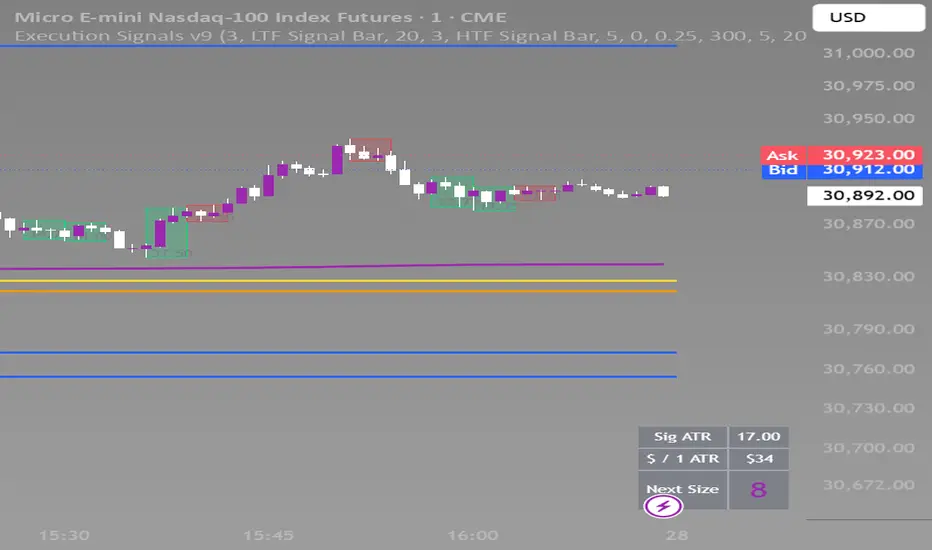
A mechanical price action breakout strategy for intraday futures. Signals form on a higher timeframe; execution happens on the chart timeframe (multi-timeframe / MTF). Built and tested primarily on index futures (NQ/MNQ/ES/MES), but works on any symbol with valid point value and tick data.
SIGNALS (detected on the last completed signal-timeframe bar)
- Failure to Go High — price exceeds the prior signal-TF bar's high but closes back at or below it, leaving an upper wick (a trapped breakout)
- Failure to Go Low — the mirror on the downside
- Inside Bar — the full range held within the prior signal-TF bar (compression)
Each pattern can be toggled independently. Includes a gap guard: if the underlying signal-TF data skips more than ~1.5× the signal period (a data gap or session break), that pair of bars isn't compared, so a gap can't masquerade as a signal.
EXECUTION MODES (choose one)
- Break of Signal Bar — enter the instant chart-TF price closes beyond the signal bar's high or low. Whichever side breaks first wins; the other side is void.
- LTF Signal Bar (nested) — the same HTF break only sets a directional bias (expires after a set number of chart-TF bars). The strategy then waits for a failure bar or inside bar on the chart timeframe itself — optionally required to match the bias direction — and enters on THAT bar's own break, which has its own shorter expiry.
STOP & TARGET
Stop placement is configurable: prior chart-TF bar, prior two bars, the HTF signal bar's own wick, or (in nested mode) the LTF signal bar's wick — with a minimum stop distance floor in points regardless of model. An optional max-risk-per-trade cap (points) rejects any setup whose stop is wider than that, rather than resizing it. Take profit is an R-multiple of the actual stop distance.
POSITION SIZING
Per trade, not daily-paced. Contracts are sized so that a 1-ATR (signal timeframe) favorable move nets roughly a target dollar amount you set, computed fresh at the moment of entry — floor(target ÷ (signal-TF ATR × point value)), capped at a configurable max contract count. That cap is also enforced independently at the platform level. A small on-chart table shows the live signal-TF ATR, dollar value of 1 ATR at one contract, and the size that would be used right now.
OPTIONAL DIRECTIONAL BIAS
Off by default. When enabled: trading above the prior RTH session's high restricts entries to longs only, below the prior low to shorts only; inside the prior day's range is either neutral (both directions allowed) or blocked entirely, per a toggle.
SESSION
RTH for level-building purposes: 9:30 AM–4:15 PM ET. Trading window: 6:00 PM ET through 3:59 PM ET the next session; all positions force-closed at 3:59 PM ET; no new entries 3:59–6:00 PM ET.
ON-CHART TOOLS
- Signal boxes over each qualifying bar (colored by type), with an optional range label
- Position boxes — every trade marked with its risk (red) and reward (green) zones, frozen on chart after the trade closes
- Day-Set Levels — deployed once per session like pivots: the prior RTH session's high/low (yellow), plus a master list of levels from synthetic hourly-bucket color flips within RTH (blue), invalidated

Penafian
Maklumat dan penerbitan adalah tidak bertujuan, dan tidak membentuk, nasihat atau cadangan kewangan, pelaburan, dagangan atau jenis lain yang diberikan atau disahkan oleh TradingView. Baca lebih dalam Terma Penggunaan.
Penafian
Maklumat dan penerbitan adalah tidak bertujuan, dan tidak membentuk, nasihat atau cadangan kewangan, pelaburan, dagangan atau jenis lain yang diberikan atau disahkan oleh TradingView. Baca lebih dalam Terma Penggunaan.