Telah dikemas kini
GProf - Kangaroo Tail
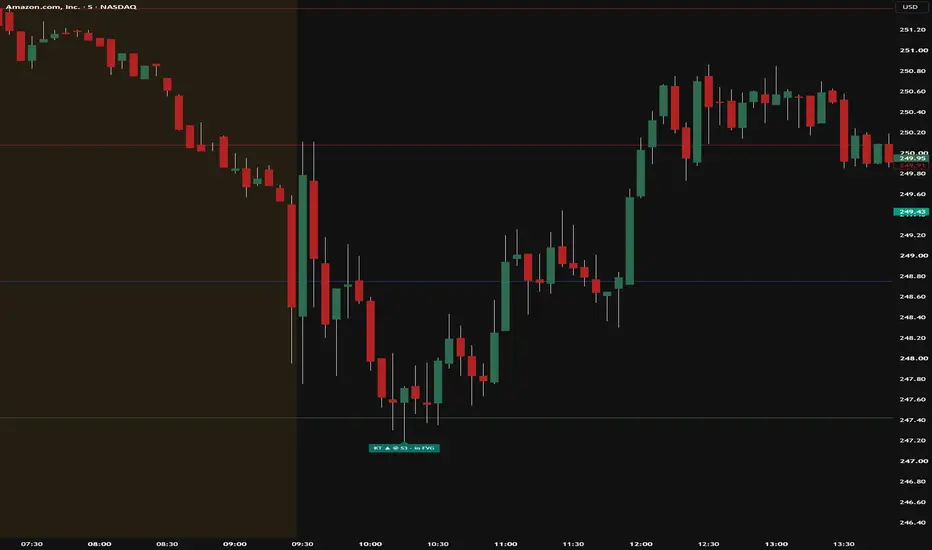
GProf - Kangaroo Tail
═══════════════════════════════════════════
OVERVIEW
This indicator detects a single, specific reversal event: a liquidity-sweep candle at a meaningful level — the Kangaroo Tail. Price runs an extreme, sweeps through a level where liquidity rests, and is rejected hard within one candle, closing back on the other side.
It is deliberately quiet. Most sessions it prints nothing. It speaks only when a candle sweeps a genuine multi-hour extreme, shows textbook rejection anatomy, and does so at a nameable level. The Kangaroo Tail is not a candle pattern that happens to be near a level — it is a level rejection whose evidence is a candle.
───────────────────────────────────────────
THE CANDLE (KT Short shown — KT Long is the mirror)
1. THE SWEEP — the candle's high prints a new high versus a long lookback (default 78 bars, about 6.5 hours on the 5m). Room to the left, measured in time: the extreme must be genuinely fresh, which excludes signals from inside congestion — you cannot sweep a multi-hour high from within chop.
2. REJECTION ANATOMY — the entire body sits in the bottom third of the range (body position is the filter; color is reported, not required). The opposite wick is capped tightly, and the sweep wick itself must be significant: at least a set percentage of the daily ATR, with a tick floor, so the threshold scales across instruments.
3. CONTEXT — the body sits inside the previous candle's range (toggleable), and a large prior same-direction candle raises a caution tag on the signal rather than suppressing it: the thrust into a level is often strong, and that thrust-sweep-reject sequence is the pattern at its best.
───────────────────────────────────────────
THE LEVEL — REQUIRED, AND MEASURED CORRECTLY
No level, no signal. The confluence set:
• Session levels: PMH/PML, YH/YL, PDC, WH/WL — computed internally, non-repainting.
• Camarilla pivots: R3/R4 for shorts, S3/S4 for longs, from yesterday's RTH high/low/close, DRAWN on the chart (S3/S4 green, R3/R4 red, central pivot marked).
• Up to three custom levels — enter your own higher-timeframe lines and they become part of the confluence set.
Two details most level tools get wrong:
LEVEL-IN-WICK GEOMETRY: the level must lie within the sweep wick's span. A deep sweep THROUGH the level is the pattern at its strongest, not a disqualification. When the wick spans more than one level, the nearest to the wick tip is named.
LIVE-LEVEL MATURITY: a running level (WH/WL always; PMH/PML while the premarket window is open) must rest untouched for a set number of bars before it counts — a sweep candle's own extreme IS the newborn premarket high, and a level seconds old is not structure.
WHEN "YESTERDAY" ROLLS: Roll Mode is Auto by default — futures roll at the 18:00 ET session open, equities at the next regular-session open — so evening and overnight signals test the session that just completed and the Camarilla levels derived from it. Session boundaries are read in exchange time, correct year-round through daylight-saving changes.
───────────────────────────────────────────
SIGNALS AND ALERTS
A qualifying candle prints one label — "KT ▼" or "KT ▲" — carrying its context: the level swept, whether the wick landed inside an unfilled qualified Fair Value Gap, and a caution tag when the prior candle was large.
The alert message includes everything needed to assess without opening the chart: sweep depth in points, the level, FVG confluence, body color, and reference trade geometry — trigger one tick beyond the KT extreme, stop one tick beyond the wick, and the 1:1 target.
Alert setup: add the indicator, create ONE alert with condition "Any alert() function call", expiration Open-ended. Direction is controlled in settings. Note: TradingView alerts snapshot settings at creation — after changing settings, recreate the alert.
A near-miss diagnostics mode (off by default) is available for investigation: candles at a level that fail exactly one anatomy check print a small marker naming it.
───────────────────────────────────────────
HOW TO USE IT
The Kangaroo Tail marks a completed liquidity event at structure. Traders who study these typically look for entry on a break of the candle's extreme in the rejection direction, with the stop beyond the sweep wick — the geometry the alert pre-computes. Keep your own higher-timeframe levels current in the custom slots: the level set is the heart of the tool.
This indicator identifies a candle pattern at a level. It does not generate buy/sell recommendations, does not place trades, and does not replace your own analysis and risk management.
───────────────────────────────────────────
TECHNICAL NOTES
• Non-repainting: all detection confirms on bar close; ATR uses completed daily bars; levels are built from session windows with no lookahead.
• Intraday timeframes only. Built for index and commodity futures but works on any liquid symbol; size thresholds are a percentage of daily ATR with tick floors, so they travel across instruments.
• Sweep lookback, anatomy thresholds, proximity band, maturity, and session times are fully configurable.
───────────────────────────────────────────
DISCLAIMER
This script is for informational and educational purposes only. It does not constitute financial, investment, or trading advice. A rejection candle at a level is a pattern, not a guarantee of future price behavior. All trading decisions made using this tool are solely the responsibility of the user.
Nota Keluaran
v1.8 — FOUR CHANGES, all driven by live misses logged Sep 2026.//
// (1) OPPOSITE WICK CAP 5% -> 25% OF RANGE.
// The 5% cap was rejecting textbook KTs across every instrument,
// not just fine-tick ones. Measured live:
// MNQ 10:35 range 41.50 opp wick 9.25 = 22.3% WANTED
// MNQ 07:15 range 27.25 opp wick 6.25 = 22.9% WANTED
// AMD 11:10 range 1.80 opp wick 0.38 = 21.1% WANTED
// MNQ 09:55 range 110.0 opp wick 31.75 = 28.9% rejected
// Three keeps cluster at 21-23% across three instruments and
// three tick sizes; the one reject sits at 28.9%. 25% splits
// them. Note the AMD case: 5% of a 1.80 range is 0.09, so a
// 0.38 wick — barely visible on screen — failed by 4x. This was
// never an MCL tick-size problem; MCL only made it visible.
// KNOWN COST: MCL Sep 2 (range 0.15, opp wick 0.03 = 20%) is
// inside the keep cluster but was rejected by eye — the trader's
// stated line there was 2 ticks. A single percentage cannot
// reproduce that judgement. 25% is a starting value under live
// observation, not a settled one.
//
// (2) CAMARILLA R6 / S6 ADDED.
// R6 = C x H / L. S6 = 2C - R6 — a REFLECTION of R6 about the
// close, NOT the mirror C x L / H. Verified against a reference
// implementation and reproduced numerically from MNQ Sep 9
// (CP 29,525.50, H3 29,619.07 -> range 340.25 -> L4 29,338.36,
// matching to the cent). R5/S5 deliberately NOT added.
// Range source is unchanged: yesterday's RTH H/L, per the
// existing engine. The reference implementation switches to full
// ETH data when the overnight range exceeds RTH by >2% of ATR;
// that is a larger change touching the shared level engine
// (KT / LRA / B&R) and is NOT adopted here.
//
// (3) YYH / YYL — PREVIOUS OVERNIGHT (GLOBEX) EXTREMES.
// The high and low of the completed 18:00-09:30 ET session,
// frozen at 09:30 and held until the next 09:30. Distinct from
// YH/YL (which are RTH by default) and from PMH/PML (today's
// premarket, live until the open).
// MGC Sep 2: a textbook KT swept to 4,445.5 — exactly the prior
// overnight low — and was silent, because that level did not
// exist anywhere in the tool. No level means no label AND no
// diagnostic (v1.3), so the miss was invisible.
// Toggleable; frozen once set, so maturity does not apply.
//
// (4) EQUITIES: RTH ONLY.
// For non-futures symbols, detection is suppressed outside the
// market-hours window. Thin premarket and after-hours bars make
// the anatomy percentages behave badly. Auto-detected from
// syminfo.type, matching the Roll Mode precedent. Futures are
// unaffected and continue to signal around the clock.
//
// ALSO: GREEN/RED CLOSE CAUTION TAG. A short KT closing green (or a
// long closing red) now appends ⚠grn / ⚠red to the label and alert,
// following the ⚠mom pattern. Reported, never suppressed — body
// POSITION remains the filter, body COLOUR remains information.
// Two of the logged keeps closed against their direction and the
// trades still worked; the journal decides whether it matters.
//
// NOT CHANGED, and why:
// * Opposite-wick tick FLOOR stays at 1 tick. At 25%, a candle needs
// to be under 4 ticks of range before the floor binds at all.
// * Body-zone boundary can still land between ticks and be
// unreachable (MCL Sep 2: body top 91.38 vs a 91.3795 boundary,
// failing by half a tick). Real, but it was the second failure on
// that candle, not the deciding one. Open.
// * A missing level still produces no diagnostic, which is what made
// (3) invisible for weeks. Worth revisiting.
Nota Keluaran
// v1.8 — FOUR CHANGES, all driven by live misses logged Sep 2026.//
// (1) OPPOSITE WICK CAP 5% -> 25% OF RANGE.
// The 5% cap was rejecting textbook KTs across every instrument,
// not just fine-tick ones. Measured live:
// MNQ 10:35 range 41.50 opp wick 9.25 = 22.3% WANTED
// MNQ 07:15 range 27.25 opp wick 6.25 = 22.9% WANTED
// AMD 11:10 range 1.80 opp wick 0.38 = 21.1% WANTED
// MNQ 09:55 range 110.0 opp wick 31.75 = 28.9% rejected
// Three keeps cluster at 21-23% across three instruments and
// three tick sizes; the one reject sits at 28.9%. 25% splits
// them. Note the AMD case: 5% of a 1.80 range is 0.09, so a
// 0.38 wick — barely visible on screen — failed by 4x. This was
// never an MCL tick-size problem; MCL only made it visible.
// KNOWN COST: MCL Sep 2 (range 0.15, opp wick 0.03 = 20%) is
// inside the keep cluster but was rejected by eye — the trader's
// stated line there was 2 ticks. A single percentage cannot
// reproduce that judgement. 25% is a starting value under live
// observation, not a settled one.
//
// (2) CAMARILLA R6 / S6 ADDED.
// R6 = C x H / L. S6 = 2C - R6 — a REFLECTION of R6 about the
// close, NOT the mirror C x L / H. Verified against a reference
// implementation and reproduced numerically from MNQ Sep 9
// (CP 29,525.50, H3 29,619.07 -> range 340.25 -> L4 29,338.36,
// matching to the cent). R5/S5 deliberately NOT added.
// Range source is unchanged: yesterday's RTH H/L, per the
// existing engine. The reference implementation switches to full
// ETH data when the overnight range exceeds RTH by >2% of ATR;
// that is a larger change touching the shared level engine
// (KT / LRA / B&R) and is NOT adopted here.
//
// (3) YYH / YYL — PREVIOUS OVERNIGHT (GLOBEX) EXTREMES.
// The high and low of the completed 18:00-09:30 ET session,
// frozen at 09:30 and held until the next 09:30. Distinct from
// YH/YL (which are RTH by default) and from PMH/PML (today's
// premarket, live until the open).
// MGC Sep 2: a textbook KT swept to 4,445.5 — exactly the prior
// overnight low — and was silent, because that level did not
// exist anywhere in the tool. No level means no label AND no
// diagnostic (v1.3), so the miss was invisible.
// Toggleable; frozen once set, so maturity does not apply.
//
// (4) EQUITIES: RTH ONLY.
// For non-futures symbols, detection is suppressed outside the
// market-hours window. Thin premarket and after-hours bars make
// the anatomy percentages behave badly. Auto-detected from
// syminfo.type, matching the Roll Mode precedent. Futures are
// unaffected and continue to signal around the clock.
//
// ALSO: GREEN/RED CLOSE CAUTION TAG. A short KT closing green (or a
// long closing red) now appends ⚠grn / ⚠red to the label and alert,
// following the ⚠mom pattern. Reported, never suppressed — body
// POSITION remains the filter, body COLOUR remains information.
// Two of the logged keeps closed against their direction and the
// trades still worked; the journal decides whether it matters.
//
// NOT CHANGED, and why:
// * Opposite-wick tick FLOOR stays at 1 tick. At 25%, a candle needs
// to be under 4 ticks of range before the floor binds at all.
// * Body-zone boundary can still land between ticks and be
// unreachable (MCL Sep 2: body top 91.38 vs a 91.3795 boundary,
// failing by half a tick). Real, but it was the second failure on
// that candle, not the deciding one. Open.
// * A missing level still produces no diagnostic, which is what made
// (3) invisible for weeks. Worth revisiting.
// v1.8.1 — Publication chart updated. No functional change.
Nota Keluaran
v1.9 — Camarilla levels: automatic RTH/ETH data• Camarilla pivots now choose their data source automatically. They use yesterday's regular-session high/low/close, unless the post-market or today's premarket (futures: from the 18:00 open) trades beyond yesterday's regular-session range by more than 2% of daily ATR. In that case they use the full extended-hours day and its close. Force RTH / Force ETH and a separate close override are available.
• Because the premarket is watched live, pivots can step during the overnight session when the switch triggers. Each bar is evaluated against the levels as they stood at that bar, so history does not repaint.
• R6/S6 follow the same data source.
• The drawn CP is the Camarilla close, which can differ from PDC on extended-hours days. PDC as a confluence level is unchanged.
• Equities: keep extended hours visible. On a regular-hours-only chart the pivots use regular-session data.
• New: Camarilla debug label (off by default) and pivot values in the Data Window.
• The RTH/ETH selection method follows the approach used in BruzX's Camarilla Pivot Plays.
• Recreate your alerts after updating.
Nota Keluaran
v1.9.1: Camarilla lines stay in view• Camarilla lines (and YYH/YYL) now start at the bar where the current levels began: the session start, or the bar where they switched to extended-hours data. Previously they were drawn from the last bar only and often sat off the right edge of the chart, especially in Replay.
• On days when the levels switch to extended-hours data, you can now see exactly when the switch happened.
• Display only: detection, levels and alerts are unchanged.
• Recreate your alerts after updating.

GProf Trades
Penafian
Maklumat dan penerbitan adalah tidak bertujuan, dan tidak membentuk, nasihat atau cadangan kewangan, pelaburan, dagangan atau jenis lain yang diberikan atau disahkan oleh TradingView. Baca lebih dalam Terma Penggunaan.
GProf Trades
Penafian
Maklumat dan penerbitan adalah tidak bertujuan, dan tidak membentuk, nasihat atau cadangan kewangan, pelaburan, dagangan atau jenis lain yang diberikan atau disahkan oleh TradingView. Baca lebih dalam Terma Penggunaan.