Momentum Candle By Skyrooth
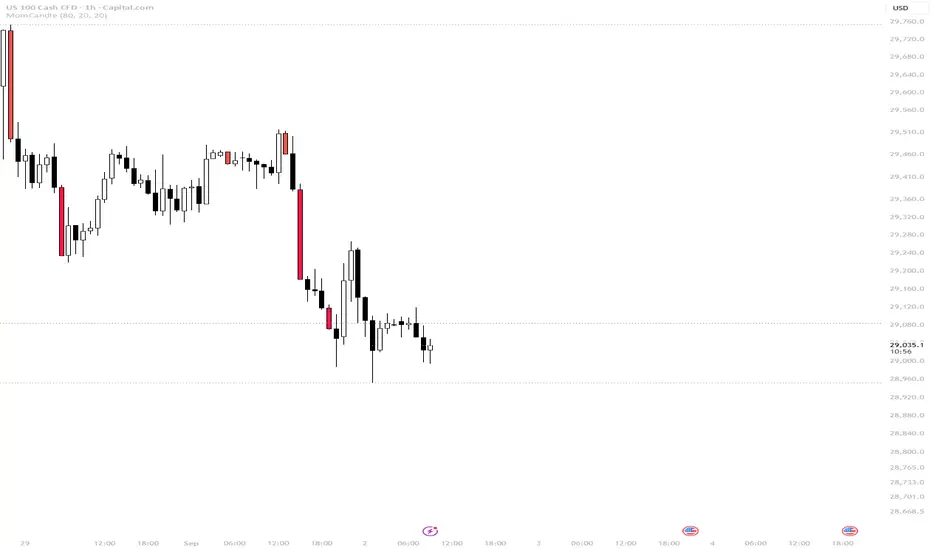
Momentum Candle By Skyrooth highlights expansion candles — the bars where one
side takes control decisively — and filters out the ordinary bars that only look
big because volatility happened to be high at the time.
WHAT PROBLEM THIS SOLVES
Most price action methods depend on a single instruction: "wait for
displacement". A break of structure only counts if the candle that caused it was
decisive. An order block only counts if the move leaving it was strong.
The problem is that "strong" is usually judged by eye, and the eye is unreliable.
A 40 point candle is large on a quiet morning and unremarkable during a news
release. Traders end up calling the same candle valid or invalid depending on
what they want to see.
This indicator applies one fixed measurement instead.
HOW IT WORKS
A candle is marked when all of the following are true:
1. BODY DOMINANCE — the body is large relative to the total range of the bar, so
the close finishes near the extreme rather than in the middle. This is what
separates a decisive bar from a bar that spent the session being rejected.
2. RANGE VS RECENT VOLATILITY — the range is compared against a rolling average
of recent ranges, not against a fixed point value. This is what makes the
measurement adapt: the same threshold works on a quiet session and a volatile
one, and on gold as well as an index.
3. VOLUME CONFIRMATION — the bar is compared against its own recent volume
average. Expansion on thin volume is usually a liquidity gap rather than
participation.
4. DIRECTIONAL AGREEMENT — the bar's direction is checked against the prevailing
trend, so continuation bars are separated from isolated spikes.
Bars meeting the conditions are coloured and marked on the chart. Everything
else is left alone.
HOW TO USE IT
This is a filter, not an entry signal. It answers one question — "was that move
decisive?" — and nothing else. There is no entry, stop or target here.
Typical use:
- CONFIRMING A STRUCTURE BREAK. When price breaks a swing high or low, check
whether the breaking candle is marked. An unmarked break is more likely to be
a liquidity sweep that reverses.
- VALIDATING AN ORDER BLOCK OR IMBALANCE. The candle that leaves the zone should
be marked. If the departure was weak, the zone is weak.
- AVOIDING CHASING. A marked candle means the move already happened. Wait for a
retracement into the area the candle originated from rather than entering at
the extreme.
SETTINGS
- Body ratio threshold — minimum share of the range the body must occupy.
Raise it for fewer, cleaner signals.
- Volatility lookback — number of bars in the rolling range average.
- Volume multiplier — how far above its own average the bar's volume must be.
Set to zero to disable the volume condition on instruments with unreliable
volume data, such as spot forex.
- Trend filter — enable to keep only bars aligned with the prevailing direction.
NOTES AND LIMITATIONS
- Signals are confirmed on bar close. An intrabar candle can meet the conditions
and then lose them before closing.
- Volume conditions depend on the feed. Centralised futures volume is reliable;
spot forex volume is broker specific and often is not.
- A marked candle describes what already happened. It carries no claim about
what happens next, and no win rate is implied.
- Works on any symbol and timeframe, though the volume condition is most
meaningful on instruments with genuine exchange volume.

Penafian
Maklumat dan penerbitan adalah tidak bertujuan, dan tidak membentuk, nasihat atau cadangan kewangan, pelaburan, dagangan atau jenis lain yang diberikan atau disahkan oleh TradingView. Baca lebih dalam Terma Penggunaan.
Penafian
Maklumat dan penerbitan adalah tidak bertujuan, dan tidak membentuk, nasihat atau cadangan kewangan, pelaburan, dagangan atau jenis lain yang diberikan atau disahkan oleh TradingView. Baca lebih dalam Terma Penggunaan.