OPEN-SOURCE SCRIPT
Ehlers Instant Trend [SchizoQuant]
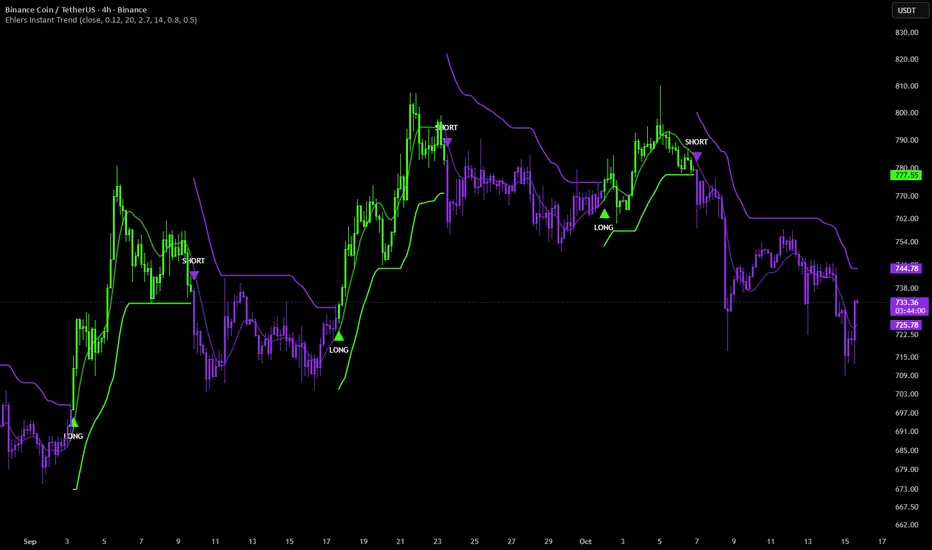
🟣Ehlers Instant Trend is an adaptive trend-regime indicator that combines John Ehlers' Instantaneous Trendline, directional momentum, residual noise estimation, and a one-way trailing defense to identify bullish and bearish market conditions.
Rather than relying on conventional moving-average crossovers or a fixed trailing distance, the indicator adapts its trend boundaries to price behavior and volatility while requiring directional confirmation before reversing the active regime.
🟣✦ How It Works
🟣Ehlers Trend and Momentum
🟣Adaptive Trend Defense
🟣One-Way Trend Trail
🟣Signal Logic
🟣Visual Feedback
🟣User Controls and Alerts
🟣What Makes It Different
🟣Intended Use
🟣Limitations
Rather than relying on conventional moving-average crossovers or a fixed trailing distance, the indicator adapts its trend boundaries to price behavior and volatility while requiring directional confirmation before reversing the active regime.
🟣✦ How It Works
The indicator combines four primary components:
• Ehlers Instantaneous Trendline establishes a smoothed price reference.
• A leading Ehlers Trigger measures emerging directional momentum.
• Residual RMS noise and ATR determine adaptive trend-defense distance.
• A one-way trailing mechanism maintains the active trend until price and directional confirmation support a reversal.
This approach separates the underlying trend, its directional momentum, and the structural boundary required to establish a new regime.
🟣Ehlers Trend and Momentum
The Ehlers Instantaneous Trendline uses recursive filtering to create a responsive price baseline while reducing short-term fluctuations.
Trend Response controls the filter's sensitivity. Higher values react faster, while lower values produce smoother behavior.
A leading trigger is calculated from the current trendline and its value two bars earlier.Pine Script®
Positive momentum indicates that the trigger is above the trendline, while negative momentum indicates that it is below.
The trigger contributes directional confirmation to the reversal logic rather than acting as an independent crossover signal.
🟣Adaptive Trend Defense
The indicator measures residual tracking error between price and the Ehlers trendline using a smoothed root mean square calculation.
This provides a noise-sensitive distance that expands when price deviates more strongly from the filtered baseline.
ATR establishes a separate minimum defense distance.Pine Script®
The model uses whichever distance is larger.
This prevents the trend boundaries from becoming excessively narrow during quieter conditions while allowing them to expand when residual price noise increases.
Bullish defense is positioned below the Ehlers trendline, while bearish defense is positioned above it.
🟣One-Way Trend Trail
The active trailing boundary follows a one-way mechanism.
• During bullish regimes, the trail can advance upward but cannot move downward.
• During bearish regimes, the trail can advance downward but cannot move upward.
This prevents changing noise measurements from loosening an already established trailing boundary.
Following a reversal, the trail is reinitialized using the relevant Ehlers defense boundary and an ATR-based minimum distance from price.
The adaptive defense then resumes its one-way progression in the direction of the new regime.
🟣Signal Logic
LONG and SHORT markers identify changes in the indicator's internal bullish or bearish trend regime.
A reversal requires price to cross the active trailing boundary together with either opposing Ehlers momentum or a sufficiently strong price displacement beyond the trendline.Pine Script®
A LONG condition requires:
• The previous trend regime to be bearish
• Price to move above the active trend trail
• Bullish Ehlers momentum or a strong bullish reversal override
A SHORT condition requires:
• The previous trend regime to be bullish
• Price to move below the active trend trail
• Bearish Ehlers momentum or a strong bearish reversal override
Reversal Override controls the ATR-based distance required for price to bypass the momentum confirmation.
Once a reversal occurs, the indicator updates its internal regime and resets the trail on the opposite side of price.
LONG and SHORT markers appear only when the internal regime changes, avoiding repeated signals during an uninterrupted trend.
🟣Visual Feedback
The indicator displays the Ehlers trendline, optional leading trigger, and active bullish or bearish trailing defense.
• Neon green identifies bullish regimes and LONG signals.
• Purple identifies bearish regimes and SHORT signals.
• The trendline follows the active regime color.
• Optional candle coloring reflects the prevailing trend regime.
Users can independently control the trendline, trigger, trail, signals, and candle coloring.
Additional measurements are available through TradingView's Data Window:
• Normalized Ehlers Momentum
• Defense Distance ATR
• SQ Regime
🟣User Controls and Alerts
Configurable settings include Trend Response, Noise Length, Defense Multiplier, ATR Length, Minimum ATR Distance, and Reversal Override.
These parameters control trendline responsiveness, noise sensitivity, volatility protection, and reversal requirements.
Separate TradingView alerts are provided for Long Signal and Short Signal regime transitions.
🟣What Makes It Different
Ehlers Instant Trend combines recursive trend filtering with an adaptive trailing mechanism that responds to measured price noise.
Rather than treating the Ehlers trendline as a standalone crossover indicator, the model uses:
• Ehlers momentum for directional confirmation
• Residual RMS noise for adaptive defense
• ATR for minimum volatility protection
• One-way trailing boundaries for trend persistence
• An opposing-price displacement override for additional reversal responsiveness
The distinctive feature is the interaction between adaptive noise defense, directional confirmation, and persistent structural trailing.
🟣Intended Use
Ehlers Instant Trend is designed for trend-regime identification, adaptive support and resistance monitoring, and potential directional reversal analysis.
It can be used to identify prevailing market direction, monitor trailing trend boundaries, and filter trading decisions within an existing trading methodology.
The indicator can be applied across different markets and chart timeframes, with sensitivity determined by its configurable settings.
🟣Limitations
Ehlers Instant Trend is a trend-regime indicator and not a complete trading system. LONG and SHORT markers identify changes in its internal regime and do not imply guaranteed trading outcomes or future performance.
During sideways or irregular market conditions, repeated trailing-boundary breaks may produce frequent regime changes.
Skrip sumber terbuka
Dalam semangat TradingView sebenar, pencipta skrip ini telah menjadikannya sumber terbuka, jadi pedagang boleh menilai dan mengesahkan kefungsiannya. Terima kasih kepada penulis! Walaupuan anda boleh menggunakan secara percuma, ingat bahawa penerbitan semula kod ini tertakluk kepada Peraturan Dalaman.

🟣 Systematic Crypto Strategies | Free Trial — schizoquant.com
Penafian
Maklumat dan penerbitan adalah tidak bertujuan, dan tidak membentuk, nasihat atau cadangan kewangan, pelaburan, dagangan atau jenis lain yang diberikan atau disahkan oleh TradingView. Baca lebih dalam Terma Penggunaan.
Skrip sumber terbuka
Dalam semangat TradingView sebenar, pencipta skrip ini telah menjadikannya sumber terbuka, jadi pedagang boleh menilai dan mengesahkan kefungsiannya. Terima kasih kepada penulis! Walaupuan anda boleh menggunakan secara percuma, ingat bahawa penerbitan semula kod ini tertakluk kepada Peraturan Dalaman.
🟣 Systematic Crypto Strategies | Free Trial — schizoquant.com
Penafian
Maklumat dan penerbitan adalah tidak bertujuan, dan tidak membentuk, nasihat atau cadangan kewangan, pelaburan, dagangan atau jenis lain yang diberikan atau disahkan oleh TradingView. Baca lebih dalam Terma Penggunaan.