Super-Trend / Structure Edge - BOS/CHOCH + Order Blocks
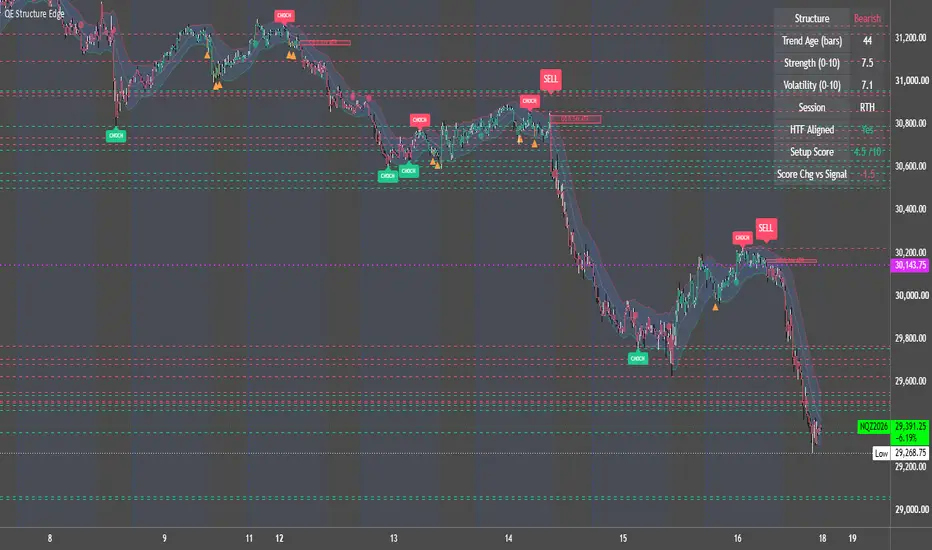
STRUCTURE EDGE
Confirmed structure breaks • Order block zones • Weighted setup scoring
-Structure Edge combines pivot-based market structure, BOS and CHOCH detection, candle-body order block zones, and a WMA/ATR trend envelope.
A weighted setup score adds context using higher-timeframe bias, band proximity, breakout distance, candle characteristics, and structural risk distance.
This is a rule-based analytical indicator—not an automated strategy or a detector of institutional orders.
━━ MARKET STRUCTURE ━━
The indicator identifies swing highs and lows using confirmed, symmetrical pivots.
With the default pivot setting of 5, a potential swing requires five bars on each side. The swing becomes available five bars after its original location.
Structure changes require a confirmed candle close beyond the latest eligible swing:
Each swing can trigger only one break until a new pivot becomes available.
CHOCH — Change of Character
A break that changes the tracked structure direction. The first directional break from an undefined state is also classified as CHOCH.
BOS — Break of Structure
A subsequent break in the existing structure direction.
━━ STRUCTURE MARKERS ━━
Not every CHOCH produces a BUY or SELL label.
Dashed CHOCH references
After a bullish CHOCH, the dashed reference marks the latest swing low. After a bearish CHOCH, it marks the latest swing high.
These are opposite-swing reference levels—not the levels that were broken.
Reference labels are anchored to the earlier swing candle but are created only when the later CHOCH occurs. The number of retained references is adjustable.
━━ WMA / ATR TREND ENVELOPE ━━
The envelope consists of:
Default settings
WMA: 20 | ATR: 14 | Multiplier: 1.5
The lower band is the active reference during bullish structure. The upper band is the active reference during bearish structure.
A closing price within 0.25 ATR of the active band qualifies as “near band.”
This measures closing-price proximity. It does not require a wick touch, rejection candle, or confirmed bounce.
━━ SETUP SCORE: 0–10 ━━
The score combines five weighted components:
Structure quality updates on BOS or CHOCH and is held between those events. Other components can change as price develops.
The structural risk reference must be on the appropriate invalidation side of price to receive a positive risk-efficiency contribution.
When the higher-timeframe filter is disabled, its score component uses a fixed value of 7 out of 10.
The score is a heuristic ranking—not a probability of success, accuracy estimate, or expected return.
Risk efficiency does not calculate reward-to-risk. The indicator does not define a profit target or execute a stop.
━━ HIGHER-TIMEFRAME BIAS ━━
The optional filter compares the previous completed reference-timeframe close with its corresponding WMA:
Despite the input label “Require HTF Structure Alignment,” this is a close-versus-WMA filter—not a separate higher-timeframe BOS/CHOCH engine.
The calculation uses completed higher-timeframe values rather than an unfinished candle.
The selected timeframe must be strictly higher than the chart timeframe when this filter is enabled.
An equal or lower selection blocks BUY / SELL labels and displays “INVALID HTF” in the dashboard.
━━ BUY / SELL REQUIREMENTS ━━
A qualifying label requires:
Default filters
Minimum Setup Score: 5/10
Minimum Trend Strength: 4/10
Higher-Timeframe Filter: Enabled
Volatility-Range Filter: Disabled
“Trend Strength” is the held structure-quality value based on breakout distance. It is not ADX or an independent trend-strength calculation.
BOS circles, CHOCH references, and order block creation are not restricted by these BUY / SELL filters.
━━ CONTINUATION MARKERS ━━
A continuation triangle can appear on the first confi
Confirmed structure breaks • Order block zones • Weighted setup scoring
-Structure Edge combines pivot-based market structure, BOS and CHOCH detection, candle-body order block zones, and a WMA/ATR trend envelope.
A weighted setup score adds context using higher-timeframe bias, band proximity, breakout distance, candle characteristics, and structural risk distance.
This is a rule-based analytical indicator—not an automated strategy or a detector of institutional orders.
━━ MARKET STRUCTURE ━━
The indicator identifies swing highs and lows using confirmed, symmetrical pivots.
With the default pivot setting of 5, a potential swing requires five bars on each side. The swing becomes available five bars after its original location.
Structure changes require a confirmed candle close beyond the latest eligible swing:
- Bullish break: Close above the latest swing high.
- Bearish break: Close below the latest swing low.
Each swing can trigger only one break until a new pivot becomes available.
CHOCH — Change of Character
A break that changes the tracked structure direction. The first directional break from an undefined state is also classified as CHOCH.
BOS — Break of Structure
A subsequent break in the existing structure direction.
━━ STRUCTURE MARKERS ━━
- BUY / SELL labels: CHOCH events that meet the setup-score threshold and enabled signal filters.
- Small circles: BOS events in the current structure direction.
- Continuation triangles: Qualifying returns toward the active trend band.
Not every CHOCH produces a BUY or SELL label.
Dashed CHOCH references
After a bullish CHOCH, the dashed reference marks the latest swing low. After a bearish CHOCH, it marks the latest swing high.
These are opposite-swing reference levels—not the levels that were broken.
Reference labels are anchored to the earlier swing candle but are created only when the later CHOCH occurs. The number of retained references is adjustable.
━━ WMA / ATR TREND ENVELOPE ━━
The envelope consists of:
- Basis: Weighted moving average of closing prices.
- Upper band: WMA + ATR × Multiplier.
- Lower band: WMA − ATR × Multiplier.
Default settings
WMA: 20 | ATR: 14 | Multiplier: 1.5
The lower band is the active reference during bullish structure. The upper band is the active reference during bearish structure.
A closing price within 0.25 ATR of the active band qualifies as “near band.”
This measures closing-price proximity. It does not require a wick touch, rejection candle, or confirmed bounce.
━━ SETUP SCORE: 0–10 ━━
The score combines five weighted components:
- Higher-timeframe alignment — 25%
Agreement with the selected reference timeframe’s directional bias. - Band location — 20%
Closing-price proximity to the active trend band. - Structure quality — 20%
The latest break’s closing distance beyond the broken swing, normalized by ATR. - Candle characteristics — 20%
Body-to-range ratio, plus a qualifying directional wick-rejection bonus. - Risk efficiency — 15%
ATR relative to the distance to the opposite structural swing.
Structure quality updates on BOS or CHOCH and is held between those events. Other components can change as price develops.
The structural risk reference must be on the appropriate invalidation side of price to receive a positive risk-efficiency contribution.
When the higher-timeframe filter is disabled, its score component uses a fixed value of 7 out of 10.
The score is a heuristic ranking—not a probability of success, accuracy estimate, or expected return.
Risk efficiency does not calculate reward-to-risk. The indicator does not define a profit target or execute a stop.
━━ HIGHER-TIMEFRAME BIAS ━━
The optional filter compares the previous completed reference-timeframe close with its corresponding WMA:
- Bullish bias: Completed close above the WMA.
- Bearish bias: Completed close below the WMA.
Despite the input label “Require HTF Structure Alignment,” this is a close-versus-WMA filter—not a separate higher-timeframe BOS/CHOCH engine.
The calculation uses completed higher-timeframe values rather than an unfinished candle.
The selected timeframe must be strictly higher than the chart timeframe when this filter is enabled.
An equal or lower selection blocks BUY / SELL labels and displays “INVALID HTF” in the dashboard.
━━ BUY / SELL REQUIREMENTS ━━
A qualifying label requires:
- A confirmed CHOCH event.
- A setup score at or above the selected threshold.
- Valid higher-timeframe alignment when enabled.
- The minimum structure-strength requirement.
- Volatility within the selected range when that optional filter is enabled.
Default filters
Minimum Setup Score: 5/10
Minimum Trend Strength: 4/10
Higher-Timeframe Filter: Enabled
Volatility-Range Filter: Disabled
“Trend Strength” is the held structure-quality value based on breakout distance. It is not ADX or an independent trend-strength calculation.
BOS circles, CHOCH references, and order block creation are not restricted by these BUY / SELL filters.
━━ CONTINUATION MARKERS ━━
A continuation triangle can appear on the first confi

Penafian
Maklumat dan penerbitan adalah tidak bertujuan, dan tidak membentuk, nasihat atau cadangan kewangan, pelaburan, dagangan atau jenis lain yang diberikan atau disahkan oleh TradingView. Baca lebih dalam Terma Penggunaan.
Penafian
Maklumat dan penerbitan adalah tidak bertujuan, dan tidak membentuk, nasihat atau cadangan kewangan, pelaburan, dagangan atau jenis lain yang diberikan atau disahkan oleh TradingView. Baca lebih dalam Terma Penggunaan.