AcroTrail India Pro - By Acrofins
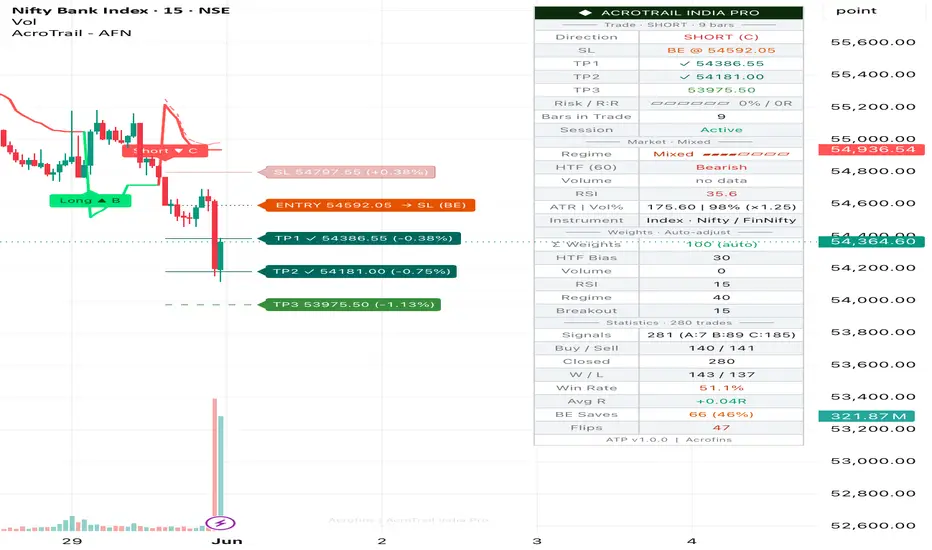
AcroTrail India Pro is a professional-grade trailing signal system built specifically for Indian markets — NSE indices, BSE indices, and NSE/BSE equities. Developed by Acrofins (Kiva Financial Services), it combines a high-quality trailing band engine with a multi-factor signal scoring system, full risk management levels, and India-specific session intelligence that most global indicators completely ignore.
What makes this different from generic trail indicators
Most trailing indicators give you a line and a signal. AcroTrail India Pro gives you a signal with a quality score, a grade, a risk/reward framework, and context about whether that signal should be trusted right now given the time of day, the market regime, and where we are in the expiry cycle.
It is built for how Indian markets actually behave, not how Western markets do.
Core engine
The trail is built on an ATR-based adaptive band with an EMA center. The band ratchets in the direction of the position, meaning it only tightens and never loosens during an active trade. Defaults are tuned for NSE intraday: ATR period 9 (vs the typical 14), a base multiplier of 2.0 for Nifty and 2.25 for BankNifty, and a 14-period trail EMA.
An optional adaptive volatility multiplier reads the 100-bar ATR percentile rank and automatically widens the band in high-volatility regimes and tightens it in low-volatility ones.
Dynamic Quality Score (0 to 100)
Every signal is scored across five components. The weights are not fixed. They shift automatically based on what is happening in the market right now.
HTF Bias checks whether the higher-timeframe trend aligns with the signal. On a 15-minute chart, it reads the 1-hour. On a daily chart, it reads the weekly. The score is graduated: full marks for alignment, partial for neutral, zero for opposition.
Volume confirms whether institutional participation is present. For index charts where TradingView reports zero volume, this weight is automatically redistributed to regime and HTF so the score stays meaningful.
RSI Momentum uses a gradient rather than a binary switch. A strong trending RSI scores full marks. A marginal RSI near the 50 line scores partial. An opposing RSI scores zero. This prevents overbought long signals from scoring the same as ideal momentum entries.
Market Regime combines ADX, Choppiness Index, and linear regression R-squared into a composite 0-100 regime score. Trending markets score high. Choppy markets score low. This score flows directly into the quality calculation.
Breakout Strength measures how decisively price pierced the trail band, capped at 3x ATR. Clean decisive breakouts score higher than marginal ones.
Signals are graded A (75 and above), B (55 to 74), or C (below 55). You can set a minimum quality threshold to filter out lower-conviction signals entirely.
Smart auto-adjust weight model
Three layers work together:
The base preset differs by instrument type. Index charts redistribute the volume weight (unavailable) to regime and HTF. Equity charts keep volume as a full component.
The auto-adjust layer shifts weights in real time based on session context. During the opening volatility window (09:15 to 09:45), HTF weight increases and breakout weight falls because gap-open band pierces are unreliable. During the expiry last-90-minute window, regime weight rises because IV-driven choppiness dominates. In high-volatility environments, regime rises and RSI falls.
The custom override layer lets you set your own weights via sliders if you want full control. The dashboard shows a live weight sum check to confirm your sliders add up correctly.
India-specific session intelligence
Session gate. Signals are blocked outside 09:15 to 15:30 IST. No false signals from pre-market or after-hours data.
Opening volatility window. Signals between 09:15 and 09:45 carry a ⚡ warning flag. This is the highest-noise window on NSE, where gap opens, institutional order flow, and retail panic all collide.
Expiry warning. Tuesday is Nifty and FinNifty expiry. Thursday is Sensex and BankNifty expiry. Signals during the last 90 minutes of those days (13:00 to 15:30) carry a 🔔 warning flag. Signals still appear so you can make your own judgment, but the flag tells you to apply extra scrutiny.
All three flags can appear together on the same signal. The dashboard also shows a live session status row so you always know which context you are trading in.
Risk management
Four presets: Conservative (SL 2.5x ATR), Balanced (SL 1.5x ATR, recommended for index), Aggressive (SL 1.0x ATR), and Scalping (SL 0.8x ATR). All three TP levels are expressed as R-multiples of the SL distance so the reward-to-risk relationship scales automatically with volatility.
Break-even option moves the stop to entry after TP1 is hit, letting the trade run to TP2 and TP3 risk-free. For intraday options trading, consider disabling this as IV spikes can trigger the BE stop before the real move to TP2 develops.
Dashboard
A unified four-section panel shows live trade status (direction, grade, SL/TP levels, R:R gauge, bars in trade, session status), market context (regime with visual gauge, HTF bias, volume, RSI, ATR), active weights (live readout of all five components plus mode indicator), and session statistics (signals by grade, win/loss count, win rate, average R-multiple, break-even saves, position flips).
How to set it up
Set the instrument type first: Index or Equity. For indices, also select the subtype (Nifty/FinNifty, BankNifty/Sensex, or MidcapNifty). This drives the base weight preset and shows ATR multiplier guidance on the dashboard.
For Nifty on 15-minute charts, the recommended starting configuration is ATR 9, multiplier 2.0, trail EMA 14, Balanced risk preset, adaptive multiplier on, ratchet on.
For BankNifty or Sensex, raise the multiplier to 2.25 or 2.5 to account for the wider intraday range.
For daily chart swing trading on equities, use ATR 13, trail EMA 21, Conservative or Balanced preset.
Built by Acrofins (Kiva Financial Services Private Limited). For educational and analytical purposes. Not financial advice.

Penafian
Maklumat dan penerbitan adalah tidak bertujuan, dan tidak membentuk, nasihat atau cadangan kewangan, pelaburan, dagangan atau jenis lain yang diberikan atau disahkan oleh TradingView. Baca lebih dalam Terma Penggunaan.
Penafian
Maklumat dan penerbitan adalah tidak bertujuan, dan tidak membentuk, nasihat atau cadangan kewangan, pelaburan, dagangan atau jenis lain yang diberikan atau disahkan oleh TradingView. Baca lebih dalam Terma Penggunaan.