OPEN-SOURCE SCRIPT
CRR FRANKENSTEIN
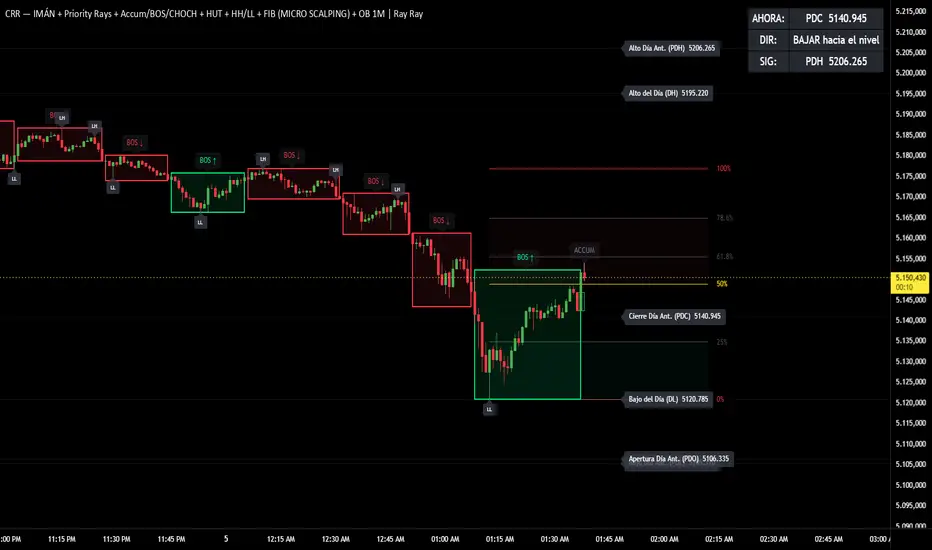
CRR Magnet Micro Scalping is a multi-layer trading tool designed to help traders identify liquidity targets, market structure, institutional intent, and high-probability reaction zones in very short timeframes. The script combines several concepts commonly used in institutional price action analysis such as priority liquidity levels, structure shifts, accumulation breakouts, order blocks, and automatic Fibonacci retracements. Its purpose is not to generate automatic buy or sell signals, but to help the trader understand where price is most likely to move and where reactions may occur.
The Priority Levels system plots the most important daily liquidity levels on the chart, including the current or previous Day High and Day Low, the previous Day High and Day Low, and the previous day Open and Close. These levels act as natural liquidity magnets and are used by the internal magnet engine to estimate the most probable price target. The Magnet Engine continuously evaluates distance, directional bias, freshness of the level, and market conditions to determine the most likely liquidity destination. The HUT panel displays three simple readings: the current primary magnet level (NOW), the expected directional movement toward that level (DIR), and the next likely liquidity level after the current one (NEXT).
Market structure is analyzed through pivot detection to label Higher Highs, Higher Lows, Lower Highs, and Lower Lows. These labels help traders visually understand trend continuation or potential reversals. The script also detects accumulation ranges where price consolidates within a defined block of candles. When price breaks the range with sufficient momentum and volatility, the block changes state and signals a structural breakout (BOS). This helps identify moments where liquidity expansion may begin.
An internal institutional confirmation engine operates using a 15-minute timeframe regardless of the chart timeframe. It evaluates liquidity sweeps of the previous day high or low, wick absorption behavior, displacement strength relative to ATR, market structure break confirmation, and optional Fibonacci retest confirmation. This engine produces internal states that help validate whether a move is likely to have real institutional participation rather than being a simple noise breakout.
The script also identifies expansion-based Order Blocks on the 1-minute timeframe. These zones appear after strong displacement candles and mark the origin of potential institutional activity. Order Blocks can be used as reaction zones, especially when they align with liquidity levels or Fibonacci retracement zones.
The automatic Fibonacci module dynamically detects swing pivots and draws the key institutional retracement levels including 0%, 25%, 50%, 61.8%, 78.6%, and 100%. The 50% level is highlighted because it often acts as the equilibrium level where price decides continuation or rejection. The script also draws extremely transparent buy and sell zones derived from these Fibonacci ranges to visually guide potential reaction areas without cluttering the chart.
This indicator is primarily designed for micro scalping environments such as the 1-minute or 5-minute chart, while using higher timeframe information internally to filter noise. Traders typically use the tool by observing where the magnet engine indicates price is likely to move, monitoring market structure changes, and watching for confluence between liquidity levels, order blocks, and Fibonacci zones. The tool is intended to assist discretionary decision-making and should be used together with proper risk management and personal trading rules.
The Priority Levels system plots the most important daily liquidity levels on the chart, including the current or previous Day High and Day Low, the previous Day High and Day Low, and the previous day Open and Close. These levels act as natural liquidity magnets and are used by the internal magnet engine to estimate the most probable price target. The Magnet Engine continuously evaluates distance, directional bias, freshness of the level, and market conditions to determine the most likely liquidity destination. The HUT panel displays three simple readings: the current primary magnet level (NOW), the expected directional movement toward that level (DIR), and the next likely liquidity level after the current one (NEXT).
Market structure is analyzed through pivot detection to label Higher Highs, Higher Lows, Lower Highs, and Lower Lows. These labels help traders visually understand trend continuation or potential reversals. The script also detects accumulation ranges where price consolidates within a defined block of candles. When price breaks the range with sufficient momentum and volatility, the block changes state and signals a structural breakout (BOS). This helps identify moments where liquidity expansion may begin.
An internal institutional confirmation engine operates using a 15-minute timeframe regardless of the chart timeframe. It evaluates liquidity sweeps of the previous day high or low, wick absorption behavior, displacement strength relative to ATR, market structure break confirmation, and optional Fibonacci retest confirmation. This engine produces internal states that help validate whether a move is likely to have real institutional participation rather than being a simple noise breakout.
The script also identifies expansion-based Order Blocks on the 1-minute timeframe. These zones appear after strong displacement candles and mark the origin of potential institutional activity. Order Blocks can be used as reaction zones, especially when they align with liquidity levels or Fibonacci retracement zones.
The automatic Fibonacci module dynamically detects swing pivots and draws the key institutional retracement levels including 0%, 25%, 50%, 61.8%, 78.6%, and 100%. The 50% level is highlighted because it often acts as the equilibrium level where price decides continuation or rejection. The script also draws extremely transparent buy and sell zones derived from these Fibonacci ranges to visually guide potential reaction areas without cluttering the chart.
This indicator is primarily designed for micro scalping environments such as the 1-minute or 5-minute chart, while using higher timeframe information internally to filter noise. Traders typically use the tool by observing where the magnet engine indicates price is likely to move, monitoring market structure changes, and watching for confluence between liquidity levels, order blocks, and Fibonacci zones. The tool is intended to assist discretionary decision-making and should be used together with proper risk management and personal trading rules.
Skrip sumber terbuka
Dalam semangat TradingView sebenar, pencipta skrip ini telah menjadikannya sumber terbuka, jadi pedagang boleh menilai dan mengesahkan kefungsiannya. Terima kasih kepada penulis! Walaupuan anda boleh menggunakan secara percuma, ingat bahawa penerbitan semula kod ini tertakluk kepada Peraturan Dalaman.

Penafian
Maklumat dan penerbitan adalah tidak bertujuan, dan tidak membentuk, nasihat atau cadangan kewangan, pelaburan, dagangan atau jenis lain yang diberikan atau disahkan oleh TradingView. Baca lebih dalam Terma Penggunaan.
Skrip sumber terbuka
Dalam semangat TradingView sebenar, pencipta skrip ini telah menjadikannya sumber terbuka, jadi pedagang boleh menilai dan mengesahkan kefungsiannya. Terima kasih kepada penulis! Walaupuan anda boleh menggunakan secara percuma, ingat bahawa penerbitan semula kod ini tertakluk kepada Peraturan Dalaman.
Penafian
Maklumat dan penerbitan adalah tidak bertujuan, dan tidak membentuk, nasihat atau cadangan kewangan, pelaburan, dagangan atau jenis lain yang diberikan atau disahkan oleh TradingView. Baca lebih dalam Terma Penggunaan.