OPEN-SOURCE SCRIPT
VWAP Aurora_Suite
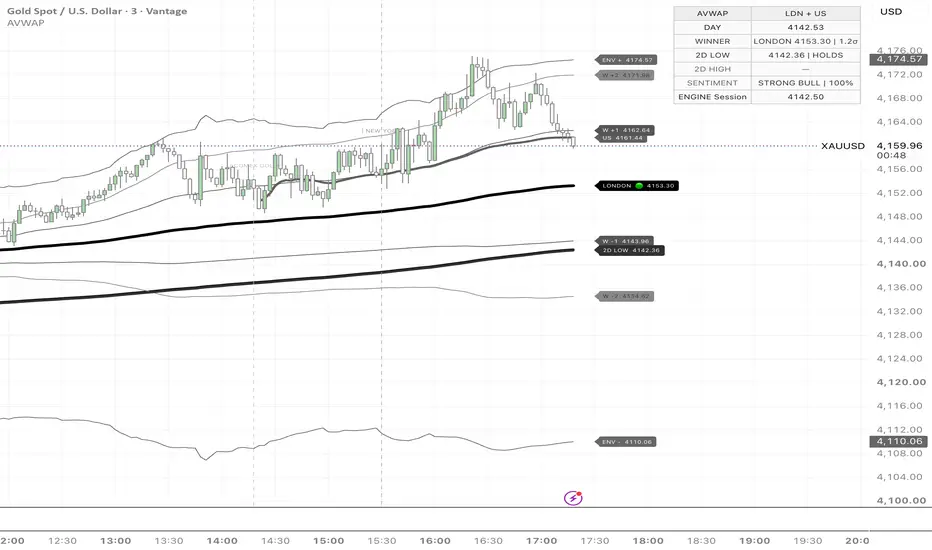
Aurora VWAP _SUITE
Overview
Aurora VWAP places several volume-weighted price references on one chart: a daily VWAP, London and US/COMEX session VWAPs, a volume-leading session VWAP with deviation bands, two-day extreme anchored VWAPs, and a separate reference VWAP engine. A compact table summarizes the current values, anchor states, and a five-factor sentiment reading. Optional right-edge tags and exchange-open markers help identify lines and session transitions.
The purpose is to compare where volume has traded across different starting points and windows. A session VWAP describes the average price weighted by volume accumulated during that session. An extreme AVWAP follows volume from a confirmed swing near the current or previous day's high or low. The reference engine supplies another view of equilibrium using a rolling, day-reset, or adaptive swing calculation. These are different contexts, so their lines can diverge without one being wrong.
Main features
Daily and session VWAPs. The Day VWAP accumulates HLC3 × volume from the first bar of each selected calendar day. London uses the 08:00–16:30 London session and US/COMEX uses the 08:20–13:30 New York session by default. The session inputs and timezones can be edited. Accumulators reset when a new day begins in the selected Day Reset Timezone.
Volume leader and deviation bands. Once session volume is available, the indicator compares the accumulated London and US volumes. The larger total becomes the winner. A thick winning VWAP and optional ±1 and ±2 volume-weighted standard-deviation bands follow that session. The defaults are 1.0σ and 2.0σ, and the multipliers are adjustable. A change in leader breaks the plotted winner line at the transition rather than drawing a misleading connector between different session VWAPs. An exact volume tie has no winner.
Two-day extreme AVWAPs. The script tracks the high and low across the current and previous days. A confirmed swing pivot can start a high or low AVWAP only when it lies within the chosen ATR distance of the corresponding two-day extreme. The cumulative price-volume calculation begins at the pivot bar; the line becomes visible only after the configured number of swing confirmation bars. A newer qualifying pivot replaces the older anchor on the same side. Anchors expire when their day is no longer in the current/previous-day window. The table describes a low AVWAP as HOLDS, LOST, or TEST and a high AVWAP as REJECTS, RECLAIM, or TEST using an ATR-based tolerance.
Independent reference engine. Select Rolling, Session, or Smart Swing. Rolling is a volume-weighted moving average over the specified bars. Session accumulates the selected HL2 or HLC3 source from the Day Reset Timezone boundary. Smart Swing resets its decayed, volume-weighted sums when the latest rolling high/low changes direction; its tracking speed can adjust with ATR. These engine modes do not move the London/US session VWAPs or the two-day pivot anchors.
Engine bands. The optional volume/ADX envelope begins with the engine's volume-weighted standard deviation. The multiplier expands above its base when current volume exceeds its 20-bar average and also scales with ADX; the upper and lower levels are smoothed. Optional fixed-multiplier bands use the same engine sigma without the volume/ADX expansion. Fixed refers to their multipliers, not to static prices.
Dashboard, labels, and opens. The table shows the active session, Day VWAP, winning session and its distance in sigma, two-day AVWAP states, normalized sentiment, and reference engine value. Right-edge tags can include the latest price. Dashed markers are available for Tokyo/OSE, Shanghai, London, New York, COMEX, and the Asia/Sydney reopen. Each marker has its own enable switch and color.
How it works
The core VWAP calculation uses the typical price and volume accumulated within the relevant day or session:
Pine Script®
The winning session is determined by accumulated session volume, rather than by which VWAP is higher or closer to price:
Pine Script®
The selectable day boundary is also used for the two-day extreme window and the engine's Session mode. Exchange uses the symbol's exchange timezone; named locations use IANA timezones, so their daylight-saving changes are handled by the timezone rules. The default is Europe/Berlin.
Pine Script®
The sentiment value counts up to five available comparisons: price versus Day VWAP, Day VWAP slope, price versus winning VWAP, price versus low AVWAP, and price versus high AVWAP. Each available comparison casts one bullish or bearish vote, or zero on equality. The sum is divided by the number of available votes, producing a reading from −100% to +100%. The dashboard labels strong readings at ±60% and moderate readings at ±20%. This is a description of agreement between references, not a probability forecast.
How to use
Read the daily context. Compare price with Day VWAP, then check whether London and US session VWAPs agree with or diverge from it. The selected reset timezone determines which bars belong to each day; choose it before comparing days on an intraday chart.
Watch the session handoff. During the London/US overlap, observe which session has contributed more cumulative volume. When the leader changes, the winning line changes its underlying session. Treat the break in that line as a handoff, not as a sudden price jump.
Evaluate a test of an extreme anchor. A confirmed low or high AVWAP shows the volume-weighted average since a qualifying extreme pivot. Use the table's HOLDS/LOST or REJECTS/RECLAIM state to see whether the close is outside the ATR tolerance. A TEST state means the close is within that tolerance. Pivot confirmation takes time, so the anchor line appears after the pivot and is not an advance signal at the extreme.
Judge distance from equilibrium. Winner deviation bands measure distance in that session's volume-weighted sigma. The reference envelope adds volume and ADX sensitivity. A touch or move beyond a band describes extension; it does not imply that a reversal must occur.
Settings guide
Chart Lines: Show the Day, London, and US VWAPs and optionally emphasize the session volume leader.
Session Times: Set the Day Reset Timezone and the London and US/COMEX session windows and timezones. The day reset choices include Berlin, Exchange, UTC, London, Zurich, New York, Chicago, Los Angeles, Tokyo, Shanghai, Dubai, and Sydney.
Winning Session: Show the winner line and deviation bands; adjust both sigma multipliers.
Extreme Anchors: Control pivot confirmation, ATR length, qualifying distance, and AVWAP test tolerance. The Day VWAP slope setting affects the sentiment vote.
Reference Engine: Choose Rolling, Session, or Smart Swing and configure its price source and mode-specific parameters.
Engine Bands: Enable the dynamic envelope or fixed-multiplier bands and adjust sigma, volume, ADX, and smoothing parameters.
Exchange Opens / Right Edge Labels: Select visible open markers, label content, and horizontal tag offset.
Dashboard Table: Show or hide the summary and select its own Dark or Light mode.
Line Palette / Custom Colors: Select Dark, Light, or Custom for VWAP lines, bands, anchors, tags, and open markers. In Custom mode, the individual color pickers are used. The table mode does not change line colors, and the line mode does not change the table.
Alerts
The indicator provides four alert conditions: a newly confirmed two-day low AVWAP, a newly confirmed two-day high AVWAP, London taking the accumulated session-volume lead, and US taking that lead. Create the desired alerts in TradingView after adding the indicator to the chart.
Notes and limitations
This tool is designed chiefly for intraday charts. Calculations use the chart's available bar prices and volume; symbols with missing or zero volume may have unavailable VWAPs. Session and open-event timing depends on bar resolution: an open marker is drawn on the bar spanning its specified time. The two-day anchors require pivot confirmation and can change when a newer qualifying pivot appears. On a live, unclosed bar, the displayed values and conditions can continue to update.
VWAPs, deviations, sentiment, and anchor states provide context for analysis. They do not place orders or define a complete trading strategy. This description is for educational use and is not financial advice.
Overview
Aurora VWAP places several volume-weighted price references on one chart: a daily VWAP, London and US/COMEX session VWAPs, a volume-leading session VWAP with deviation bands, two-day extreme anchored VWAPs, and a separate reference VWAP engine. A compact table summarizes the current values, anchor states, and a five-factor sentiment reading. Optional right-edge tags and exchange-open markers help identify lines and session transitions.
The purpose is to compare where volume has traded across different starting points and windows. A session VWAP describes the average price weighted by volume accumulated during that session. An extreme AVWAP follows volume from a confirmed swing near the current or previous day's high or low. The reference engine supplies another view of equilibrium using a rolling, day-reset, or adaptive swing calculation. These are different contexts, so their lines can diverge without one being wrong.
Main features
Daily and session VWAPs. The Day VWAP accumulates HLC3 × volume from the first bar of each selected calendar day. London uses the 08:00–16:30 London session and US/COMEX uses the 08:20–13:30 New York session by default. The session inputs and timezones can be edited. Accumulators reset when a new day begins in the selected Day Reset Timezone.
Volume leader and deviation bands. Once session volume is available, the indicator compares the accumulated London and US volumes. The larger total becomes the winner. A thick winning VWAP and optional ±1 and ±2 volume-weighted standard-deviation bands follow that session. The defaults are 1.0σ and 2.0σ, and the multipliers are adjustable. A change in leader breaks the plotted winner line at the transition rather than drawing a misleading connector between different session VWAPs. An exact volume tie has no winner.
Two-day extreme AVWAPs. The script tracks the high and low across the current and previous days. A confirmed swing pivot can start a high or low AVWAP only when it lies within the chosen ATR distance of the corresponding two-day extreme. The cumulative price-volume calculation begins at the pivot bar; the line becomes visible only after the configured number of swing confirmation bars. A newer qualifying pivot replaces the older anchor on the same side. Anchors expire when their day is no longer in the current/previous-day window. The table describes a low AVWAP as HOLDS, LOST, or TEST and a high AVWAP as REJECTS, RECLAIM, or TEST using an ATR-based tolerance.
Independent reference engine. Select Rolling, Session, or Smart Swing. Rolling is a volume-weighted moving average over the specified bars. Session accumulates the selected HL2 or HLC3 source from the Day Reset Timezone boundary. Smart Swing resets its decayed, volume-weighted sums when the latest rolling high/low changes direction; its tracking speed can adjust with ATR. These engine modes do not move the London/US session VWAPs or the two-day pivot anchors.
Engine bands. The optional volume/ADX envelope begins with the engine's volume-weighted standard deviation. The multiplier expands above its base when current volume exceeds its 20-bar average and also scales with ADX; the upper and lower levels are smoothed. Optional fixed-multiplier bands use the same engine sigma without the volume/ADX expansion. Fixed refers to their multipliers, not to static prices.
Dashboard, labels, and opens. The table shows the active session, Day VWAP, winning session and its distance in sigma, two-day AVWAP states, normalized sentiment, and reference engine value. Right-edge tags can include the latest price. Dashed markers are available for Tokyo/OSE, Shanghai, London, New York, COMEX, and the Asia/Sydney reopen. Each marker has its own enable switch and color.
How it works
The core VWAP calculation uses the typical price and volume accumulated within the relevant day or session:
The winning session is determined by accumulated session volume, rather than by which VWAP is higher or closer to price:
The selectable day boundary is also used for the two-day extreme window and the engine's Session mode. Exchange uses the symbol's exchange timezone; named locations use IANA timezones, so their daylight-saving changes are handled by the timezone rules. The default is Europe/Berlin.
The sentiment value counts up to five available comparisons: price versus Day VWAP, Day VWAP slope, price versus winning VWAP, price versus low AVWAP, and price versus high AVWAP. Each available comparison casts one bullish or bearish vote, or zero on equality. The sum is divided by the number of available votes, producing a reading from −100% to +100%. The dashboard labels strong readings at ±60% and moderate readings at ±20%. This is a description of agreement between references, not a probability forecast.
How to use
Read the daily context. Compare price with Day VWAP, then check whether London and US session VWAPs agree with or diverge from it. The selected reset timezone determines which bars belong to each day; choose it before comparing days on an intraday chart.
Watch the session handoff. During the London/US overlap, observe which session has contributed more cumulative volume. When the leader changes, the winning line changes its underlying session. Treat the break in that line as a handoff, not as a sudden price jump.
Evaluate a test of an extreme anchor. A confirmed low or high AVWAP shows the volume-weighted average since a qualifying extreme pivot. Use the table's HOLDS/LOST or REJECTS/RECLAIM state to see whether the close is outside the ATR tolerance. A TEST state means the close is within that tolerance. Pivot confirmation takes time, so the anchor line appears after the pivot and is not an advance signal at the extreme.
Judge distance from equilibrium. Winner deviation bands measure distance in that session's volume-weighted sigma. The reference envelope adds volume and ADX sensitivity. A touch or move beyond a band describes extension; it does not imply that a reversal must occur.
Settings guide
Chart Lines: Show the Day, London, and US VWAPs and optionally emphasize the session volume leader.
Session Times: Set the Day Reset Timezone and the London and US/COMEX session windows and timezones. The day reset choices include Berlin, Exchange, UTC, London, Zurich, New York, Chicago, Los Angeles, Tokyo, Shanghai, Dubai, and Sydney.
Winning Session: Show the winner line and deviation bands; adjust both sigma multipliers.
Extreme Anchors: Control pivot confirmation, ATR length, qualifying distance, and AVWAP test tolerance. The Day VWAP slope setting affects the sentiment vote.
Reference Engine: Choose Rolling, Session, or Smart Swing and configure its price source and mode-specific parameters.
Engine Bands: Enable the dynamic envelope or fixed-multiplier bands and adjust sigma, volume, ADX, and smoothing parameters.
Exchange Opens / Right Edge Labels: Select visible open markers, label content, and horizontal tag offset.
Dashboard Table: Show or hide the summary and select its own Dark or Light mode.
Line Palette / Custom Colors: Select Dark, Light, or Custom for VWAP lines, bands, anchors, tags, and open markers. In Custom mode, the individual color pickers are used. The table mode does not change line colors, and the line mode does not change the table.
Alerts
The indicator provides four alert conditions: a newly confirmed two-day low AVWAP, a newly confirmed two-day high AVWAP, London taking the accumulated session-volume lead, and US taking that lead. Create the desired alerts in TradingView after adding the indicator to the chart.
Notes and limitations
This tool is designed chiefly for intraday charts. Calculations use the chart's available bar prices and volume; symbols with missing or zero volume may have unavailable VWAPs. Session and open-event timing depends on bar resolution: an open marker is drawn on the bar spanning its specified time. The two-day anchors require pivot confirmation and can change when a newer qualifying pivot appears. On a live, unclosed bar, the displayed values and conditions can continue to update.
VWAPs, deviations, sentiment, and anchor states provide context for analysis. They do not place orders or define a complete trading strategy. This description is for educational use and is not financial advice.
Skrip sumber terbuka
Dalam semangat TradingView sebenar, pencipta skrip ini telah menjadikannya sumber terbuka, jadi pedagang boleh menilai dan mengesahkan kefungsiannya. Terima kasih kepada penulis! Walaupuan anda boleh menggunakan secara percuma, ingat bahawa penerbitan semula kod ini tertakluk kepada Peraturan Dalaman.

Penafian
Maklumat dan penerbitan adalah tidak bertujuan, dan tidak membentuk, nasihat atau cadangan kewangan, pelaburan, dagangan atau jenis lain yang diberikan atau disahkan oleh TradingView. Baca lebih dalam Terma Penggunaan.
Skrip sumber terbuka
Dalam semangat TradingView sebenar, pencipta skrip ini telah menjadikannya sumber terbuka, jadi pedagang boleh menilai dan mengesahkan kefungsiannya. Terima kasih kepada penulis! Walaupuan anda boleh menggunakan secara percuma, ingat bahawa penerbitan semula kod ini tertakluk kepada Peraturan Dalaman.
Penafian
Maklumat dan penerbitan adalah tidak bertujuan, dan tidak membentuk, nasihat atau cadangan kewangan, pelaburan, dagangan atau jenis lain yang diberikan atau disahkan oleh TradingView. Baca lebih dalam Terma Penggunaan.