Heartbeat Rhythm Detector [forexobroker]
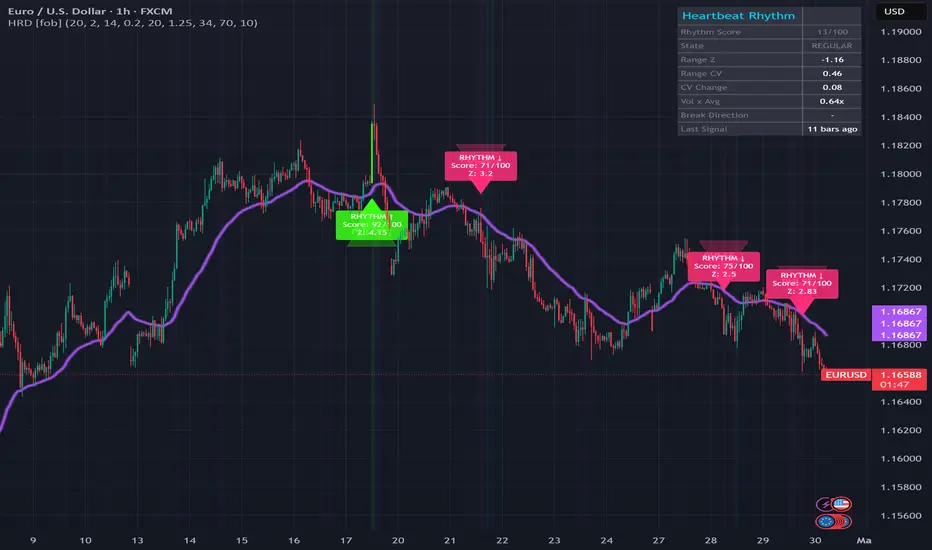
Heartbeat Rhythm Detector tracks the rhythm of bar ranges over a rolling window and fires when the rhythm breaks -- when a single bar's range becomes a statistical outlier (high z-score) with directional close and volume confirmation. A healthy market has a regular heartbeat of similar-sized bars; a broken rhythm marks a real shift.
Built for traders who want to enter when the market's normal volatility cadence abruptly changes, usually at the onset of a new trend leg.
🔶 CONCEPTS
Rhythm is regularity. If the last 20 bars all have similar ranges, the range distribution is tight, and the z-score of any given bar is small. When a single bar prints a range that is two or more standard deviations above the rolling mean, the rhythm has broken -- something out of the ordinary has happened. If the close confirms a direction and volume supports it, the rhythm break is real and tradable. Rising coefficient of variation adds an extra confirm: irregularity was building before the break itself.
🔶 HOW IT WORKS
- Measures current bar range (high - low)
- Computes rolling mean and standard deviation of range over the Rhythm Window
- Calculates range z-score
- Computes coefficient of variation (stddev / mean) of ranges and its change over the window
- Confirms volume exceeds average by the volume multiplier
- Combines z-score magnitude, CV rise, volume excess, and EMA slope into a 0-100 Rhythm Score
- Classifies state as REGULAR, IRREGULAR, SPIKE, or ARRHYTHMIA
- Fires signal on rhythm-break bar with matching directional close and bias
🔶 HOW TO USE
1. Add the indicator -- background tints by rhythm state
2. Watch the dashboard (top-right) for live range z-score, CV, CV change, volume ratio, and break direction
3. Green BUY triangles with "PULSE ↑" label fire on bullish rhythm breaks; pink SELL triangles on bearish
4. The Bias EMA plotted with glow gates signals to macro direction
5. Raise Rhythm Break Z-Score for only extreme outliers; lower it for more frequent signals
🔶 FEATURES
- Non-repainting signals (barstate.isconfirmed)
- Works on all timeframes and instruments
- 9 alert conditions with JSON webhook support
- Statistical outlier detection in bar ranges (not just ATR expansion)
- Coefficient-of-variation context that confirms increasing irregularity
🔶 SETTINGS GUIDE
- Rhythm Window -- Bars used to measure range mean, stddev, and CV
- Rhythm Break Z-Score -- Required range z-score to qualify as a rhythm break
- ATR Length -- ATR period (used for label offsets)
- Rising CV Floor -- Minimum CV increase over the window to count as rhythm shift
- Volume Average Length / Volume Multiplier -- Volume confirmation criterion
- Bias EMA Length -- Macro EMA used to gate signals
- Rhythm Score Threshold -- Minimum 0-100 score required at fire
- Signal Cooldown Bars -- Minimum bars between consecutive signals
🔶 ALERTS
- HRD Buy Pulse -- Bullish rhythm break confirmed
- HRD Sell Pulse -- Bearish rhythm break confirmed
- HRD Any Signal -- Any rhythm signal
- HRD Arrhythmia -- Rhythm score reaches 85+
- HRD Up Break -- Bullish rhythm break event
- HRD Down Break -- Bearish rhythm break event
- HRD Range Z-Spike -- Range z-score above threshold (informational)
- HRD Rising CV -- Range coefficient of variation increasing
- HRD Webhook JSON -- Generic webhook payload for external automation
🔶 LIMITATIONS & DISCLAIMER
- This is a technical analysis tool, not financial advice. Always use proper risk management.
- Z-score normalization adapts to recent rhythm; regime shifts can temporarily mis-scale thresholds.
- News-driven spikes can cause rhythm breaks unrelated to structural change.
- The Rhythm Score is a composite heuristic, not a calibrated probability.

🔵Gain access to our powerful tools : kestutisbalciunas.com/tradingview/
🔵Join our free telegram for updates : t.me/algotradingedge
All scripts & content provided by Forexobroker are for informational & educational purposes only.
🔵Join our free telegram for updates : t.me/algotradingedge
All scripts & content provided by Forexobroker are for informational & educational purposes only.
Penafian
Maklumat dan penerbitan adalah tidak bertujuan, dan tidak membentuk, nasihat atau cadangan kewangan, pelaburan, dagangan atau jenis lain yang diberikan atau disahkan oleh TradingView. Baca lebih dalam Terma Penggunaan.