
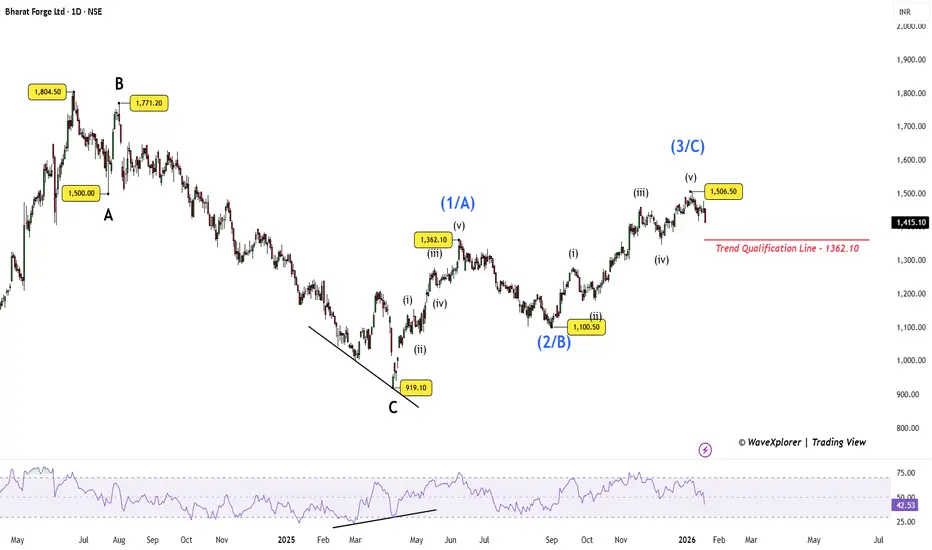
One of the most common challenges in Elliott Wave analysis is deciding whether a strong rally is an impulse or just a corrective move. This chart of Bharat Forge serves as a practical example of how Elliott Wave rules help remove that ambiguity.
From the ₹919.10 low, price staged a sharp rally that appears to be unfolding as five waves advance. At first glance, this can easily be mistaken for the start of a new impulsive trend. However, Elliott Wave analysis is not based on appearances — it is based on rules.
The key rule illustrated here is straightforward:
In an impulse, Wave 4 must not overlap Wave 1.
To apply this rule objectively, the chart highlights a Trend Qualification Line at ₹1362.10. This level represents the termination of the initial advance from the lows to form Wave (1/A) at 1362.10 and acts as a structural divider.
If price moves below ₹1362.10, the overlap rule is violated. In that case, the entire advance from ₹919.10 should be treated as a corrective ABC structure, rather than an impulse. This would imply that the market is still in a broader corrective phase.
If, instead, price holds above ₹1362.10 and later moves above ₹1506.50, the overlap rule remains intact. This keeps the impulsive interpretation valid and allows the move from ₹919.10 to be viewed as a complete five-wave advance, potentially of a higher degree.
Momentum indicators provide useful context but do not define structure. In this case, the RSI dropping below 50 leans toward a corrective interpretation, but it does not override Elliott Wave rules.
Momentum can hint. Structure decides.
This example highlights why clearly defined levels like the Trend Qualification Line are so valuable in Elliott Wave analysis. They shift the focus from prediction to qualification, helping analysts stay aligned with price behavior rather than bias.
From the ₹919.10 low, price staged a sharp rally that appears to be unfolding as five waves advance. At first glance, this can easily be mistaken for the start of a new impulsive trend. However, Elliott Wave analysis is not based on appearances — it is based on rules.
The key rule illustrated here is straightforward:
In an impulse, Wave 4 must not overlap Wave 1.
To apply this rule objectively, the chart highlights a Trend Qualification Line at ₹1362.10. This level represents the termination of the initial advance from the lows to form Wave (1/A) at 1362.10 and acts as a structural divider.
If price moves below ₹1362.10, the overlap rule is violated. In that case, the entire advance from ₹919.10 should be treated as a corrective ABC structure, rather than an impulse. This would imply that the market is still in a broader corrective phase.
If, instead, price holds above ₹1362.10 and later moves above ₹1506.50, the overlap rule remains intact. This keeps the impulsive interpretation valid and allows the move from ₹919.10 to be viewed as a complete five-wave advance, potentially of a higher degree.
Momentum indicators provide useful context but do not define structure. In this case, the RSI dropping below 50 leans toward a corrective interpretation, but it does not override Elliott Wave rules.
Momentum can hint. Structure decides.
This example highlights why clearly defined levels like the Trend Qualification Line are so valuable in Elliott Wave analysis. They shift the focus from prediction to qualification, helping analysts stay aligned with price behavior rather than bias.

WaveXplorer | Elliott Wave insights
📊 X profile: @veerappa89
📊 X profile: @veerappa89
Wyłączenie odpowiedzialności
Informacje i publikacje nie stanowią i nie powinny być traktowane jako porady finansowe, inwestycyjne, tradingowe ani jakiekolwiek inne rekomendacje dostarczane lub zatwierdzone przez TradingView. Więcej informacji znajduje się w Warunkach użytkowania.
WaveXplorer | Elliott Wave insights
📊 X profile: @veerappa89
📊 X profile: @veerappa89
Wyłączenie odpowiedzialności
Informacje i publikacje nie stanowią i nie powinny być traktowane jako porady finansowe, inwestycyjne, tradingowe ani jakiekolwiek inne rekomendacje dostarczane lub zatwierdzone przez TradingView. Więcej informacji znajduje się w Warunkach użytkowania.