
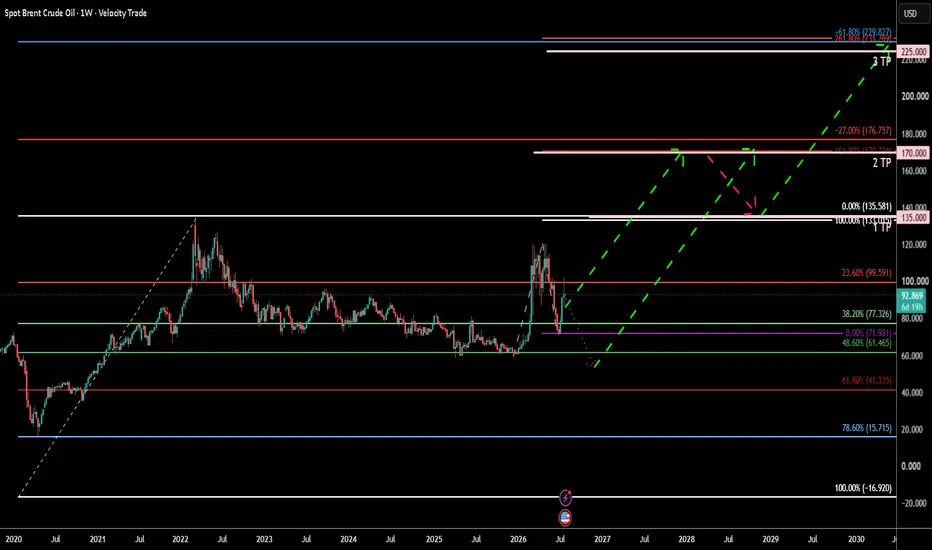
# Technical Analysis: Brent Crude Oil (1W Chart) - Bullish Continuation Scenario
The attached weekly chart for Brent Crude Oil presents a clear technical framework built on the anticipation of a long-term bullish continuation, contingent upon the successful defense of key support levels. This analysis utilizes a confluence of **Fibonacci Retracement** and **Trend-Based Fibonacci Extension** tools to identify critical price action zones and high-probability targets.
### Key Structure and Support
Following a prolonged consolidation phase, the price action has established a strong foundational base. The current price is navigating the area around the **38.2% Fibonacci Retracement level at $84.720**.
The critical demand zone for this bullish setup is defined by the **48.6% Retracement level, located near $70.874**. This area serves as the primary structural support. Should the price hold above this level, the higher probability remains with the bullish scenario. A deeper move to the **61.8% Retracement at $53.299** would indicate significant weakness, but the structural integrity of the long-term uptrend would remain valid as long as this floor holds.
### Resistance and Targets (Take Profits - TPs)
Upside momentum will first face resistance at the **23.6% Retracement level at $104.159**. A decisive break and weekly close above this zone would confirm the resumption of the uptrend toward the primary targets.
The targets are set using the synergy between the two Fibonacci tools, creating strong confluence zones:
1. **TP1 (Primary Target): $135.581 - $133.333**
* This is a highly significant confluence zone, marked by the alignment of the **0.0% Fibonacci Extension** and the **100.0% Level** of the underlying structural move. This area represents the completion of the first major extension phase.
2. **TP2 (Secondary Target): $170.000 - $175.000**
* This target aligns with a key extension level, suggesting strong resistance and potential profit-taking. The price path indicates an anticipated sharp extension followed by a potential mean reversion/retest before continuing the ascent.
3. **TP3 (Final Long-Term Target): $220.000 - $230.000**
* The ultimate extension target, aligned with the **-61.80% Fibonacci Extension**, marking a new historical high territory for Brent Crude Oil.
### Trade Thesis Summary
The overarching thesis is a high-conviction bullish trade, provided the price respects the established support at the $70-$71 demand zone. Sustained price action above $84.720 is ideal for initiating long positions aimed at the three predefined targets.
# Fundamental Analysis: IRGC-Led Regional Escalation and Global Oil Supply Shock Thesis
The bullish long-term outlook for Brent Crude is not based solely on technical structure; it is also supported by a high-impact geopolitical thesis centered on the risk of a broader regional war in the Middle East. In this framework, the Islamic Revolutionary Guard Corps (IRGC) is viewed as the main escalation actor capable of expanding the conflict beyond bilateral confrontation and into a multi-front regional disruption affecting the entire Gulf energy system.
The core of this thesis is that if the conflict intensifies, the IRGC could directly or indirectly strike GCC infrastructure and energy-exporting states, creating severe and prolonged instability across the Persian Gulf. In such a scenario, the objective would not merely be military signaling, but the effective breakdown of regional oil export capacity and maritime security. This would place the Gulf states under extreme pressure and materially damage their ability to sustain normal crude flows.
The most important macro consequence would be the disruption or closure of the world's key energy chokepoints:
1. Strait of Hormuz:
Hormuz is the most critical artery for global seaborne oil flows from the Persian Gulf. If the IRGC moves to effectively shut or militarize this corridor, a substantial portion of global crude exports would be delayed, rerouted, or halted altogether.
2. Bab el-Mandeb:
A second layer of disruption could come through Yemen's Houthis, acting as a force multiplier against shipping lanes linking the Red Sea to global markets. If Bab el-Mandeb becomes functionally impassable, the oil trade route between the Gulf, Europe, and broader global markets would face another major shock.
3. Wider Maritime Chokepoint Destabilization:
If the conflict spreads further and additional maritime bottlenecks are threatened, the result would be a cascading breakdown in global energy logistics. Even partial disruption across multiple chokepoints would sharply reduce effective supply and amplify freight, insurance, and strategic stockpiling pressures.
Under this scenario, the market would not be dealing with a normal geopolitical premium, but with a full-scale supply shock. The immediate result would be a violent imbalance between collapsing supply and emergency demand repricing. Major import-dependent economies such as China, Europe, India, Australia, and other Asia-Pacific consumers would be forced to compete aggressively for reduced available barrels. That dynamic would tighten prompt supply, steepen backwardation, and drive Brent into a much higher pricing regime.
This is the macro logic that supports the higher extension targets on the chart. If a broad IRGC-led escalation materially disrupts GCC exporters and key maritime routes, Brent would likely move far beyond ordinary cyclical resistance levels. In that environment, the technical upside objectives at $135.58, $170.00-$171.53, and even $217.86-$220.00 become fundamentally explainable as crisis-driven repricing zones rather than purely theoretical Fibonacci extensions.
In short, the bullish thesis is built on the idea that the oil market remains structurally vulnerable to a regional conflict expansion in which the IRGC acts as the primary destabilizing force against GCC security architecture and the global crude transport system. If this tail-risk scenario materializes, the upside in Brent could become nonlinear and historic in scale.
Supporting News and Sources
1) Reuters — Oil settles up more than 3% to six-week high as Mideast tensions flare
Link:
reuters.com/business/energy/oil-prices-rise-slightly-after-us-announces-new-round-strikes-iran-2026-07-22/
Summary:
Brent crude rose 3.36% and settled at $94.07 per barrel after new U.S. strikes on Iran, reaching its highest level in nearly six weeks. This supports the view that any escalation tied to Iran rapidly injects a geopolitical risk premium into oil and can accelerate upside momentum.
2) Reuters — Oil prices settle at multi-week highs as global supply risks persist
Link:
reuters.com/business/energy/oil-rises-reports-us-will-extend-iran-blockade-prolonging-mideast-supply-2026-04-29/
Summary:
Brent climbed to $118.03 as concerns over prolonged Middle East supply disruption intensified. This is important because it shows that when regional export risk rises, Brent can reprice sharply and move into a much higher range very quickly.
3) Reuters — Iran war shock drives steepest hike yet in oil price forecasts
Link:
reuters.com/business/energy/iran-war-shock-drives-steepest-hike-yet-oil-price-forecasts-2026-03-31/
Summary:
Reuters reported a major upward revision in oil forecasts, with Brent expected to average $82.85 in 2026, roughly 30% above earlier projections. This confirms that war-related supply risk was significant enough to force analysts to re-anchor Brent in a higher pricing regime.
4) Reuters — Analysts dial down oil forecasts as Hormuz reopening eases supply concerns
Link:
reuters.com/business/energy/poll-analysts-dial-down-oil-forecasts-hormuz-reopening-eases-supply-concerns-2026-06-30/
Summary:
Even after some easing in tensions and partial relief around Hormuz, Brent was still projected to average $84.50 in 2026. This suggests that the market continued to price oil at structurally elevated levels despite temporary de-escalation.
5) Reuters — Oil needs an Iran supply shock, not tough talk, to break out of range
Link:
reuters.com/markets/commodities/oil-needs-an-iran-supply-shock-not-tough-talk-break-out-range-2026-01-30/
Summary:
Reuters highlighted that Brent needed a real supply shock, not just rhetoric, to break decisively out of its range. This aligns directly with the thesis that a genuine disruption through Hormuz, Bab el-Mandeb, or broader GCC infrastructure would be the catalyst for a major upside breakout.
Combined News Takeaway
Taken together, these reports support a bullish oil thesis built on geopolitical escalation and maritime supply risk. The common message across the Reuters coverage is that Brent reacts aggressively when conflict involving Iran threatens regional exports, shipping routes, or broader Gulf security. Even when tensions ease, analysts still keep Brent in an elevated range, which implies that the market sees structural vulnerability in global supply. This creates a strong macro backdrop for a continuation move higher if a larger disruption scenario materializes.
# Market Sentiment Analysis
Current market sentiment remains cautious but is significantly skewed toward the upside, primarily due to the persistent geopolitical risk premium.
### Risk Perception
Market positioning shows that traders are actively pricing in "tail risk" events—low probability, high-impact scenarios—that could lead to supply destruction. Recent price spikes to multi-week highs (as reported by Reuters in late July) confirm that news headlines related to Middle East military action or chokepoint threats immediately trigger strong buying momentum, indicating an underlying fear of missing out (FOMO) on a major supply shock.
### Futures and Options Positioning
Although exact Commitment of Traders (COT) data is required for precise positioning, the market behavior suggests a net-long bias among institutional participants, particularly in the longer-dated futures contracts, indicating a structural belief in higher prices over the next 12-24 months. The elevated Volatility Index (VIX) for oil futures reflects the high degree of uncertainty but, critically, suggests that the market is willing to pay a premium for bullish call options, aligning with the extended upside targets.
### Summary
The prevailing sentiment is one of **bullish vigilance**. While short-term fluctuations exist due to economic concerns, the overall mood is dominated by the readiness of the market to drive prices sharply higher upon any concrete evidence of supply constraint. This strongly supports the bullish continuation thesis developed in the technical and fundamental sections.
The attached weekly chart for Brent Crude Oil presents a clear technical framework built on the anticipation of a long-term bullish continuation, contingent upon the successful defense of key support levels. This analysis utilizes a confluence of **Fibonacci Retracement** and **Trend-Based Fibonacci Extension** tools to identify critical price action zones and high-probability targets.
### Key Structure and Support
Following a prolonged consolidation phase, the price action has established a strong foundational base. The current price is navigating the area around the **38.2% Fibonacci Retracement level at $84.720**.
The critical demand zone for this bullish setup is defined by the **48.6% Retracement level, located near $70.874**. This area serves as the primary structural support. Should the price hold above this level, the higher probability remains with the bullish scenario. A deeper move to the **61.8% Retracement at $53.299** would indicate significant weakness, but the structural integrity of the long-term uptrend would remain valid as long as this floor holds.
### Resistance and Targets (Take Profits - TPs)
Upside momentum will first face resistance at the **23.6% Retracement level at $104.159**. A decisive break and weekly close above this zone would confirm the resumption of the uptrend toward the primary targets.
The targets are set using the synergy between the two Fibonacci tools, creating strong confluence zones:
1. **TP1 (Primary Target): $135.581 - $133.333**
* This is a highly significant confluence zone, marked by the alignment of the **0.0% Fibonacci Extension** and the **100.0% Level** of the underlying structural move. This area represents the completion of the first major extension phase.
2. **TP2 (Secondary Target): $170.000 - $175.000**
* This target aligns with a key extension level, suggesting strong resistance and potential profit-taking. The price path indicates an anticipated sharp extension followed by a potential mean reversion/retest before continuing the ascent.
3. **TP3 (Final Long-Term Target): $220.000 - $230.000**
* The ultimate extension target, aligned with the **-61.80% Fibonacci Extension**, marking a new historical high territory for Brent Crude Oil.
### Trade Thesis Summary
The overarching thesis is a high-conviction bullish trade, provided the price respects the established support at the $70-$71 demand zone. Sustained price action above $84.720 is ideal for initiating long positions aimed at the three predefined targets.
# Fundamental Analysis: IRGC-Led Regional Escalation and Global Oil Supply Shock Thesis
The bullish long-term outlook for Brent Crude is not based solely on technical structure; it is also supported by a high-impact geopolitical thesis centered on the risk of a broader regional war in the Middle East. In this framework, the Islamic Revolutionary Guard Corps (IRGC) is viewed as the main escalation actor capable of expanding the conflict beyond bilateral confrontation and into a multi-front regional disruption affecting the entire Gulf energy system.
The core of this thesis is that if the conflict intensifies, the IRGC could directly or indirectly strike GCC infrastructure and energy-exporting states, creating severe and prolonged instability across the Persian Gulf. In such a scenario, the objective would not merely be military signaling, but the effective breakdown of regional oil export capacity and maritime security. This would place the Gulf states under extreme pressure and materially damage their ability to sustain normal crude flows.
The most important macro consequence would be the disruption or closure of the world's key energy chokepoints:
1. Strait of Hormuz:
Hormuz is the most critical artery for global seaborne oil flows from the Persian Gulf. If the IRGC moves to effectively shut or militarize this corridor, a substantial portion of global crude exports would be delayed, rerouted, or halted altogether.
2. Bab el-Mandeb:
A second layer of disruption could come through Yemen's Houthis, acting as a force multiplier against shipping lanes linking the Red Sea to global markets. If Bab el-Mandeb becomes functionally impassable, the oil trade route between the Gulf, Europe, and broader global markets would face another major shock.
3. Wider Maritime Chokepoint Destabilization:
If the conflict spreads further and additional maritime bottlenecks are threatened, the result would be a cascading breakdown in global energy logistics. Even partial disruption across multiple chokepoints would sharply reduce effective supply and amplify freight, insurance, and strategic stockpiling pressures.
Under this scenario, the market would not be dealing with a normal geopolitical premium, but with a full-scale supply shock. The immediate result would be a violent imbalance between collapsing supply and emergency demand repricing. Major import-dependent economies such as China, Europe, India, Australia, and other Asia-Pacific consumers would be forced to compete aggressively for reduced available barrels. That dynamic would tighten prompt supply, steepen backwardation, and drive Brent into a much higher pricing regime.
This is the macro logic that supports the higher extension targets on the chart. If a broad IRGC-led escalation materially disrupts GCC exporters and key maritime routes, Brent would likely move far beyond ordinary cyclical resistance levels. In that environment, the technical upside objectives at $135.58, $170.00-$171.53, and even $217.86-$220.00 become fundamentally explainable as crisis-driven repricing zones rather than purely theoretical Fibonacci extensions.
In short, the bullish thesis is built on the idea that the oil market remains structurally vulnerable to a regional conflict expansion in which the IRGC acts as the primary destabilizing force against GCC security architecture and the global crude transport system. If this tail-risk scenario materializes, the upside in Brent could become nonlinear and historic in scale.
Supporting News and Sources
1) Reuters — Oil settles up more than 3% to six-week high as Mideast tensions flare
Link:
reuters.com/business/energy/oil-prices-rise-slightly-after-us-announces-new-round-strikes-iran-2026-07-22/
Summary:
Brent crude rose 3.36% and settled at $94.07 per barrel after new U.S. strikes on Iran, reaching its highest level in nearly six weeks. This supports the view that any escalation tied to Iran rapidly injects a geopolitical risk premium into oil and can accelerate upside momentum.
2) Reuters — Oil prices settle at multi-week highs as global supply risks persist
Link:
reuters.com/business/energy/oil-rises-reports-us-will-extend-iran-blockade-prolonging-mideast-supply-2026-04-29/
Summary:
Brent climbed to $118.03 as concerns over prolonged Middle East supply disruption intensified. This is important because it shows that when regional export risk rises, Brent can reprice sharply and move into a much higher range very quickly.
3) Reuters — Iran war shock drives steepest hike yet in oil price forecasts
Link:
reuters.com/business/energy/iran-war-shock-drives-steepest-hike-yet-oil-price-forecasts-2026-03-31/
Summary:
Reuters reported a major upward revision in oil forecasts, with Brent expected to average $82.85 in 2026, roughly 30% above earlier projections. This confirms that war-related supply risk was significant enough to force analysts to re-anchor Brent in a higher pricing regime.
4) Reuters — Analysts dial down oil forecasts as Hormuz reopening eases supply concerns
Link:
reuters.com/business/energy/poll-analysts-dial-down-oil-forecasts-hormuz-reopening-eases-supply-concerns-2026-06-30/
Summary:
Even after some easing in tensions and partial relief around Hormuz, Brent was still projected to average $84.50 in 2026. This suggests that the market continued to price oil at structurally elevated levels despite temporary de-escalation.
5) Reuters — Oil needs an Iran supply shock, not tough talk, to break out of range
Link:
reuters.com/markets/commodities/oil-needs-an-iran-supply-shock-not-tough-talk-break-out-range-2026-01-30/
Summary:
Reuters highlighted that Brent needed a real supply shock, not just rhetoric, to break decisively out of its range. This aligns directly with the thesis that a genuine disruption through Hormuz, Bab el-Mandeb, or broader GCC infrastructure would be the catalyst for a major upside breakout.
Combined News Takeaway
Taken together, these reports support a bullish oil thesis built on geopolitical escalation and maritime supply risk. The common message across the Reuters coverage is that Brent reacts aggressively when conflict involving Iran threatens regional exports, shipping routes, or broader Gulf security. Even when tensions ease, analysts still keep Brent in an elevated range, which implies that the market sees structural vulnerability in global supply. This creates a strong macro backdrop for a continuation move higher if a larger disruption scenario materializes.
# Market Sentiment Analysis
Current market sentiment remains cautious but is significantly skewed toward the upside, primarily due to the persistent geopolitical risk premium.
### Risk Perception
Market positioning shows that traders are actively pricing in "tail risk" events—low probability, high-impact scenarios—that could lead to supply destruction. Recent price spikes to multi-week highs (as reported by Reuters in late July) confirm that news headlines related to Middle East military action or chokepoint threats immediately trigger strong buying momentum, indicating an underlying fear of missing out (FOMO) on a major supply shock.
### Futures and Options Positioning
Although exact Commitment of Traders (COT) data is required for precise positioning, the market behavior suggests a net-long bias among institutional participants, particularly in the longer-dated futures contracts, indicating a structural belief in higher prices over the next 12-24 months. The elevated Volatility Index (VIX) for oil futures reflects the high degree of uncertainty but, critically, suggests that the market is willing to pay a premium for bullish call options, aligning with the extended upside targets.
### Summary
The prevailing sentiment is one of **bullish vigilance**. While short-term fluctuations exist due to economic concerns, the overall mood is dominated by the readiness of the market to drive prices sharply higher upon any concrete evidence of supply constraint. This strongly supports the bullish continuation thesis developed in the technical and fundamental sections.

Powiązane publikacje
Wyłączenie odpowiedzialności
Informacje i publikacje nie stanowią i nie powinny być traktowane jako porady finansowe, inwestycyjne, tradingowe ani jakiekolwiek inne rekomendacje dostarczane lub zatwierdzone przez TradingView. Więcej informacji znajduje się w Warunkach użytkowania.
Powiązane publikacje
Wyłączenie odpowiedzialności
Informacje i publikacje nie stanowią i nie powinny być traktowane jako porady finansowe, inwestycyjne, tradingowe ani jakiekolwiek inne rekomendacje dostarczane lub zatwierdzone przez TradingView. Więcej informacji znajduje się w Warunkach użytkowania.