
──────────────────────────────
Section 1: Problem and Opportunity
──────────────────────────────
Section 2: Probability Comparison – Jar vs. Strategies
──────────────────────────────
Section 3: Implementation and Feasibility
──────────────────────────────
Section 4: Feasibility & Community Support
──────────────────────────────
Section 1: Problem and Opportunity
- Timing the perfect entry in trading is extremely challenging. Many traders attempt a single entry and fail, and trying multiple instruments at once increases uncertainty and risk.
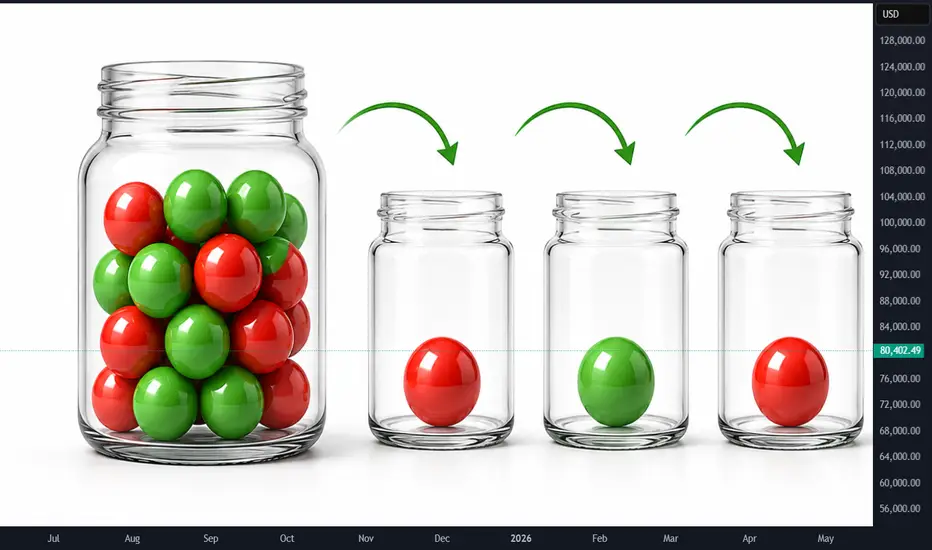
- Focusing on a single instrument with sequential attempts allows for a higher chance of success. Using the “jar of balls” analogy: each draw has a chance to pick a winning ball. Multiple sequential draws increase the likelihood of success.
- In trading, this translates to multiple sequential entries within a short time window, improving the probability of capturing a favorable move without unnecessary risk.
──────────────────────────────
Section 2: Probability Comparison – Jar vs. Strategies
- Jar Analogy:
- Single ball probability per draw: ~50% chance to pick the correct color.
- Probability of failing all three draws: ~12.5%.
- Therefore, probability of winning at least once in three draws: ~87.5%.
- Sequential Trading Strategies:
- First attempt: Strategy signal gives an initial probability of success.
- Second attempt: If the first fails, the second strategy tries again with the same or slightly adjusted signal.
- Third attempt: If the first two fail, the third strategy is applied, completing the sequence.
- Overall insight:
- Even if each strategy has only a moderate chance of success (e.g., 40–50%), the probability of winning at least once over the three attempts is very high—close to 90% or more.
- Failure in one attempt does not prevent success in the next; each attempt is independent but sequenced to maximize the chance of a positive outcome.
- Compared to the jar, trading gives control over strategy selection, timing, and position size, increasing the chance of at least one win beyond pure probability.
- Key takeaway: Using three sequential strategies on the same instrument dramatically increases the likelihood of a successful trade. Even a single win out of three is a significant achievement.
──────────────────────────────
Section 3: Implementation and Feasibility
- The approach begins with a first strategic entry based on a tested signal. This is not theoretical — I have already started implementing it with real data and small-scale tests.
- If the first attempt does not succeed, a second and third sequential entry are executed within the same short time frame, giving the system multiple opportunities to capture a favorable move.
- Even with moderate individual success rates, sequential entries dramatically increase the likelihood of at least one successful trade, as early feasibility checks show.
- Feasibility is supported by control: Unlike a simple jar game, in trading I can adjust risk, exposure, and timing to improve outcomes and adapt to market conditions.
- Initial tests confirm that the system produces consistent signals and sequential attempts increase overall probability of success, demonstrating that this is not only mathematically sound but practically feasible.
- This early performance shows that the strategy has potential to become a reliable, high-probability trading approach, but it still requires careful refinement and community feedback to reach its full potential.
──────────────────────────────
Section 4: Feasibility & Community Support
- Initial feasibility check shows the concept is promising. Further refinement is needed to make it robust.
- You can support by:
- Leaving a comment with your thoughts or suggestions.
- Pressing the rocket icon if you find the idea valuable.
- Following my profile to stay updated on the final indicator.
- Your engagement provides motivation, feedback, and interest that helps me continue development and convert this idea into a professional, reliable trading strategy.
──────────────────────────────
This proposal outlines the approach, probability insights, and how community support can help turn the idea into a fully functional trading strategy.

Wyłączenie odpowiedzialności
Informacje i publikacje nie stanowią i nie powinny być traktowane jako porady finansowe, inwestycyjne, tradingowe ani jakiekolwiek inne rekomendacje dostarczane lub zatwierdzone przez TradingView. Więcej informacji znajduje się w Warunkach użytkowania.
Wyłączenie odpowiedzialności
Informacje i publikacje nie stanowią i nie powinny być traktowane jako porady finansowe, inwestycyjne, tradingowe ani jakiekolwiek inne rekomendacje dostarczane lub zatwierdzone przez TradingView. Więcej informacji znajduje się w Warunkach użytkowania.