
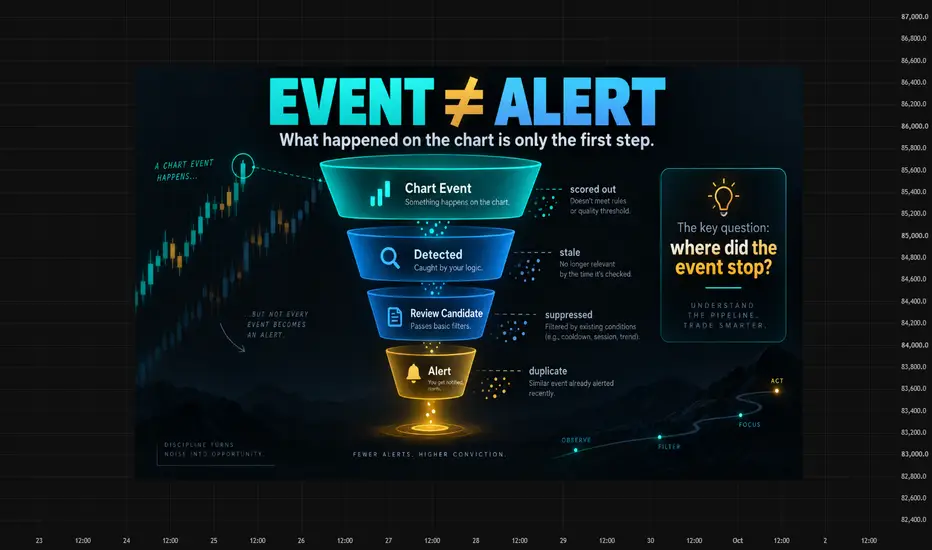
Seeing a structure event on a finished chart does not automatically mean the scanner should have sent an alert.
That sounds obvious once the pipeline is written down, but it is easy to collapse several different stages into one. A BOS, CHoCH, order block or sweep can exist under a defined chart rule without necessarily becoming a delivered review candidate.
The distinction matters because chart event, detection, review candidate and alert are not the same thing.
────────────────────────────
A CHART EVENT IS ONLY THE FIRST STAGE
────────────────────────────
Start with the chart itself. A structure condition exists under a stated rule: perhaps a BOS has confirmed, a CHoCH has appeared, an order block qualifies, or a liquidity event has occurred.
That tells us something about the market structure. It does not yet tell us what the scanner did with that information.
The scanner still has to register the event correctly, determine whether it remains eligible, apply its current scoring and filtering rules, handle duplicates or stale context, and only then decide whether the event reaches the review queue.
So the first useful distinction is simple:
Chart event = the structural condition exists.
Alert = that event survived the rest of the pipeline and was delivered.
────────────────────────────
DETECTION AND DELIVERY ARE DIFFERENT QUESTIONS
────────────────────────────
A cleaner vocabulary helps.
Chart event asks: did the structural condition exist under the rule?
Detection asks: did the scanner actually register that event?
Review candidate asks: after qualification, scoring and other filters, was the event still eligible to surface?
Alert asks: did that candidate survive the remaining suppression, deduplication and delivery logic and actually reach the user?
Those stages matter because a missing alert can have very different explanations depending on where the event stopped progressing.
────────────────────────────
WHY AN EVENT MAY NEVER BECOME AN ALERT
────────────────────────────
A chart event can fail to reach the final stage for legitimate reasons.
It may be detected but fail the current qualification rules. It may score below the delivery threshold. It may be too old by the time the scanner processes it, duplicate something already surfaced, or be intentionally suppressed because another event already represents the same structural context.
There can also be state-related reasons. Restart reconstruction, stale data or incomplete coverage can affect what the scanner knows at a given moment.
The important point is that all of these belong to different stages. Calling every non-alert a “miss” loses useful information.
────────────────────────────
BUT FILTERING SHOULD NOT BECOME AN EXCUSE
────────────────────────────
The opposite mistake is just as dangerous.
If a chart event should have been detected, should have remained eligible and should have survived the current delivery rules, but no alert appeared, that is not something to explain away as “filtering.”
That becomes an investigation.
The useful question is not whether the finished chart looks convincing. It is whether the event progressed through the expected stages under the rules and information available at the time.
If it did not, the reason should be identified rather than guessed.
────────────────────────────
THIS IS WHY RECEIPTS MATTER
────────────────────────────
A useful scanner should eventually be able to explain what happened to a selected event.
For example:
Event existed
→ detected
→ eligible
→ score passed
→ not suppressed
→ delivered
Or:
Event existed
→ detected
→ scored out
Or:
Event existed
→ not detected
Those are very different outcomes, even though all three may look identical to the user who simply asks:
“Why didn’t I get an alert?”
That is why I find the idea of a detector receipt useful. The goal is not to expose every internal field in every message. It is to make the system increasingly able to account for what it did.
────────────────────────────
THE USEFUL QUESTION
────────────────────────────
When a meaningful structure event appears on the chart but no scanner notification follows, I do not think the best question is:
“Why didn’t the scanner see this?”
The better question is:
“At which stage did this event stop progressing?”
Was the event never detected? Was it ineligible? Scored out? Suppressed? Deduplicated? Was there a state or data problem? Or did the scanner behave exactly as designed?
That distinction turns a vague complaint into something that can actually be tested.
A chart event is not an alert. The useful part is being able to explain the path between the two.
Structure observations, not signals.

Wyłączenie odpowiedzialności
Informacje i publikacje nie stanowią i nie powinny być traktowane jako porady finansowe, inwestycyjne, tradingowe ani jakiekolwiek inne rekomendacje dostarczane lub zatwierdzone przez TradingView. Więcej informacji znajduje się w Warunkach użytkowania.
Wyłączenie odpowiedzialności
Informacje i publikacje nie stanowią i nie powinny być traktowane jako porady finansowe, inwestycyjne, tradingowe ani jakiekolwiek inne rekomendacje dostarczane lub zatwierdzone przez TradingView. Więcej informacji znajduje się w Warunkach użytkowania.