
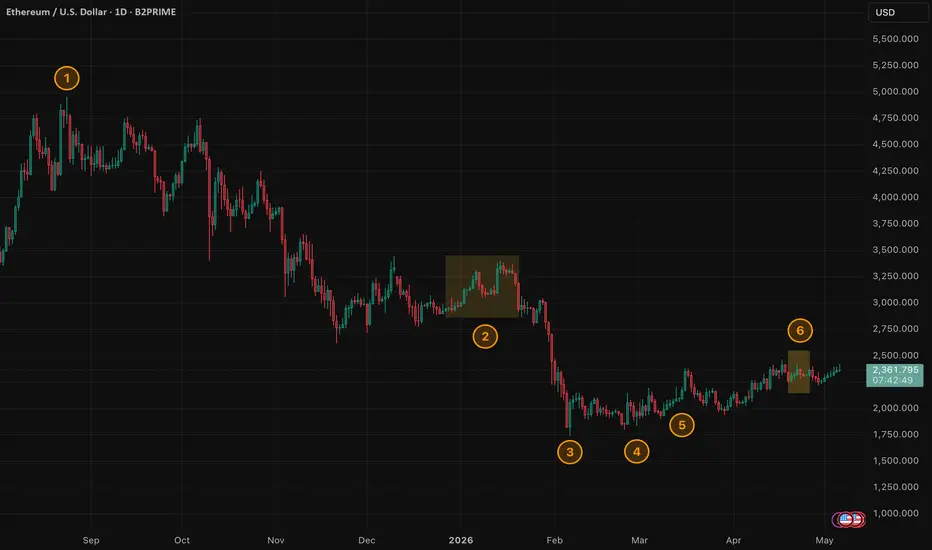
Ethereum entered 2026 with more institutional backing than at any point in its history - spot ETFs, staking products, corporate treasuries, and a tokenization thesis backed by BlackRock. It then fell 47% from its January high to a February trough of $1,840. The pattern captures ETH's dual nature: it carries one of the more frequently cited structural cases in digital assets, and one of the most volatile short-term price profiles.
Price: The Year So Far
Aug 24, 2025 — ATH: $4,952. All-time high driven by ETF inflows and corporate treasury accumulation.
Early Jan 2026 — ~$3,400–$3,500. Brief recovery alongside Bitcoin. ETH starts year on fragile footing.
Feb 6, 2026 — Low: ~$1,755. Steepest weekly decline of the year. BTC drops below $71K; ETH falls harder.
Feb 28, 2026 — ~$1,840. US-Israel operation against Iran begins. ETH drops alongside BTC as crypto is the only liquid weekend market. Possible cycle low.
Mar 12, 2026 — ~$2,200. BlackRock launches ETHB — first staked Ethereum ETF on Nasdaq.
Apr 20–26, 2026 — $2,300–$2,350. Trump extends Iran ceasefire. ETH rises with BTC. Ethereum Foundation stakes 70,000 ETH.
Dependent on Bitcoin and the Geopolitical Mood
Geopolitical events have reinforced this throughout 2026. When the US-Israel operation against Iran began on February 28 - a Saturday, with traditional markets closed - ETH dropped alongside BTC as crypto was the only available liquid asset. Several ceasefire announcements in April appeared to coincide with coordinated rallies in both assets.. Periods of failed negotiations generally coincided with simultaneous reversals in both assets.. ETH has often moved in the same direction as BTC, just with greater amplitude in both directions.
The Corporate Treasury Wave
A notable structural development in Ethereum's 2026 story is the emergence of publicly listed companies holding ETH as their primary treasury asset - modelled on Strategy's Bitcoin playbook, but with a yield twist: staking the holdings to generate income while providing shareholders leveraged ETH exposure through equity.
Bitmine Immersion Technologies (NASDAQ: BMNR), holds approximately 4.976 million ETH - around 4.12% of total circulating supply - with 73% of it staked, generating an estimated $264 million in annualized staking revenue. The company has continued buying through the drawdown despite sitting on substantial unrealized losses, adding over 100,000 ETH in a single week in late April 2026.
SharpLink Gaming (NASDAQ: SBET), holds approximately 740,760 ETH (~$3.15 billion). It pivoted from sports betting marketing in May 2025 following a $425 million investment round led by Consensys. Around 14 publicly listed companies now hold ETH in their corporate treasuries.
The collective effect is structural supply compression. Approximately 30% of total ETH supply is staked and locked across the network. The proportion of ETH sitting on exchanges available for trading has dropped to its lowest level since 2016. Every ETH committed to a corporate treasury or staking contract is removed from the liquid float - this dynamic may provide some degree of support to the price, though market conditions and sentiment can still drive significant downside.
Beyond ETFs, Ethereum is the primary infrastructure for the tokenization of real-world assets - the process of representing stocks, bonds, real estate, and funds as on-chain tokens. Goldman Sachs is building parallel infrastructure through GS DAP. BNP Paribas has issued a tokenized money market fund on Ethereum. Ethereum currently processes more tokenized assets than any competing network.
Price Forecasts for 2026
Standard Chartered — $7,500. Revised down from $12,000 in Jan 2026; corporate treasuries absorbing ~3.8% of supply.
Fundstrat — $7,000–$9,000. ETH as settlement layer for tokenized securities; BlackRock and Robinhood integrating on-chain settlement.
Arthur Hayes — $10,000. Price discovery following bear market; ETH as financial infrastructure layer.
CoinShares — $4,500–$4,900. Conservative base; L2 fee compression a headwind, ETF-driven recovery in H2 2026.
CoinCodex — $2,200–$3,900 range. Post-halving dynamics and ETF flows; 200-day MA at $2,345 the key technical line.
The above price targets are analyst projections published by third parties and are reproduced for informational purposes only. They do not constitute investment advice or a recommendation to buy, sell, or hold any asset. Forecasts may not be achieved.
Key Risks
Layer-2 fee compression. Ethereum's mainnet fee revenue faces structural pressure from cheaper Layer-2 networks (Base, Arbitrum, Linea) that handle transactions at a fraction of mainnet cost, reducing the economic demand for ETH as a gas token. The upcoming Glamsterdam protocol upgrade aims to partially address this.
Concentration risk. With Bitmine alone targeting 5% of total supply, and ~30% already staked, Vitalik Buterin has flagged concentrated staking as a potential systemic risk. A forced unwind by a large corporate holder would create significant supply-side pressure.
Regulatory uncertainty. The Clarity Act - establishing a digital asset market-structure framework - has stalled in Congress. Staking tax treatment remains unresolved, creating friction for institutional participants. The SEC-CFTC resolved ETH's regulatory classification in March 2026, a positive step, but broader clarity may not arrive until late 2026.
For educational purposes only - not investment advice.
Past performance is not indicative of future results. The value of investments may fall as well as rise.
This content contains forward-looking statements that involve risks and uncertainties. Actual results may differ materially from those anticipated. Forward-looking statements are based on current expectations and assumptions that are subject to change.
Price: The Year So Far
Aug 24, 2025 — ATH: $4,952. All-time high driven by ETF inflows and corporate treasury accumulation.
Early Jan 2026 — ~$3,400–$3,500. Brief recovery alongside Bitcoin. ETH starts year on fragile footing.
Feb 6, 2026 — Low: ~$1,755. Steepest weekly decline of the year. BTC drops below $71K; ETH falls harder.
Feb 28, 2026 — ~$1,840. US-Israel operation against Iran begins. ETH drops alongside BTC as crypto is the only liquid weekend market. Possible cycle low.
Mar 12, 2026 — ~$2,200. BlackRock launches ETHB — first staked Ethereum ETF on Nasdaq.
Apr 20–26, 2026 — $2,300–$2,350. Trump extends Iran ceasefire. ETH rises with BTC. Ethereum Foundation stakes 70,000 ETH.
Dependent on Bitcoin and the Geopolitical Mood
Geopolitical events have reinforced this throughout 2026. When the US-Israel operation against Iran began on February 28 - a Saturday, with traditional markets closed - ETH dropped alongside BTC as crypto was the only available liquid asset. Several ceasefire announcements in April appeared to coincide with coordinated rallies in both assets.. Periods of failed negotiations generally coincided with simultaneous reversals in both assets.. ETH has often moved in the same direction as BTC, just with greater amplitude in both directions.
The Corporate Treasury Wave
A notable structural development in Ethereum's 2026 story is the emergence of publicly listed companies holding ETH as their primary treasury asset - modelled on Strategy's Bitcoin playbook, but with a yield twist: staking the holdings to generate income while providing shareholders leveraged ETH exposure through equity.
Bitmine Immersion Technologies (NASDAQ: BMNR), holds approximately 4.976 million ETH - around 4.12% of total circulating supply - with 73% of it staked, generating an estimated $264 million in annualized staking revenue. The company has continued buying through the drawdown despite sitting on substantial unrealized losses, adding over 100,000 ETH in a single week in late April 2026.
SharpLink Gaming (NASDAQ: SBET), holds approximately 740,760 ETH (~$3.15 billion). It pivoted from sports betting marketing in May 2025 following a $425 million investment round led by Consensys. Around 14 publicly listed companies now hold ETH in their corporate treasuries.
The collective effect is structural supply compression. Approximately 30% of total ETH supply is staked and locked across the network. The proportion of ETH sitting on exchanges available for trading has dropped to its lowest level since 2016. Every ETH committed to a corporate treasury or staking contract is removed from the liquid float - this dynamic may provide some degree of support to the price, though market conditions and sentiment can still drive significant downside.
Beyond ETFs, Ethereum is the primary infrastructure for the tokenization of real-world assets - the process of representing stocks, bonds, real estate, and funds as on-chain tokens. Goldman Sachs is building parallel infrastructure through GS DAP. BNP Paribas has issued a tokenized money market fund on Ethereum. Ethereum currently processes more tokenized assets than any competing network.
Price Forecasts for 2026
Standard Chartered — $7,500. Revised down from $12,000 in Jan 2026; corporate treasuries absorbing ~3.8% of supply.
Fundstrat — $7,000–$9,000. ETH as settlement layer for tokenized securities; BlackRock and Robinhood integrating on-chain settlement.
Arthur Hayes — $10,000. Price discovery following bear market; ETH as financial infrastructure layer.
CoinShares — $4,500–$4,900. Conservative base; L2 fee compression a headwind, ETF-driven recovery in H2 2026.
CoinCodex — $2,200–$3,900 range. Post-halving dynamics and ETF flows; 200-day MA at $2,345 the key technical line.
The above price targets are analyst projections published by third parties and are reproduced for informational purposes only. They do not constitute investment advice or a recommendation to buy, sell, or hold any asset. Forecasts may not be achieved.
Key Risks
Layer-2 fee compression. Ethereum's mainnet fee revenue faces structural pressure from cheaper Layer-2 networks (Base, Arbitrum, Linea) that handle transactions at a fraction of mainnet cost, reducing the economic demand for ETH as a gas token. The upcoming Glamsterdam protocol upgrade aims to partially address this.
Concentration risk. With Bitmine alone targeting 5% of total supply, and ~30% already staked, Vitalik Buterin has flagged concentrated staking as a potential systemic risk. A forced unwind by a large corporate holder would create significant supply-side pressure.
Regulatory uncertainty. The Clarity Act - establishing a digital asset market-structure framework - has stalled in Congress. Staking tax treatment remains unresolved, creating friction for institutional participants. The SEC-CFTC resolved ETH's regulatory classification in March 2026, a positive step, but broader clarity may not arrive until late 2026.
For educational purposes only - not investment advice.
Past performance is not indicative of future results. The value of investments may fall as well as rise.
This content contains forward-looking statements that involve risks and uncertainties. Actual results may differ materially from those anticipated. Forward-looking statements are based on current expectations and assumptions that are subject to change.

Wyłączenie odpowiedzialności
Informacje i publikacje nie stanowią i nie powinny być traktowane jako porady finansowe, inwestycyjne, tradingowe ani jakiekolwiek inne rekomendacje dostarczane lub zatwierdzone przez TradingView. Więcej informacji znajduje się w Warunkach użytkowania.
Wyłączenie odpowiedzialności
Informacje i publikacje nie stanowią i nie powinny być traktowane jako porady finansowe, inwestycyjne, tradingowe ani jakiekolwiek inne rekomendacje dostarczane lub zatwierdzone przez TradingView. Więcej informacji znajduje się w Warunkach użytkowania.