
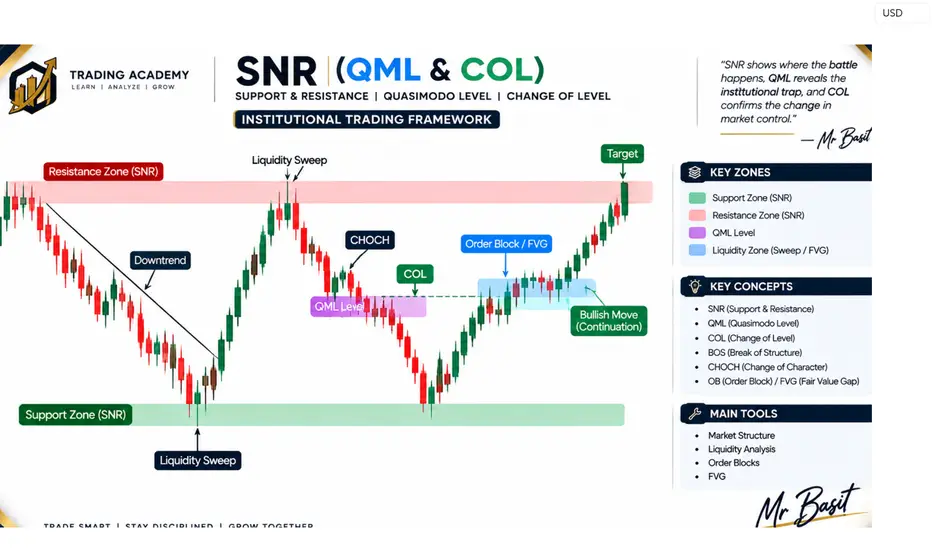
The SNR Model (Support & Resistance) with QML (Quasimodo Level) and COL (Change of Level) is an advanced price-action framework used to identify high-probability reversal and continuation zones.
Traditional traders see support and resistance as simple lines, but professional traders understand them as institutional decision areas where liquidity, order flow, and market structure interact.
The combination of SNR + QML + COL helps traders identify where smart money may enter, exit, or reverse the market.
1. Support & Resistance (SNR) Foundation
Support Zone (Demand Area)
Support is a zone where buyers become stronger than sellers.
Institutional traders look for:
Previous strong reactions
Liquidity below lows
Demand imbalance
Order accumulation areas
A strong support zone usually creates a powerful bullish move after rejection.
Professional Confirmation:
Support + Liquidity Sweep + Market Structure Shift = High Probability Buy
Resistance Zone (Supply Area)
Resistance is a zone where sellers become stronger than buyers.
Institutions may use these areas to distribute positions.
Look for:
Previous rejection
Liquidity above highs
Supply imbalance
Strong bearish reaction
Professional Confirmation:
Resistance + Liquidity Sweep + Bearish Structure Shift = High Probability Sell
2. QML (Quasimodo Level) Model
What Is QML?
QML is an advanced reversal pattern that identifies a potential institutional trap before a major market reversal.
It is based on a change in market structure where the market creates a unique high or low before reversing.
Bullish QML Setup
Formation:
1. Market creates a lower low
2. Price makes a higher high
3. Price returns and creates a new lower low
4. The previous high becomes the QML neckline
5. Price returns to QML zone
6. Bullish reversal begins
Entry Confirmation:
✓ QML level
✓ Liquidity sweep
✓ Bullish CHOCH
✓ BOS confirmation
✓ Order Block / FVG reaction
Bearish QML Setup
Formation:
1. Market creates a higher high
2. Price creates a lower low
3. Market makes another higher high
4. Previous low becomes QML neckline
5. Price returns to QML zone
6. Bearish reversal begins
Entry Confirmation:
✓ QML resistance
✓ Buy-side liquidity sweep
✓ Bearish CHOCH
✓ BOS confirmation
✓ Supply zone reaction
3. COL (Change of Level) Concept
COL represents the moment when an important support or resistance level changes its role.
Support Becomes Resistance
Example:
Strong support breaks
Price moves below the zone
Retest happens
Previous support becomes new resistance
This indicates seller control.
Resistance Becomes Support
Example:
Resistance breaks
Price returns to the level
Buyers defend the area
This indicates buyer strength.
4. SNR + QML + COL Trading Model
The strongest setups happen when multiple confirmations align:
Higher Timeframe SNR Zone
↓
Liquidity Sweep
↓
QML Formation
↓
COL Confirmation
↓
CHOCH/BOS
↓
OB/FVG Entry
This creates a professional institutional trading setup.
5. Multi-Timeframe Analysis
Higher Timeframe (Direction)
Use:
Weekly
Daily
4H
Find:
Major SNR zones
QML areas
Liquidity targets
Entry Timeframe
Use:
1H
15M
5M
Confirm:
COL reaction
CHOCH
BOS
Order Block
FVG
6. Risk Management Rules
Even the best SNR/QML setup needs discipline.
Professional rules:
Risk only 1–2% per trade
Place Stop Loss beyond invalidation zone
Target opposite liquidity
Maintain minimum 1:2 risk-reward
Avoid entering without confirmation
Final Institutional Concept
SNR shows where the battle happens, QML reveals the institutional trap, and COL confirms the change in market control."
The highest probability trades come when:
SNR + QML + COL + Liquidity + Market Structure
align together.
A professional trader does not trade levels blindly; they wait for the market to show who is in control.
For the next chart, should I make QML + COL bullish setup or bearish setup?
Uwaga
Education Note — SNR + QML + COLSupport & Resistance should not be treated as simple lines. They are areas where price may react because of liquidity, order flow and previous market structure.
QML (Quasimodo Level) helps identify potential reversal zones after a structural imbalance. COL (Change of Level) adds confirmation by showing how a previous support or resistance can change its role after a decisive break.
A high-quality setup comes from confluence, not from one level alone:
SNR + Liquidity Sweep + QML/COL + Market Structure Shift = Stronger Confirmation
For a buy, look for price reaching a meaningful support/demand area, sweeping liquidity below a previous low, then showing bullish structure confirmation.
For a sell, look for resistance/supply, liquidity above previous highs, followed by bearish structure confirmation.
The key lesson is wait for price to prove the reaction. Do not enter simply because price touches support or resistance. Always define the invalidation level, manage risk, and avoid forcing trades when the structure is unclear.
Trade the reaction, not the level.

Powiązane publikacje
Wyłączenie odpowiedzialności
Informacje i publikacje nie stanowią i nie powinny być traktowane jako porady finansowe, inwestycyjne, tradingowe ani jakiekolwiek inne rekomendacje dostarczane lub zatwierdzone przez TradingView. Więcej informacji znajduje się w Warunkach użytkowania.