
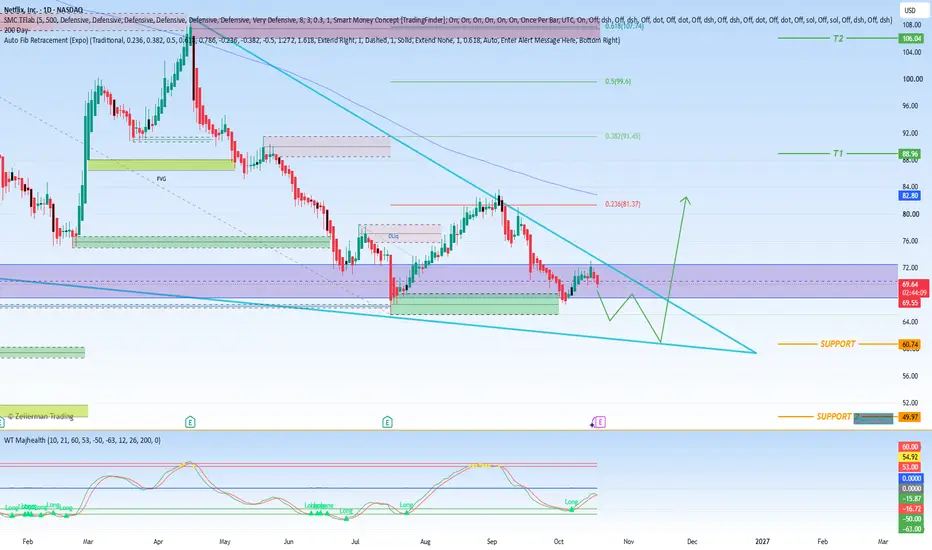
Seaport Research lowered its Netflix price target to $90 from $102 on October 18, 2026, while reiterating a Buy rating ahead of the company's third-quarter earnings report, scheduled for October 20 . The cut is not an isolated move. It adds to a series of reductions by analysts covering Netflix this month, including Wedbush, KeyBanc, Morgan Stanley, Barclays, and Huber Research .
The firm's message is nuanced: Netflix shares appear oversold relative to the company's long-term growth prospects, but the company is now in a "show-me," wait-and-see period in which investors will demand clearer evidence that its growth story can deliver . That framing makes Tuesday's earnings report and management commentary unusually important catalysts.
The "Show-Me" Thesis: Why Seaport Cut but Stayed Bullish
Seaport analyst David Joyce's position captures the tension running through Netflix's investor base. On one hand, the stock has fallen far enough that the long-term risk-reward looks attractive. On the other hand, the near-term narrative is unresolved. Netflix has to prove something—about engagement, about advertising, about its ability to reaccelerate growth—before the market is willing to pay up again .
The stock traded at $70.53** at the October 16 close, down **2.86%** for the day and well below its 52-week high of **$124.86 . Retail sentiment on Stocktwits shifted to "bearish" from "neutral" over the past day, with chatter remaining at normal levels . The options market is pricing a 9.3% move in either direction around earnings, above the typical post-earnings swing .
The consensus price target across 52 analysts sits at approximately **$91.39**, implying roughly **29.6% upside** from the October 16 close . Seaport's $90 target is therefore slightly below consensus, not an outlier—it reflects the broader recalibration of expectations rather than a uniquely bearish view.
Wedbush's Parallel Cut: Engagement Is the Central Concern
Wedbush made a nearly identical move last week, lowering its Netflix price target to $90 from $105 while maintaining an Outperform rating . The firm identified user engagement as the central concern underpinning the bearish case against Netflix. That is not a new worry, but it has become the organizing principle for how analysts are thinking about the stock.
Wedbush also pointed to the content leadership change as a potential positive catalyst. The firm argued that the reshuffle could help address engagement concerns and redirect spending from heavy infrastructure investments toward more focused content spending . In other words, the leadership change is being read not as a sign of crisis but as a sign that management recognizes the problem and is reallocating resources accordingly.
Wedbush also highlighted advertising revenue, which it expects to reach roughly $3 billion by year-end, doubling from the previous year . That figure aligns with Netflix's own guidance. The ad tier is expected to have been the standout driver in Q3, with U.S. upfront commitments nearly doubling year-over-year and programmatic access expanding through Google's Display & Video 360, Amazon, Yahoo, and The Trade Desk . However, the ad-tier expansion into nine EMEA countries does not begin until March 2027, limiting near-term contribution, and advertising remains a small portion of total revenue .
The Content Leadership Shuffle: Bajaria Out, Rice In
Netflix announced on October 15 that Bela Bajaria, chief content officer since 2023, would step down immediately, and that Peter Rice, a former Disney and Fox executive, would take over the role effective October 26 .
Bajaria had been at Netflix for nearly a decade and oversaw its global film and television slate since 2023. Her departure came one day after Netflix announced it would cut 6% of its staff, or roughly 1,000 jobs—its largest round of layoffs since 2022 . The layoffs affected product, technology, legal, and human resources teams, with co-CEOs Greg Peters and Ted Sarandos telling employees that the company needed to be "disciplined about where we prioritize our people and resources" .
Rice spent roughly three decades at Fox before joining Disney after its acquisition of most of Fox's entertainment assets in 2019. He oversaw Disney's television operations, including ABC, FX, Hulu, and its television studios, before leaving in 2022 . Sarandos praised him as "one of the most effective at-scale operators in the entertainment industry," citing his sharp business acumen, strong talent relationships, and deep experience across both TV and film .
The context for the shake-up is not flattering. Netflix's share price has fallen nearly 40% over the past year . Sarandos said at a Bloomberg conference in September that "overall, we're not growing as fast as I want us to, and we're working on making that move faster" . Netflix has struggled to find another giant global hit since Stranger Things wrapped up, and its share of U.S. television viewing time has dropped while YouTube's has increased, according to Nielsen .
The leadership change is therefore a bet that Rice can do what Bajaria could not: restore momentum in the content slate, particularly in the United States, and translate that into engagement that justifies the valuation.
The Layoffs: Cost Discipline or Admission of Slowing Growth?
The decision to cut 1,000 jobs—approximately 6% of the workforce—is the largest round since 2022, when Netflix eliminated roughly 450 positions after losing subscribers for the first time in over a decade . The affected departments are product, technology, legal, and HR, not content. That distribution suggests the cuts are aimed at overhead and infrastructure rather than creative output.
Peters and Sarandos said in the company-wide email that Netflix remained on track to meet its full-year forecast and would continue to "invest aggressively in high-impact areas" . The stock rose about 1% after the layoff news broke, a muted reaction that suggests investors viewed the cuts as prudent rather than alarming .
But the layoffs also fit the broader "show-me" narrative. A company that is growing as fast as it wants does not typically eliminate 6% of its workforce. The cuts are a signal that management is prioritizing margin discipline while it works to fix the growth trajectory.
What Earnings on October 20 Needs to Show
Netflix reports Q3 2026 results after the closing bell on Tuesday, October 20 . Management has guided revenues of $12.86 billion**, implying roughly **12% year-over-year growth** (11% on a foreign-exchange-neutral basis), with adjusted EPS projected at **82 cents** and net income at **$3.45 billion . The full-year revenue outlook is $51 billion to $51.4 billion, with a 31.5% operating margin .
The key questions investors will be asking:
Engagement metrics. First-half view hours grew only 2%, highlighting the competition for viewer attention from YouTube, Disney+, and Amazon Prime Video . Any acceleration or deceleration in that figure will be scrutinized as evidence of whether the content slate is working.
Advertising traction. The $3 billion ad revenue target for 2026 is the most concrete growth lever outside of subscriptions. Upfront commitments and programmatic expansion are the leading indicators, but the actual Q3 ad revenue figure will matter more than the guidance .
Management commentary on 2027. With the leadership change and layoffs fresh, investors will want to hear how Rice plans to approach the content slate and whether management sees a path to reaccelerating engagement .
Pricing power. Netflix has raised prices in the U.S., Mexico, and Spain, and the UCAN segment benefited from a full quarter of the U.S. price increase . But Huber Research downgraded the stock to Underweight with a $70 target, citing declining viewing time per subscriber and reduced room for additional U.S. price increases after recent hikes . If management signals that further pricing action is limited, the growth algorithm becomes harder to sustain.
Bottom Line
Netflix is not a broken business. It generated $48.37 billion in trailing revenue**, **$13.65 billion in net income, and a 22.2x trailing P/E—hardly the profile of a company in distress . The consensus rating remains Buy, and the average target implies nearly 30% upside .
But the stock is in a prove-it phase. The Seaport and Wedbush target cuts to $90, the layoffs, the content leadership change, and the shift in retail sentiment all point to the same conclusion: investors are no longer willing to give Netflix the benefit of the doubt on growth. They want to see engagement stabilize, advertising scale, and the new content leadership deliver results before they bid the stock back toward its former highs.
Tuesday's earnings report is the first real test of whether the "show-me" period ends with evidence or extends into another quarter of waiting. Seaport's $90 target implies roughly 28% upside from the current price—a meaningful gap that reflects genuine uncertainty rather than conviction in either direction. For investors, the question is whether they believe Netflix can show enough on October 20 to close that gap, or whether the waiting period has further to run.
The firm's message is nuanced: Netflix shares appear oversold relative to the company's long-term growth prospects, but the company is now in a "show-me," wait-and-see period in which investors will demand clearer evidence that its growth story can deliver . That framing makes Tuesday's earnings report and management commentary unusually important catalysts.
The "Show-Me" Thesis: Why Seaport Cut but Stayed Bullish
Seaport analyst David Joyce's position captures the tension running through Netflix's investor base. On one hand, the stock has fallen far enough that the long-term risk-reward looks attractive. On the other hand, the near-term narrative is unresolved. Netflix has to prove something—about engagement, about advertising, about its ability to reaccelerate growth—before the market is willing to pay up again .
The stock traded at $70.53** at the October 16 close, down **2.86%** for the day and well below its 52-week high of **$124.86 . Retail sentiment on Stocktwits shifted to "bearish" from "neutral" over the past day, with chatter remaining at normal levels . The options market is pricing a 9.3% move in either direction around earnings, above the typical post-earnings swing .
The consensus price target across 52 analysts sits at approximately **$91.39**, implying roughly **29.6% upside** from the October 16 close . Seaport's $90 target is therefore slightly below consensus, not an outlier—it reflects the broader recalibration of expectations rather than a uniquely bearish view.
Wedbush's Parallel Cut: Engagement Is the Central Concern
Wedbush made a nearly identical move last week, lowering its Netflix price target to $90 from $105 while maintaining an Outperform rating . The firm identified user engagement as the central concern underpinning the bearish case against Netflix. That is not a new worry, but it has become the organizing principle for how analysts are thinking about the stock.
Wedbush also pointed to the content leadership change as a potential positive catalyst. The firm argued that the reshuffle could help address engagement concerns and redirect spending from heavy infrastructure investments toward more focused content spending . In other words, the leadership change is being read not as a sign of crisis but as a sign that management recognizes the problem and is reallocating resources accordingly.
Wedbush also highlighted advertising revenue, which it expects to reach roughly $3 billion by year-end, doubling from the previous year . That figure aligns with Netflix's own guidance. The ad tier is expected to have been the standout driver in Q3, with U.S. upfront commitments nearly doubling year-over-year and programmatic access expanding through Google's Display & Video 360, Amazon, Yahoo, and The Trade Desk . However, the ad-tier expansion into nine EMEA countries does not begin until March 2027, limiting near-term contribution, and advertising remains a small portion of total revenue .
The Content Leadership Shuffle: Bajaria Out, Rice In
Netflix announced on October 15 that Bela Bajaria, chief content officer since 2023, would step down immediately, and that Peter Rice, a former Disney and Fox executive, would take over the role effective October 26 .
Bajaria had been at Netflix for nearly a decade and oversaw its global film and television slate since 2023. Her departure came one day after Netflix announced it would cut 6% of its staff, or roughly 1,000 jobs—its largest round of layoffs since 2022 . The layoffs affected product, technology, legal, and human resources teams, with co-CEOs Greg Peters and Ted Sarandos telling employees that the company needed to be "disciplined about where we prioritize our people and resources" .
Rice spent roughly three decades at Fox before joining Disney after its acquisition of most of Fox's entertainment assets in 2019. He oversaw Disney's television operations, including ABC, FX, Hulu, and its television studios, before leaving in 2022 . Sarandos praised him as "one of the most effective at-scale operators in the entertainment industry," citing his sharp business acumen, strong talent relationships, and deep experience across both TV and film .
The context for the shake-up is not flattering. Netflix's share price has fallen nearly 40% over the past year . Sarandos said at a Bloomberg conference in September that "overall, we're not growing as fast as I want us to, and we're working on making that move faster" . Netflix has struggled to find another giant global hit since Stranger Things wrapped up, and its share of U.S. television viewing time has dropped while YouTube's has increased, according to Nielsen .
The leadership change is therefore a bet that Rice can do what Bajaria could not: restore momentum in the content slate, particularly in the United States, and translate that into engagement that justifies the valuation.
The Layoffs: Cost Discipline or Admission of Slowing Growth?
The decision to cut 1,000 jobs—approximately 6% of the workforce—is the largest round since 2022, when Netflix eliminated roughly 450 positions after losing subscribers for the first time in over a decade . The affected departments are product, technology, legal, and HR, not content. That distribution suggests the cuts are aimed at overhead and infrastructure rather than creative output.
Peters and Sarandos said in the company-wide email that Netflix remained on track to meet its full-year forecast and would continue to "invest aggressively in high-impact areas" . The stock rose about 1% after the layoff news broke, a muted reaction that suggests investors viewed the cuts as prudent rather than alarming .
But the layoffs also fit the broader "show-me" narrative. A company that is growing as fast as it wants does not typically eliminate 6% of its workforce. The cuts are a signal that management is prioritizing margin discipline while it works to fix the growth trajectory.
What Earnings on October 20 Needs to Show
Netflix reports Q3 2026 results after the closing bell on Tuesday, October 20 . Management has guided revenues of $12.86 billion**, implying roughly **12% year-over-year growth** (11% on a foreign-exchange-neutral basis), with adjusted EPS projected at **82 cents** and net income at **$3.45 billion . The full-year revenue outlook is $51 billion to $51.4 billion, with a 31.5% operating margin .
The key questions investors will be asking:
Engagement metrics. First-half view hours grew only 2%, highlighting the competition for viewer attention from YouTube, Disney+, and Amazon Prime Video . Any acceleration or deceleration in that figure will be scrutinized as evidence of whether the content slate is working.
Advertising traction. The $3 billion ad revenue target for 2026 is the most concrete growth lever outside of subscriptions. Upfront commitments and programmatic expansion are the leading indicators, but the actual Q3 ad revenue figure will matter more than the guidance .
Management commentary on 2027. With the leadership change and layoffs fresh, investors will want to hear how Rice plans to approach the content slate and whether management sees a path to reaccelerating engagement .
Pricing power. Netflix has raised prices in the U.S., Mexico, and Spain, and the UCAN segment benefited from a full quarter of the U.S. price increase . But Huber Research downgraded the stock to Underweight with a $70 target, citing declining viewing time per subscriber and reduced room for additional U.S. price increases after recent hikes . If management signals that further pricing action is limited, the growth algorithm becomes harder to sustain.
Bottom Line
Netflix is not a broken business. It generated $48.37 billion in trailing revenue**, **$13.65 billion in net income, and a 22.2x trailing P/E—hardly the profile of a company in distress . The consensus rating remains Buy, and the average target implies nearly 30% upside .
But the stock is in a prove-it phase. The Seaport and Wedbush target cuts to $90, the layoffs, the content leadership change, and the shift in retail sentiment all point to the same conclusion: investors are no longer willing to give Netflix the benefit of the doubt on growth. They want to see engagement stabilize, advertising scale, and the new content leadership deliver results before they bid the stock back toward its former highs.
Tuesday's earnings report is the first real test of whether the "show-me" period ends with evidence or extends into another quarter of waiting. Seaport's $90 target implies roughly 28% upside from the current price—a meaningful gap that reflects genuine uncertainty rather than conviction in either direction. For investors, the question is whether they believe Netflix can show enough on October 20 to close that gap, or whether the waiting period has further to run.

Wyłączenie odpowiedzialności
Informacje i publikacje nie stanowią i nie powinny być traktowane jako porady finansowe, inwestycyjne, tradingowe ani jakiekolwiek inne rekomendacje dostarczane lub zatwierdzone przez TradingView. Więcej informacji znajduje się w Warunkach użytkowania.
Wyłączenie odpowiedzialności
Informacje i publikacje nie stanowią i nie powinny być traktowane jako porady finansowe, inwestycyjne, tradingowe ani jakiekolwiek inne rekomendacje dostarczane lub zatwierdzone przez TradingView. Więcej informacji znajduje się w Warunkach użytkowania.