
SpaceX (SPCX) : Wall Street’s New Rising Star
Fundamental Analysis
SpaceX shares, listed on the Nasdaq under the ticker symbol SPCX, recently made history on June 12, 2026, as the largest IPO deal in global stock market history, far surpassing the previous record held by Saudi Aramco.
The sharp rise in SpaceX’s share price was mainly driven by four key factors:
1. It was a long-awaited IPO, as SpaceX has exposure to rockets, Starlink, satellites, and the broader AI/space economy theme.
2. Elon Musk’s name commands a high premium, with many investors viewing the stock as a long-term bet on the future.
3. The limited free float and relatively low number of tradable shares allowed buying pressure to push the price higher more easily.
4. Options trading has just begun and has been highly active. Reuters reported that SpaceX options saw around 1.8 million contracts traded on the first day, a very high volume, with call options outnumbering put options, reflecting strong short-term bullish sentiment.
With the stock already trading at a high level, is there still an opportunity? Let’s look at the life cycle of a mega IPO stock.
The key factor to consider is the life cycle of a mega IPO stock.
1. The FOMO Phase and Forced Buying by Funds
First 1–3 months
During the first one to three months, the share price often stays high or becomes highly volatile. A key driver is the possibility of fast-track inclusion in major indices, such as the S&P 500 or Nasdaq 100, forcing passive funds to buy the stock to match the index.
This is often supported by retail FOMO buying, which can keep momentum strong and allow the share price to rise further for a while.
2. The Critical Test: Lock-up Expiry
3–6 months after IPO
This is usually the riskiest phase for IPO stocks. Once the lock-up period expires, early shareholders, such as founders, VC funds, and employees with low share costs, can sell their shares for the first time.
Most mega IPO stocks tend to face heavy profit-taking during this period, which can trigger a sharp price correction.
3. Returning to Reality
After one year onward: Reality Check
The IPO hype gradually fades, and investors shift their focus from the “dream” to financial results and earnings.
If the company cannot deliver revenue growth or profitability that justifies its valuation, the stock may face selling pressure, including from short sellers, pushing it closer to fair value.
Case Studies
Facebook (Meta), IPO in 2012:
Facebook IPOed in 2012 with high expectations, but weak mobile ad monetization sent its share price down more than 50% within months, before Mark Zuckerberg eventually proved the business model and drove a long-term recovery.
Saudi Aramco, IPO in 2019:
Saudi Aramco was once the world’s largest IPO, but its share price still followed fundamentals, especially global oil prices, rather than rising without limits.
Fundamental Outlook
In the short term: SpaceX (SPCX), which is still in its first week of trading, is likely still in Stage 1 and may continue to benefit from expectations, liquidity, and FOMO-driven momentum.
In the long term: The stock’s valuation will depend on actual earnings, profitability, and the company’s ability to execute in line with market expectations. These factors will ultimately determine its true value.
Technical Analysis
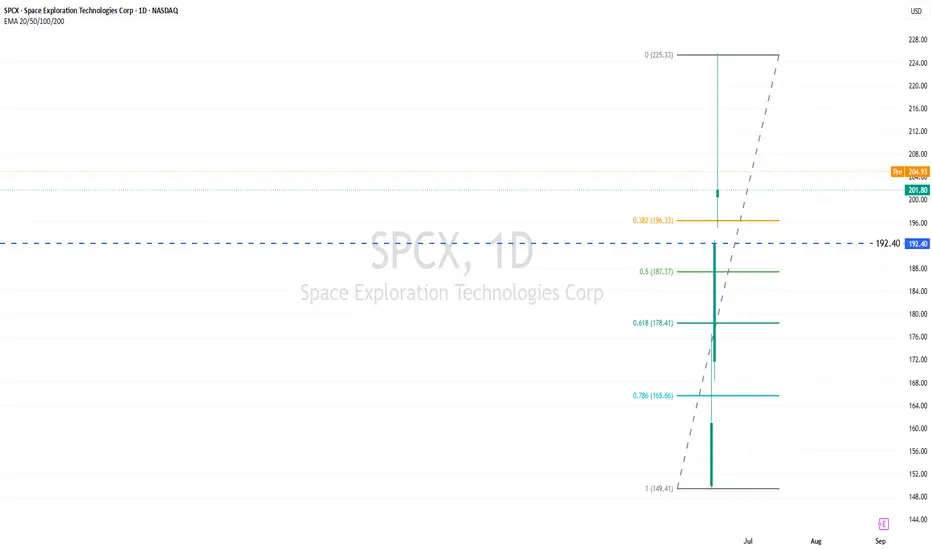
After a sharp rising, SPCX may pull back to fill the gap around 192.40 before continuing higher in line with the prevailing momentum.
If SPCX can hold above the 61.8% Fibonacci Retracement at 178.41, it may move sideways and consolidate before continuing its upward move.
Analysis by: Krisada Yoonaisil, Financial Markets Strategist at Exness
Fundamental Analysis
SpaceX shares, listed on the Nasdaq under the ticker symbol SPCX, recently made history on June 12, 2026, as the largest IPO deal in global stock market history, far surpassing the previous record held by Saudi Aramco.
The sharp rise in SpaceX’s share price was mainly driven by four key factors:
1. It was a long-awaited IPO, as SpaceX has exposure to rockets, Starlink, satellites, and the broader AI/space economy theme.
2. Elon Musk’s name commands a high premium, with many investors viewing the stock as a long-term bet on the future.
3. The limited free float and relatively low number of tradable shares allowed buying pressure to push the price higher more easily.
4. Options trading has just begun and has been highly active. Reuters reported that SpaceX options saw around 1.8 million contracts traded on the first day, a very high volume, with call options outnumbering put options, reflecting strong short-term bullish sentiment.
With the stock already trading at a high level, is there still an opportunity? Let’s look at the life cycle of a mega IPO stock.
The key factor to consider is the life cycle of a mega IPO stock.
1. The FOMO Phase and Forced Buying by Funds
First 1–3 months
During the first one to three months, the share price often stays high or becomes highly volatile. A key driver is the possibility of fast-track inclusion in major indices, such as the S&P 500 or Nasdaq 100, forcing passive funds to buy the stock to match the index.
This is often supported by retail FOMO buying, which can keep momentum strong and allow the share price to rise further for a while.
2. The Critical Test: Lock-up Expiry
3–6 months after IPO
This is usually the riskiest phase for IPO stocks. Once the lock-up period expires, early shareholders, such as founders, VC funds, and employees with low share costs, can sell their shares for the first time.
Most mega IPO stocks tend to face heavy profit-taking during this period, which can trigger a sharp price correction.
3. Returning to Reality
After one year onward: Reality Check
The IPO hype gradually fades, and investors shift their focus from the “dream” to financial results and earnings.
If the company cannot deliver revenue growth or profitability that justifies its valuation, the stock may face selling pressure, including from short sellers, pushing it closer to fair value.
Case Studies
Facebook (Meta), IPO in 2012:
Facebook IPOed in 2012 with high expectations, but weak mobile ad monetization sent its share price down more than 50% within months, before Mark Zuckerberg eventually proved the business model and drove a long-term recovery.
Saudi Aramco, IPO in 2019:
Saudi Aramco was once the world’s largest IPO, but its share price still followed fundamentals, especially global oil prices, rather than rising without limits.
Fundamental Outlook
In the short term: SpaceX (SPCX), which is still in its first week of trading, is likely still in Stage 1 and may continue to benefit from expectations, liquidity, and FOMO-driven momentum.
In the long term: The stock’s valuation will depend on actual earnings, profitability, and the company’s ability to execute in line with market expectations. These factors will ultimately determine its true value.
Technical Analysis
After a sharp rising, SPCX may pull back to fill the gap around 192.40 before continuing higher in line with the prevailing momentum.
If SPCX can hold above the 61.8% Fibonacci Retracement at 178.41, it may move sideways and consolidate before continuing its upward move.
Analysis by: Krisada Yoonaisil, Financial Markets Strategist at Exness

Wyłączenie odpowiedzialności
Informacje i publikacje nie stanowią i nie powinny być traktowane jako porady finansowe, inwestycyjne, tradingowe ani jakiekolwiek inne rekomendacje dostarczane lub zatwierdzone przez TradingView. Więcej informacji znajduje się w Warunkach użytkowania.
Wyłączenie odpowiedzialności
Informacje i publikacje nie stanowią i nie powinny być traktowane jako porady finansowe, inwestycyjne, tradingowe ani jakiekolwiek inne rekomendacje dostarczane lub zatwierdzone przez TradingView. Więcej informacji znajduje się w Warunkach użytkowania.