
Background: What is SR3 and what drives it?
SR3 refers to the three month SOFR futures contract. SOFR, or the Secured Overnight Financing Rate, represents the cost of overnight borrowing collateralized by US Treasuries. The three month SOFR future prices in the market’s expectation of average SOFR over a future three month period, making it one of the cleanest instruments for expressing interest rate expectations tied to Federal Reserve policy.
This instrument is primarily used by institutions to hedge short term interest rate exposure and to speculate on the future path of monetary policy. Because of this, SR3 is highly sensitive to macro data, Federal Reserve communication, inflation prints, labor market data, and shifts in risk sentiment. When markets expect easing, SR3 prices tend to rise. When expectations move toward higher for longer policy, prices tend to fall.
Since 2022, the dominant narrative has been centered around aggressive tightening followed by a prolonged restrictive stance. That narrative has kept SR3 in a broader downtrend. More recently, sentiment has shifted toward patience and data dependence rather than urgency in either direction. This has resulted in compression, balance, and range trade as participants wait for clarity on the next policy inflection.
What the Market Has Done
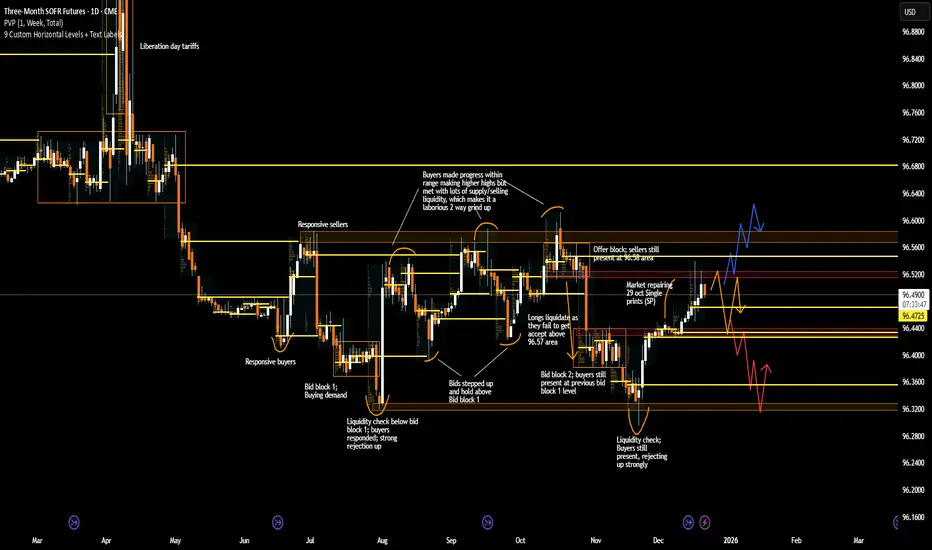
• The market has been in a downtrend since 2022 but has found a base with strong responsive selling at 96.575 and responsive buying at 96.325. This has formed a defined daily range that has contained price since June.
• From August to October, the market traded in a two way rotation with higher highs and higher lows. Buyers stepped up bids and were able to push price marginally higher, but each test of the 96.58 area was met with responsive selling that capped continuation.
• Toward the end of October, buyers failed to defend the higher lows. Price rotated back down into bid block one in the 96.42 to 96.37 area, where buyers successfully held price through mid November, establishing what is now bid block two.
• Sellers gained slight control as they were able to offer prices back down toward the lower end of the range near 96.325.
• The market performed a liquidity check below this level, but responsive buyers quickly stepped in and bid price back up through the daily range.
• Price is currently repairing the October 29 single print and is now trading between the established offer block and bid block two.
What to Expect in the Coming Week
The key level to watch remains 96.52, which sits near the upper portion of the current balance area and acts as a decision point.
Bullish scenario
• If the market is able to accept above the 96.52 area, continuation toward 96.575 becomes likely.
• A further extension toward 96.6125, which marks the October 17 high, is possible.
• Responsive selling is expected in this region.
• Failure to sustain trade above these levels would likely result in rotation back down into the range.
Neutral scenario
• In the absence of a meaningful news catalyst, a two way auction remains the highest probability outcome.
• Price could continue rotating between the offer block and bid block one.
• This rotation would serve to further repair the October 29 single print and the associated low volume area.
Bearish scenario
• If 96.435, which marks the high of bid block two, fails to hold, expect a sweep through bid block two.
• This would open the door for a revisit of the lower range boundary near 96.32.
• Responsive buyers are expected to defend this area based on prior behavior.
Conclusion
SR3 appears to have found a base and shifted from a structural downtrend into a period of sideways accumulation. Price has settled into a well defined range as market participants balance expectations around monetary policy and incoming data. Recent Federal Reserve commentary supports this shift in sentiment. The Fed has delivered multiple rate cuts this year and appears cautious about future moves, signaling a more data dependent approach and a potential pause after the most recent easing cycle, which aligns with range trade rather than directional conviction. Markets are pricing in additional easing but Fed officials have shown clear disagreement on the timing and pace of future cuts, which has dampened strong trend conviction and encouraged balancing action in rate sensitive instruments like SR3. Some officials have publicly indicated that further rate cuts could be warranted if economic conditions soften, while others have urged caution, emphasizing the need for clearer labor market and inflation signals before making additional adjustments. This split messaging has contributed to a neutral market structure where price oscillates within value rather than trending strongly higher or lower.
Interested in how others are mapping Fed communication and data dependency onto this range, and what catalysts you see as capable of breaking this structure. Please drop a comment and give a boost so that more from the community can join in the conversation. Thank you.
Disclaimer: This is not financial advice. Analysis is for educational purposes only; trade your own plan and manage risk.
SR3 refers to the three month SOFR futures contract. SOFR, or the Secured Overnight Financing Rate, represents the cost of overnight borrowing collateralized by US Treasuries. The three month SOFR future prices in the market’s expectation of average SOFR over a future three month period, making it one of the cleanest instruments for expressing interest rate expectations tied to Federal Reserve policy.
This instrument is primarily used by institutions to hedge short term interest rate exposure and to speculate on the future path of monetary policy. Because of this, SR3 is highly sensitive to macro data, Federal Reserve communication, inflation prints, labor market data, and shifts in risk sentiment. When markets expect easing, SR3 prices tend to rise. When expectations move toward higher for longer policy, prices tend to fall.
Since 2022, the dominant narrative has been centered around aggressive tightening followed by a prolonged restrictive stance. That narrative has kept SR3 in a broader downtrend. More recently, sentiment has shifted toward patience and data dependence rather than urgency in either direction. This has resulted in compression, balance, and range trade as participants wait for clarity on the next policy inflection.
What the Market Has Done
• The market has been in a downtrend since 2022 but has found a base with strong responsive selling at 96.575 and responsive buying at 96.325. This has formed a defined daily range that has contained price since June.
• From August to October, the market traded in a two way rotation with higher highs and higher lows. Buyers stepped up bids and were able to push price marginally higher, but each test of the 96.58 area was met with responsive selling that capped continuation.
• Toward the end of October, buyers failed to defend the higher lows. Price rotated back down into bid block one in the 96.42 to 96.37 area, where buyers successfully held price through mid November, establishing what is now bid block two.
• Sellers gained slight control as they were able to offer prices back down toward the lower end of the range near 96.325.
• The market performed a liquidity check below this level, but responsive buyers quickly stepped in and bid price back up through the daily range.
• Price is currently repairing the October 29 single print and is now trading between the established offer block and bid block two.
What to Expect in the Coming Week
The key level to watch remains 96.52, which sits near the upper portion of the current balance area and acts as a decision point.
Bullish scenario
• If the market is able to accept above the 96.52 area, continuation toward 96.575 becomes likely.
• A further extension toward 96.6125, which marks the October 17 high, is possible.
• Responsive selling is expected in this region.
• Failure to sustain trade above these levels would likely result in rotation back down into the range.
Neutral scenario
• In the absence of a meaningful news catalyst, a two way auction remains the highest probability outcome.
• Price could continue rotating between the offer block and bid block one.
• This rotation would serve to further repair the October 29 single print and the associated low volume area.
Bearish scenario
• If 96.435, which marks the high of bid block two, fails to hold, expect a sweep through bid block two.
• This would open the door for a revisit of the lower range boundary near 96.32.
• Responsive buyers are expected to defend this area based on prior behavior.
Conclusion
SR3 appears to have found a base and shifted from a structural downtrend into a period of sideways accumulation. Price has settled into a well defined range as market participants balance expectations around monetary policy and incoming data. Recent Federal Reserve commentary supports this shift in sentiment. The Fed has delivered multiple rate cuts this year and appears cautious about future moves, signaling a more data dependent approach and a potential pause after the most recent easing cycle, which aligns with range trade rather than directional conviction. Markets are pricing in additional easing but Fed officials have shown clear disagreement on the timing and pace of future cuts, which has dampened strong trend conviction and encouraged balancing action in rate sensitive instruments like SR3. Some officials have publicly indicated that further rate cuts could be warranted if economic conditions soften, while others have urged caution, emphasizing the need for clearer labor market and inflation signals before making additional adjustments. This split messaging has contributed to a neutral market structure where price oscillates within value rather than trending strongly higher or lower.
Interested in how others are mapping Fed communication and data dependency onto this range, and what catalysts you see as capable of breaking this structure. Please drop a comment and give a boost so that more from the community can join in the conversation. Thank you.
Disclaimer: This is not financial advice. Analysis is for educational purposes only; trade your own plan and manage risk.

EdgeClear
P: 773.832.8320
Derivatives trading involves a substantial risk of loss. Past performance is not indicative of future results. Any example trades are not inclusive of fees and commissions.
P: 773.832.8320
Derivatives trading involves a substantial risk of loss. Past performance is not indicative of future results. Any example trades are not inclusive of fees and commissions.
Wyłączenie odpowiedzialności
Informacje i publikacje nie stanowią i nie powinny być traktowane jako porady finansowe, inwestycyjne, tradingowe ani jakiekolwiek inne rekomendacje dostarczane lub zatwierdzone przez TradingView. Więcej informacji znajduje się w Warunkach użytkowania.
Wyłączenie odpowiedzialności
Informacje i publikacje nie stanowią i nie powinny być traktowane jako porady finansowe, inwestycyjne, tradingowe ani jakiekolwiek inne rekomendacje dostarczane lub zatwierdzone przez TradingView. Więcej informacji znajduje się w Warunkach użytkowania.