
TCS & The AI Integration Layer: Global Token Cost Arbitrage.
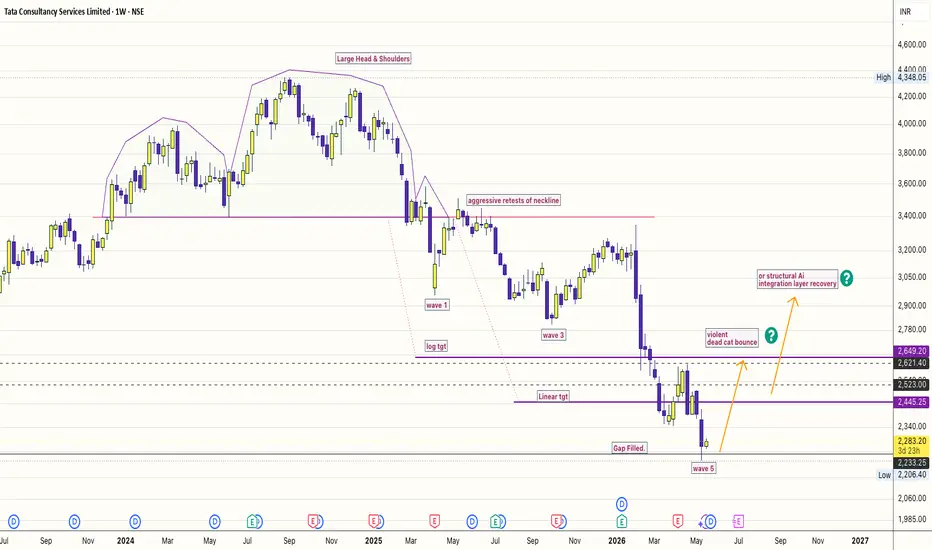
💻 💻 💻
🎯 The Macro Catalyst: The Cost of a Token & Nvidia’s Shadow
With Nvidia reporting its highly anticipated Q1 earnings this Wednesday, the entire global market is hyper-focused on the AI Infrastructure Layer (Hardware, GPUs, and Hyperscaler compute).
However, smart capital is starting to ask a critical question: Once the hardware is built, who actually implements it for global enterprises?
Building and querying raw frontier LLMs has hit an operational budget wall due to the immense energy and token costs.
Global Fortune 500 companies cannot simply plug a raw model into their legacy enterprise data—the token consumption is too expensive, and hallucinations introduce critical compliance risks.
Enter the AI Integration Layer.
🛡️ The Macro Thesis: Why Indian IT Could win the Next Phase of AI
Enterprise AI is not a software product problem; it is an integration, engineering, and data-cleansing problem.
The Integration Runway: To make AI cost-effective, enterprises must prune models, deploy specialised open-source architectures, build customised vector databases (RAG), and clean messy legacy data.
The Scale Advantage: Tata Consultancy Services (TCS) sits at the epicenter of this shift.
Instead of burning capital trying to build competing hardware or proprietary foundation models, TCS has rapidly up-skilled over 350,000 engineers to become the global army of AI implementation specialists.
Sticky Enterprise Moat: The complex operational cost of data and tokens ensures that automated software cannot easily displace human implementation teams yet.
This gives TCS a massive, multi-year revenue runway to act as the primary tollbooth for real-world corporate AI deployments.
📊
The Moving Average Engine: The underlying trend structure remains firmly bullish, coiling tightly right before a potential massive volatility injection from the upcoming global tech tape catalyst on Thursday.
The Target Framework:
Target 1 (Immediate Resistance Node): ₹2,306
Target 2 (Mid-Channel Cluster): ₹2,344
Target 3 (Structural Cycle High): ₹2,414
⚙️ Risk Management & Execution Strategy
To exploit this structural narrative with strict mathematical risk management, we use the key pivot levels defined on the chart:
The Invalidation Level: A clean daily/weekly close below the main lower support channel invalidates the immediate breakout momentum.
The Compounder Play: For derivative traders, utilising the near-the-money or slightly out-of-the-money May calls (such as the 2280, 2300, or 2320 strikes) allows for high-velocity exposure to the Thursday Mumbai opening session if the global narrative shifts violently into risk-on mode.
Disclaimer: This analysis is shared purely for educational and tracking purposes.
Options and equity trading carry significant risk.
Always size your positions appropriately to protect your trading capital.
#TCS, #NiftyIT, #AI, #Nvidia, #Breakout
🎯 The Macro Catalyst: The Cost of a Token & Nvidia’s Shadow
With Nvidia reporting its highly anticipated Q1 earnings this Wednesday, the entire global market is hyper-focused on the AI Infrastructure Layer (Hardware, GPUs, and Hyperscaler compute).
However, smart capital is starting to ask a critical question: Once the hardware is built, who actually implements it for global enterprises?
Building and querying raw frontier LLMs has hit an operational budget wall due to the immense energy and token costs.
Global Fortune 500 companies cannot simply plug a raw model into their legacy enterprise data—the token consumption is too expensive, and hallucinations introduce critical compliance risks.
Enter the AI Integration Layer.
🛡️ The Macro Thesis: Why Indian IT Could win the Next Phase of AI
Enterprise AI is not a software product problem; it is an integration, engineering, and data-cleansing problem.
The Integration Runway: To make AI cost-effective, enterprises must prune models, deploy specialised open-source architectures, build customised vector databases (RAG), and clean messy legacy data.
The Scale Advantage: Tata Consultancy Services (TCS) sits at the epicenter of this shift.
Instead of burning capital trying to build competing hardware or proprietary foundation models, TCS has rapidly up-skilled over 350,000 engineers to become the global army of AI implementation specialists.
Sticky Enterprise Moat: The complex operational cost of data and tokens ensures that automated software cannot easily displace human implementation teams yet.
This gives TCS a massive, multi-year revenue runway to act as the primary tollbooth for real-world corporate AI deployments.
📊
The Moving Average Engine: The underlying trend structure remains firmly bullish, coiling tightly right before a potential massive volatility injection from the upcoming global tech tape catalyst on Thursday.
The Target Framework:
Target 1 (Immediate Resistance Node): ₹2,306
Target 2 (Mid-Channel Cluster): ₹2,344
Target 3 (Structural Cycle High): ₹2,414
⚙️ Risk Management & Execution Strategy
To exploit this structural narrative with strict mathematical risk management, we use the key pivot levels defined on the chart:
The Invalidation Level: A clean daily/weekly close below the main lower support channel invalidates the immediate breakout momentum.
The Compounder Play: For derivative traders, utilising the near-the-money or slightly out-of-the-money May calls (such as the 2280, 2300, or 2320 strikes) allows for high-velocity exposure to the Thursday Mumbai opening session if the global narrative shifts violently into risk-on mode.
Disclaimer: This analysis is shared purely for educational and tracking purposes.
Options and equity trading carry significant risk.
Always size your positions appropriately to protect your trading capital.
#TCS, #NiftyIT, #AI, #Nvidia, #Breakout
Transakcja zakończona: osiągnięto poziom stop
look at #TCS vs the CNXITWEAK...

Wyłączenie odpowiedzialności
Informacje i publikacje nie stanowią i nie powinny być traktowane jako porady finansowe, inwestycyjne, tradingowe ani jakiekolwiek inne rekomendacje dostarczane lub zatwierdzone przez TradingView. Więcej informacji znajduje się w Warunkach użytkowania.
Wyłączenie odpowiedzialności
Informacje i publikacje nie stanowią i nie powinny być traktowane jako porady finansowe, inwestycyjne, tradingowe ani jakiekolwiek inne rekomendacje dostarczane lub zatwierdzone przez TradingView. Więcej informacji znajduje się w Warunkach użytkowania.