
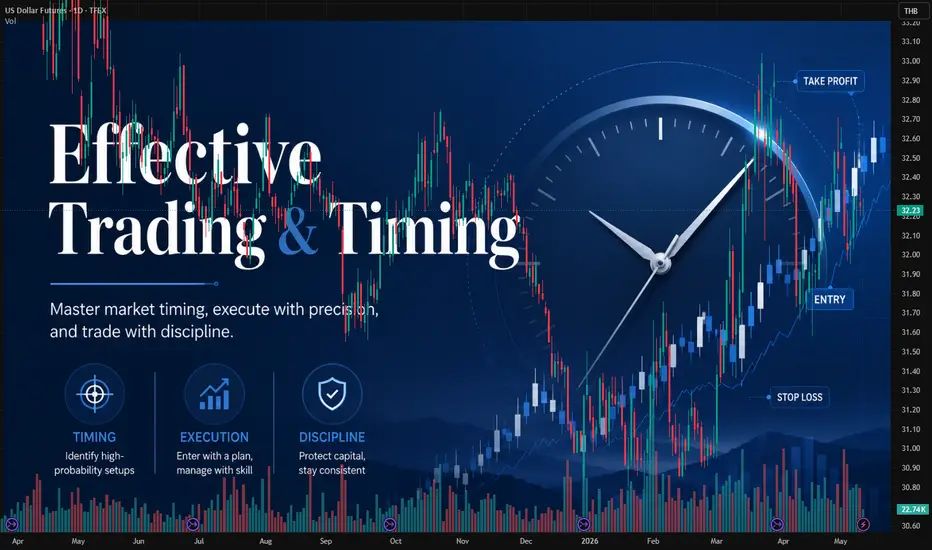
Good trading isn't just about spotting an opportunity. It's about knowing when to act, when to hold back, and when to simply stay out. Timing can make or break a trade. A strong setup entered too early can fall apart before the real move even begins. A great idea entered too late may leave almost no room to profit. That's why having a clear process before placing any trade matters so much.
Why Timing Matters
Markets don't move in one straight line. Sometimes there's a clear trend. Sometimes price drifts sideways for hours. Sometimes volatility spikes out of nowhere after a news release or a session opening.
Traders who ignore timing tend to enter on emotion. Traders who respect it wait for the market to show its hand.
Getting timing right helps in three concrete ways:
You find better entry points
You control risk more cleanly
You set more realistic profit targets
The goal isn't to nail the perfect top or bottom — it's to enter when the idea is confirmed and the risk still makes sense.
Start With the Market Session
Not all hours are equal. Volatility, volume, and price behavior all shift depending on which session is active. Some assets only really move during session overlaps or key opening hours. Others react sharply to news or liquidity events.
Before entering any trade, ask yourself a few simple questions:
Is the market actually active right now?
Is volume picking up or fading?
Is price moving with purpose, or just drifting?
Timing starts with understanding the environment you're trading in.
Don't Enter Without a Setup
Fast price movement is exciting. But excitement isn't a strategy.
Wait for a setup that matches your plan — one that includes a clear trend direction, a key level, a pullback or breakout, a logical stop-loss, and a target with enough room to breathe. When those pieces aren't there, you're trading on hope, not structure.
Start With the Higher Timeframes
A common mistake is jumping straight into a 5-minute chart and reacting to every little wiggle. Lower timeframes are useful, but they're full of noise.
Instead, start higher to get the full picture:
Check the daily or 4-hour chart for direction
Mark the important levels
Drop to the 1-hour or 15-minute chart to time the entry
Wait for confirmation before doing anything
This keeps your trade grounded in the bigger context, not just the last few candles.
Pay Attention to Key Levels
Support and resistance aren't magic, but they do reveal where buyers and sellers have shown up before. Trading near these levels makes risk easier to define — a tighter stop, a clearer invalidation point.
That said, don't enter just because price touches a level. Wait for a reaction. Look for rejection, a momentum shift, or a clean breakout. The level alone isn't enough.
Don't Chase Price
Everyone has felt it — the market moves without you and suddenly it feels like you're missing out. That's when chasing happens. And chasing almost always ends badly.
The stop gets wider, the reward shrinks, and emotions take over. A simpler rule: if the entry is gone, let it go. There will always be another setup. One rushed trade won't make your month, but it can damage your account.
Plan the Trade Before You Enter
Every trade should have a full plan in place before money is on the line — entry price, stop-loss, target, reason, risk amount, and what you'll do if price stalls. Planning after entry is too late. Once you're in, emotions get loud. A written plan keeps your head clear.
Use Risk-to-Reward Properly
Clean timing directly improves your risk-to-reward. When your entry is well-timed, the stop can sit closer to the invalidation point, which protects more capital.
A straightforward approach: only take trades where the potential reward is larger than the potential loss. Risking one unit to make two gives your strategy room to survive losing streaks — which every trader faces.
Wait for Confirmation
Confirmation reduces guesswork. It doesn't eliminate risk, but it gives your trade idea a stronger foundation. That might be a candle closing above a level, a breakout retesting cleanly, a strong rejection wick, or a volume spike confirming the move.
The exact signal depends on your strategy. The point is to avoid entering because you feel something might happen.
Know When Not to Trade
Some of the best trading decisions are the ones where you don't trade at all.
Stay out when the chart is messy, the risk-to-reward is weak, major news is around the corner, you're emotionally raw after a loss, or you genuinely can't explain why you're entering. You don't need to be active all the time — selectivity is a skill in itself.
Final Thoughts
Effective trading comes down to timing, structure, and patience. A good entry isn't just about picking the right direction — it's about reading the conditions, respecting key levels, waiting for confirmation, and keeping risk in check.
The best traders aren't the most active ones. They're the ones who wait for the market to give them a real reason to act. That patience, over time, is what turns trading from reaction into a repeatable process.
Why Timing Matters
Markets don't move in one straight line. Sometimes there's a clear trend. Sometimes price drifts sideways for hours. Sometimes volatility spikes out of nowhere after a news release or a session opening.
Traders who ignore timing tend to enter on emotion. Traders who respect it wait for the market to show its hand.
Getting timing right helps in three concrete ways:
You find better entry points
You control risk more cleanly
You set more realistic profit targets
The goal isn't to nail the perfect top or bottom — it's to enter when the idea is confirmed and the risk still makes sense.
Start With the Market Session
Not all hours are equal. Volatility, volume, and price behavior all shift depending on which session is active. Some assets only really move during session overlaps or key opening hours. Others react sharply to news or liquidity events.
Before entering any trade, ask yourself a few simple questions:
Is the market actually active right now?
Is volume picking up or fading?
Is price moving with purpose, or just drifting?
Timing starts with understanding the environment you're trading in.
Don't Enter Without a Setup
Fast price movement is exciting. But excitement isn't a strategy.
Wait for a setup that matches your plan — one that includes a clear trend direction, a key level, a pullback or breakout, a logical stop-loss, and a target with enough room to breathe. When those pieces aren't there, you're trading on hope, not structure.
Start With the Higher Timeframes
A common mistake is jumping straight into a 5-minute chart and reacting to every little wiggle. Lower timeframes are useful, but they're full of noise.
Instead, start higher to get the full picture:
Check the daily or 4-hour chart for direction
Mark the important levels
Drop to the 1-hour or 15-minute chart to time the entry
Wait for confirmation before doing anything
This keeps your trade grounded in the bigger context, not just the last few candles.
Pay Attention to Key Levels
Support and resistance aren't magic, but they do reveal where buyers and sellers have shown up before. Trading near these levels makes risk easier to define — a tighter stop, a clearer invalidation point.
That said, don't enter just because price touches a level. Wait for a reaction. Look for rejection, a momentum shift, or a clean breakout. The level alone isn't enough.
Don't Chase Price
Everyone has felt it — the market moves without you and suddenly it feels like you're missing out. That's when chasing happens. And chasing almost always ends badly.
The stop gets wider, the reward shrinks, and emotions take over. A simpler rule: if the entry is gone, let it go. There will always be another setup. One rushed trade won't make your month, but it can damage your account.
Plan the Trade Before You Enter
Every trade should have a full plan in place before money is on the line — entry price, stop-loss, target, reason, risk amount, and what you'll do if price stalls. Planning after entry is too late. Once you're in, emotions get loud. A written plan keeps your head clear.
Use Risk-to-Reward Properly
Clean timing directly improves your risk-to-reward. When your entry is well-timed, the stop can sit closer to the invalidation point, which protects more capital.
A straightforward approach: only take trades where the potential reward is larger than the potential loss. Risking one unit to make two gives your strategy room to survive losing streaks — which every trader faces.
Wait for Confirmation
Confirmation reduces guesswork. It doesn't eliminate risk, but it gives your trade idea a stronger foundation. That might be a candle closing above a level, a breakout retesting cleanly, a strong rejection wick, or a volume spike confirming the move.
The exact signal depends on your strategy. The point is to avoid entering because you feel something might happen.
Know When Not to Trade
Some of the best trading decisions are the ones where you don't trade at all.
Stay out when the chart is messy, the risk-to-reward is weak, major news is around the corner, you're emotionally raw after a loss, or you genuinely can't explain why you're entering. You don't need to be active all the time — selectivity is a skill in itself.
Final Thoughts
Effective trading comes down to timing, structure, and patience. A good entry isn't just about picking the right direction — it's about reading the conditions, respecting key levels, waiting for confirmation, and keeping risk in check.
The best traders aren't the most active ones. They're the ones who wait for the market to give them a real reason to act. That patience, over time, is what turns trading from reaction into a repeatable process.

Wyłączenie odpowiedzialności
Informacje i publikacje nie stanowią i nie powinny być traktowane jako porady finansowe, inwestycyjne, tradingowe ani jakiekolwiek inne rekomendacje dostarczane lub zatwierdzone przez TradingView. Więcej informacji znajduje się w Warunkach użytkowania.
Wyłączenie odpowiedzialności
Informacje i publikacje nie stanowią i nie powinny być traktowane jako porady finansowe, inwestycyjne, tradingowe ani jakiekolwiek inne rekomendacje dostarczane lub zatwierdzone przez TradingView. Więcej informacji znajduje się w Warunkach użytkowania.