

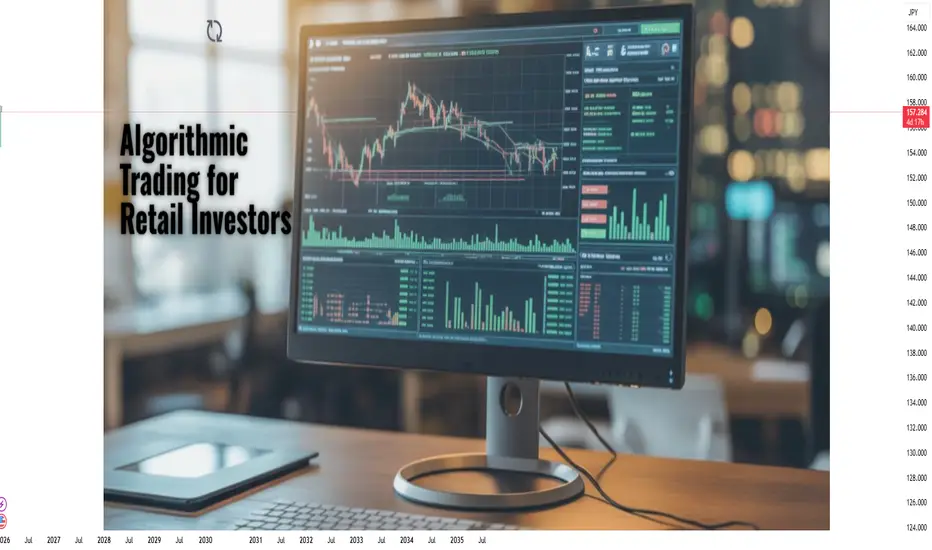
A Complete Beginner-to-Advanced Guide
Algorithmic trading, often called algo trading, is no longer limited to hedge funds and large institutions. With advancements in technology, affordable platforms, and access to market data, retail investors can now design, test, and deploy trading algorithms from their homes. Algorithmic trading involves using predefined rules, coded into software, to automatically execute trades based on market conditions. These rules can be based on price, volume, timing, technical indicators, or even news and sentiment data.
What Is Algorithmic Trading?
At its core, algorithmic trading is about automation and discipline. Instead of manually placing trades based on emotions or guesswork, an algorithm follows a structured set of instructions. For example, an algorithm may be programmed to buy a stock when its 20-day moving average crosses above its 50-day moving average and sell when the opposite occurs. Once deployed, the system monitors the market continuously and executes trades instantly when conditions are met.
For retail investors, this removes emotional bias, reduces execution delays, and allows consistent application of a strategy across different market conditions.
Why Algorithmic Trading Is Attractive for Retail Investors
One of the biggest advantages of algo trading is emotion-free decision-making. Fear and greed are common reasons retail traders fail. Algorithms strictly follow logic and predefined rules, preventing impulsive decisions during market volatility.
Another key benefit is speed and efficiency. Algorithms can analyze thousands of data points and place trades in milliseconds—something impossible for manual traders. Even for non-high-frequency strategies, this speed ensures better entry and exit prices.
Algo trading also enables backtesting, which allows retail investors to test strategies on historical data before risking real money. This helps identify strengths, weaknesses, drawdowns, and profitability potential.
Finally, algorithms offer scalability. A single trader can run multiple strategies across different stocks, indices, commodities, or cryptocurrencies simultaneously.
Common Algorithmic Trading Strategies for Retail Investors
Retail-friendly algorithmic strategies are usually simpler and focus on consistency rather than ultra-high speed.
Trend-following strategies are among the most popular. These include moving average crossovers, breakout strategies, and momentum-based systems. They aim to capture sustained price movements rather than predict tops or bottoms.
Mean reversion strategies assume prices revert to their average over time. Algorithms identify overbought or oversold conditions using indicators like RSI or Bollinger Bands and trade accordingly.
Arbitrage strategies, though more competitive today, attempt to exploit small price differences between related instruments, such as cash and futures or correlated stocks.
Intraday time-based strategies are also popular among retail investors. These algorithms trade at specific times—such as market open or close—when volatility and liquidity are higher.
Technology Stack Required for Retail Algo Trading
To start algorithmic trading, retail investors need a basic technology setup. This includes:
Market data (real-time or historical)
Trading platform or broker API
Programming environment
Backtesting engine
Execution and risk management module
Programming languages like Python are widely used due to their simplicity and powerful libraries such as Pandas, NumPy, TA-Lib, and Backtrader. Some platforms also offer no-code or low-code solutions where strategies can be built using visual interfaces.
Broker APIs allow algorithms to place orders automatically. In India, many brokers now support API trading, making algo trading more accessible than ever.
Backtesting and Strategy Validation
Backtesting is one of the most critical steps in algorithmic trading. It involves applying your strategy to historical data to evaluate how it would have performed in the past. Retail investors must be cautious of overfitting, where a strategy performs well on historical data but fails in live markets.
A robust backtest should include:
Transaction costs and slippage
Realistic execution assumptions
Multiple market cycles
Out-of-sample testing
Paper trading or simulated trading is often used after backtesting to test the algorithm in real-time market conditions without risking capital.
Risk Management in Algorithmic Trading
Risk management is what separates sustainable algo traders from gamblers. Algorithms should always include predefined risk controls such as:
Maximum loss per trade
Daily loss limits
Position sizing rules
Stop-loss and take-profit levels
Retail investors should avoid deploying algorithms with aggressive leverage or unrealistic return expectations. Consistency and capital preservation are more important than high returns.
Challenges Faced by Retail Algo Traders
Despite its advantages, algorithmic trading is not without challenges. Technical failures such as internet outages, API errors, or software bugs can cause unexpected losses. Market conditions also change, and a strategy that worked in the past may stop performing.
Another major challenge is competition. Institutional players have access to superior infrastructure and data. Retail investors must focus on niche strategies, longer timeframes, or less crowded markets to stay competitive.
Regulatory compliance is also important. Retail investors must ensure their trading activities comply with exchange and broker regulations.
Psychology and Discipline in Algo Trading
Even though trading decisions are automated, psychology still plays a role. Retail investors often interfere with algorithms during drawdowns, turning off systems prematurely or changing rules frequently. Successful algo traders trust their data, follow predefined evaluation periods, and make changes based on evidence—not emotions.
Future of Algorithmic Trading for Retail Investors
The future of algorithmic trading is increasingly retail-friendly. Cloud computing, AI-driven analytics, machine learning models, and broker-supported APIs are lowering entry barriers. Retail investors are also gaining access to alternative data such as sentiment analysis and macroeconomic indicators.
However, success will continue to depend on education, discipline, and risk control, not on complex algorithms alone.
Conclusion
Algorithmic trading offers retail investors a powerful way to participate in financial markets with discipline, speed, and consistency. While it does not guarantee profits, it provides a structured framework that reduces emotional decision-making and enhances efficiency. By starting with simple strategies, focusing on robust backtesting, and prioritizing risk management, retail investors can gradually build sustainable algorithmic trading systems. In an increasingly automated market, learning algorithmic trading is no longer optional—it is a valuable skill that can redefine how retail investors trade and invest.
Algorithmic trading, often called algo trading, is no longer limited to hedge funds and large institutions. With advancements in technology, affordable platforms, and access to market data, retail investors can now design, test, and deploy trading algorithms from their homes. Algorithmic trading involves using predefined rules, coded into software, to automatically execute trades based on market conditions. These rules can be based on price, volume, timing, technical indicators, or even news and sentiment data.
What Is Algorithmic Trading?
At its core, algorithmic trading is about automation and discipline. Instead of manually placing trades based on emotions or guesswork, an algorithm follows a structured set of instructions. For example, an algorithm may be programmed to buy a stock when its 20-day moving average crosses above its 50-day moving average and sell when the opposite occurs. Once deployed, the system monitors the market continuously and executes trades instantly when conditions are met.
For retail investors, this removes emotional bias, reduces execution delays, and allows consistent application of a strategy across different market conditions.
Why Algorithmic Trading Is Attractive for Retail Investors
One of the biggest advantages of algo trading is emotion-free decision-making. Fear and greed are common reasons retail traders fail. Algorithms strictly follow logic and predefined rules, preventing impulsive decisions during market volatility.
Another key benefit is speed and efficiency. Algorithms can analyze thousands of data points and place trades in milliseconds—something impossible for manual traders. Even for non-high-frequency strategies, this speed ensures better entry and exit prices.
Algo trading also enables backtesting, which allows retail investors to test strategies on historical data before risking real money. This helps identify strengths, weaknesses, drawdowns, and profitability potential.
Finally, algorithms offer scalability. A single trader can run multiple strategies across different stocks, indices, commodities, or cryptocurrencies simultaneously.
Common Algorithmic Trading Strategies for Retail Investors
Retail-friendly algorithmic strategies are usually simpler and focus on consistency rather than ultra-high speed.
Trend-following strategies are among the most popular. These include moving average crossovers, breakout strategies, and momentum-based systems. They aim to capture sustained price movements rather than predict tops or bottoms.
Mean reversion strategies assume prices revert to their average over time. Algorithms identify overbought or oversold conditions using indicators like RSI or Bollinger Bands and trade accordingly.
Arbitrage strategies, though more competitive today, attempt to exploit small price differences between related instruments, such as cash and futures or correlated stocks.
Intraday time-based strategies are also popular among retail investors. These algorithms trade at specific times—such as market open or close—when volatility and liquidity are higher.
Technology Stack Required for Retail Algo Trading
To start algorithmic trading, retail investors need a basic technology setup. This includes:
Market data (real-time or historical)
Trading platform or broker API
Programming environment
Backtesting engine
Execution and risk management module
Programming languages like Python are widely used due to their simplicity and powerful libraries such as Pandas, NumPy, TA-Lib, and Backtrader. Some platforms also offer no-code or low-code solutions where strategies can be built using visual interfaces.
Broker APIs allow algorithms to place orders automatically. In India, many brokers now support API trading, making algo trading more accessible than ever.
Backtesting and Strategy Validation
Backtesting is one of the most critical steps in algorithmic trading. It involves applying your strategy to historical data to evaluate how it would have performed in the past. Retail investors must be cautious of overfitting, where a strategy performs well on historical data but fails in live markets.
A robust backtest should include:
Transaction costs and slippage
Realistic execution assumptions
Multiple market cycles
Out-of-sample testing
Paper trading or simulated trading is often used after backtesting to test the algorithm in real-time market conditions without risking capital.
Risk Management in Algorithmic Trading
Risk management is what separates sustainable algo traders from gamblers. Algorithms should always include predefined risk controls such as:
Maximum loss per trade
Daily loss limits
Position sizing rules
Stop-loss and take-profit levels
Retail investors should avoid deploying algorithms with aggressive leverage or unrealistic return expectations. Consistency and capital preservation are more important than high returns.
Challenges Faced by Retail Algo Traders
Despite its advantages, algorithmic trading is not without challenges. Technical failures such as internet outages, API errors, or software bugs can cause unexpected losses. Market conditions also change, and a strategy that worked in the past may stop performing.
Another major challenge is competition. Institutional players have access to superior infrastructure and data. Retail investors must focus on niche strategies, longer timeframes, or less crowded markets to stay competitive.
Regulatory compliance is also important. Retail investors must ensure their trading activities comply with exchange and broker regulations.
Psychology and Discipline in Algo Trading
Even though trading decisions are automated, psychology still plays a role. Retail investors often interfere with algorithms during drawdowns, turning off systems prematurely or changing rules frequently. Successful algo traders trust their data, follow predefined evaluation periods, and make changes based on evidence—not emotions.
Future of Algorithmic Trading for Retail Investors
The future of algorithmic trading is increasingly retail-friendly. Cloud computing, AI-driven analytics, machine learning models, and broker-supported APIs are lowering entry barriers. Retail investors are also gaining access to alternative data such as sentiment analysis and macroeconomic indicators.
However, success will continue to depend on education, discipline, and risk control, not on complex algorithms alone.
Conclusion
Algorithmic trading offers retail investors a powerful way to participate in financial markets with discipline, speed, and consistency. While it does not guarantee profits, it provides a structured framework that reduces emotional decision-making and enhances efficiency. By starting with simple strategies, focusing on robust backtesting, and prioritizing risk management, retail investors can gradually build sustainable algorithmic trading systems. In an increasingly automated market, learning algorithmic trading is no longer optional—it is a valuable skill that can redefine how retail investors trade and invest.

Powiązane publikacje
Wyłączenie odpowiedzialności
Informacje i publikacje nie stanowią i nie powinny być traktowane jako porady finansowe, inwestycyjne, tradingowe ani jakiekolwiek inne rekomendacje dostarczane lub zatwierdzone przez TradingView. Więcej informacji znajduje się w Warunkach użytkowania.
Powiązane publikacje
Wyłączenie odpowiedzialności
Informacje i publikacje nie stanowią i nie powinny być traktowane jako porady finansowe, inwestycyjne, tradingowe ani jakiekolwiek inne rekomendacje dostarczane lub zatwierdzone przez TradingView. Więcej informacji znajduje się w Warunkach użytkowania.