
The geopolitical situation has evolved significantly this week, and although we are still far from a global return to peace in the Middle East, international equity markets are trying to stabilize and hold above the low established at the end of March.
Is this low in global stock indices, reached one month after the start of military operations on Saturday, February 28, the bottom of the sell-off? This question deserves a well-argued answer from both a fundamental and a technical perspective.
In this new article, I propose to focus on the technical analysis aspect, that is, identifying the technical levels that must be reached on strategic financial assets to genuinely believe in a stock market bottom.
I have selected the following strategic assets: oil, natural gas, urea fertilizer, the US 2-year bond yield (the one that best anticipates the future monetary policy of the Fed), the stock indices S&P 500, Dow Jones and Nasdaq 100, the US Technology sector index, and finally the US dollar (DXY).
The principle is that these strategic assets must return to minimum levels to begin to believe in the definitive end of the sell-off linked to events in the Middle East.
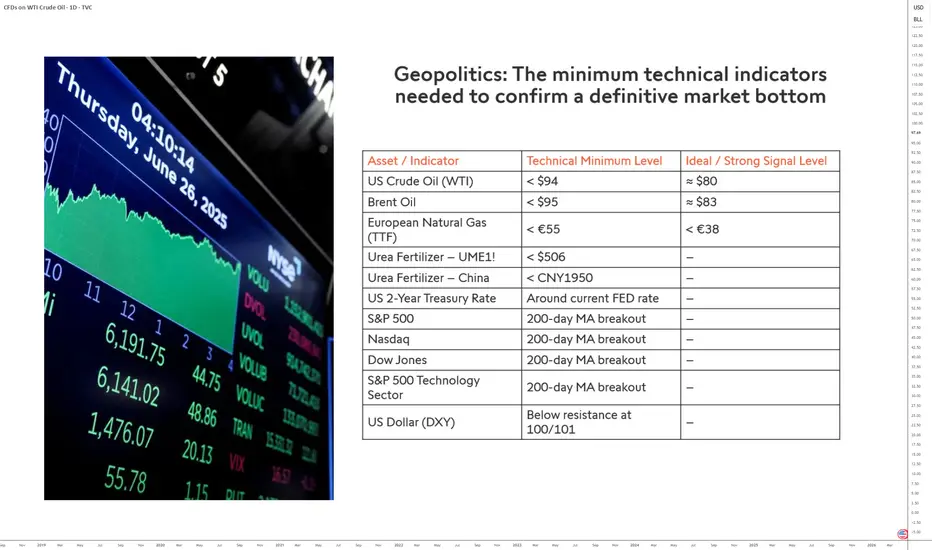
In detail, the energy market is the first barometer. A sustained easing in oil prices, with WTI below $94 and ideally close to $80, would signal a significant reduction in the geopolitical risk premium. The same reasoning applies to Brent as well as to European natural gas, where a return below critical thresholds would reflect a gradual normalization of flows and expectations.
Next, critical fertilizers such as urea play a leading role in the global economic chain. A stabilization in these prices would indicate that pressures on production costs are beginning to ease, which is a prerequisite for a broader inflationary easing.
On the bond side, the US 2-year yield must stop diverging upward from the Federal Reserve’s policy rate, as this would signal that the market is anticipating rate hikes, which is incompatible with a stock market bottom.
Regarding equity indices, the key technical signal remains the reclaiming of the 200-day moving averages. A sustained break above these levels on the S&P 500, Nasdaq and Dow Jones would indicate a return of long-term buying flows and an improvement in market structure.
Finally, the US dollar must lose its relative strength. A DXY below its resistance zone would indicate an easing of global financial conditions, favorable to risk assets.
Only the convergence of all these signals will allow, with a high degree of confidence, to validate that the market bottom has indeed been reached.
The table below provides a summary of the minimum and ideal technical thresholds to be reached in order to gain strong conviction that the stock market sell-off linked to geopolitics is definitively over.

DISCLAIMER:
This content is intended for individuals who are familiar with financial markets and instruments and is for information purposes only. The presented idea (including market commentary, market data and observations) is not a work product of any research department of Swissquote or its affiliates. This material is intended to highlight market action and does not constitute investment, legal or tax advice. If you are a retail investor or lack experience in trading complex financial products, it is advisable to seek professional advice from licensed advisor before making any financial decisions.
This content is not intended to manipulate the market or encourage any specific financial behavior.
Swissquote makes no representation or warranty as to the quality, completeness, accuracy, comprehensiveness or non-infringement of such content. The views expressed are those of the consultant and are provided for educational purposes only. Any information provided relating to a product or market should not be construed as recommending an investment strategy or transaction. Past performance is not a guarantee of future results.
Swissquote and its employees and representatives shall in no event be held liable for any damages or losses arising directly or indirectly from decisions made on the basis of this content.
The use of any third-party brands or trademarks is for information only and does not imply endorsement by Swissquote, or that the trademark owner has authorised Swissquote to promote its products or services.
Swissquote is the marketing brand for the activities of Swissquote Bank Ltd (Switzerland) regulated by FINMA, Swissquote Capital Markets Limited regulated by CySEC (Cyprus), Swissquote Bank Europe SA (Luxembourg) regulated by the CSSF, Swissquote Ltd (UK) regulated by the FCA, Swissquote Financial Services (Malta) Ltd regulated by the Malta Financial Services Authority, Swissquote MEA Ltd. (UAE) regulated by the Dubai Financial Services Authority, Swissquote Pte Ltd (Singapore) regulated by the Monetary Authority of Singapore, Swissquote Asia Limited (Hong Kong) licensed by the Hong Kong Securities and Futures Commission (SFC) and Swissquote South Africa (Pty) Ltd supervised by the FSCA.
Products and services of Swissquote are only intended for those permitted to receive them under local law.
All investments carry a degree of risk. The risk of loss in trading or holding financial instruments can be substantial. The value of financial instruments, including but not limited to stocks, bonds, cryptocurrencies, and other assets, can fluctuate both upwards and downwards. There is a significant risk of financial loss when buying, selling, holding, staking, or investing in these instruments. SQBE makes no recommendations regarding any specific investment, transaction, or the use of any particular investment strategy.
CFDs are complex instruments and come with a high risk of losing money rapidly due to leverage. The vast majority of retail client accounts suffer capital losses when trading in CFDs. You should consider whether you understand how CFDs work and whether you can afford to take the high risk of losing your money.
Digital Assets are unregulated in most countries and consumer protection rules may not apply. As highly volatile speculative investments, Digital Assets are not suitable for investors without a high-risk tolerance. Make sure you understand each Digital Asset before you trade.
Cryptocurrencies are not considered legal tender in some jurisdictions and are subject to regulatory uncertainties.
The use of Internet-based systems can involve high risks, including, but not limited to, fraud, cyber-attacks, network and communication failures, as well as identity theft and phishing attacks related to crypto-assets.
Is this low in global stock indices, reached one month after the start of military operations on Saturday, February 28, the bottom of the sell-off? This question deserves a well-argued answer from both a fundamental and a technical perspective.
In this new article, I propose to focus on the technical analysis aspect, that is, identifying the technical levels that must be reached on strategic financial assets to genuinely believe in a stock market bottom.
I have selected the following strategic assets: oil, natural gas, urea fertilizer, the US 2-year bond yield (the one that best anticipates the future monetary policy of the Fed), the stock indices S&P 500, Dow Jones and Nasdaq 100, the US Technology sector index, and finally the US dollar (DXY).
The principle is that these strategic assets must return to minimum levels to begin to believe in the definitive end of the sell-off linked to events in the Middle East.
In detail, the energy market is the first barometer. A sustained easing in oil prices, with WTI below $94 and ideally close to $80, would signal a significant reduction in the geopolitical risk premium. The same reasoning applies to Brent as well as to European natural gas, where a return below critical thresholds would reflect a gradual normalization of flows and expectations.
Next, critical fertilizers such as urea play a leading role in the global economic chain. A stabilization in these prices would indicate that pressures on production costs are beginning to ease, which is a prerequisite for a broader inflationary easing.
On the bond side, the US 2-year yield must stop diverging upward from the Federal Reserve’s policy rate, as this would signal that the market is anticipating rate hikes, which is incompatible with a stock market bottom.
Regarding equity indices, the key technical signal remains the reclaiming of the 200-day moving averages. A sustained break above these levels on the S&P 500, Nasdaq and Dow Jones would indicate a return of long-term buying flows and an improvement in market structure.
Finally, the US dollar must lose its relative strength. A DXY below its resistance zone would indicate an easing of global financial conditions, favorable to risk assets.
Only the convergence of all these signals will allow, with a high degree of confidence, to validate that the market bottom has indeed been reached.
The table below provides a summary of the minimum and ideal technical thresholds to be reached in order to gain strong conviction that the stock market sell-off linked to geopolitics is definitively over.
DISCLAIMER:
This content is intended for individuals who are familiar with financial markets and instruments and is for information purposes only. The presented idea (including market commentary, market data and observations) is not a work product of any research department of Swissquote or its affiliates. This material is intended to highlight market action and does not constitute investment, legal or tax advice. If you are a retail investor or lack experience in trading complex financial products, it is advisable to seek professional advice from licensed advisor before making any financial decisions.
This content is not intended to manipulate the market or encourage any specific financial behavior.
Swissquote makes no representation or warranty as to the quality, completeness, accuracy, comprehensiveness or non-infringement of such content. The views expressed are those of the consultant and are provided for educational purposes only. Any information provided relating to a product or market should not be construed as recommending an investment strategy or transaction. Past performance is not a guarantee of future results.
Swissquote and its employees and representatives shall in no event be held liable for any damages or losses arising directly or indirectly from decisions made on the basis of this content.
The use of any third-party brands or trademarks is for information only and does not imply endorsement by Swissquote, or that the trademark owner has authorised Swissquote to promote its products or services.
Swissquote is the marketing brand for the activities of Swissquote Bank Ltd (Switzerland) regulated by FINMA, Swissquote Capital Markets Limited regulated by CySEC (Cyprus), Swissquote Bank Europe SA (Luxembourg) regulated by the CSSF, Swissquote Ltd (UK) regulated by the FCA, Swissquote Financial Services (Malta) Ltd regulated by the Malta Financial Services Authority, Swissquote MEA Ltd. (UAE) regulated by the Dubai Financial Services Authority, Swissquote Pte Ltd (Singapore) regulated by the Monetary Authority of Singapore, Swissquote Asia Limited (Hong Kong) licensed by the Hong Kong Securities and Futures Commission (SFC) and Swissquote South Africa (Pty) Ltd supervised by the FSCA.
Products and services of Swissquote are only intended for those permitted to receive them under local law.
All investments carry a degree of risk. The risk of loss in trading or holding financial instruments can be substantial. The value of financial instruments, including but not limited to stocks, bonds, cryptocurrencies, and other assets, can fluctuate both upwards and downwards. There is a significant risk of financial loss when buying, selling, holding, staking, or investing in these instruments. SQBE makes no recommendations regarding any specific investment, transaction, or the use of any particular investment strategy.
CFDs are complex instruments and come with a high risk of losing money rapidly due to leverage. The vast majority of retail client accounts suffer capital losses when trading in CFDs. You should consider whether you understand how CFDs work and whether you can afford to take the high risk of losing your money.
Digital Assets are unregulated in most countries and consumer protection rules may not apply. As highly volatile speculative investments, Digital Assets are not suitable for investors without a high-risk tolerance. Make sure you understand each Digital Asset before you trade.
Cryptocurrencies are not considered legal tender in some jurisdictions and are subject to regulatory uncertainties.
The use of Internet-based systems can involve high risks, including, but not limited to, fraud, cyber-attacks, network and communication failures, as well as identity theft and phishing attacks related to crypto-assets.

This content is written by Vincent Ganne for Swissquote.
This content is intended for individuals who are familiar with financial markets and instruments and is for information purposes only and does not constitute investment, legal or tax advice.
This content is intended for individuals who are familiar with financial markets and instruments and is for information purposes only and does not constitute investment, legal or tax advice.
Wyłączenie odpowiedzialności
Informacje i publikacje nie stanowią i nie powinny być traktowane jako porady finansowe, inwestycyjne, tradingowe ani jakiekolwiek inne rekomendacje dostarczane lub zatwierdzone przez TradingView. Więcej informacji znajduje się w Warunkach użytkowania.
This content is written by Vincent Ganne for Swissquote.
This content is intended for individuals who are familiar with financial markets and instruments and is for information purposes only and does not constitute investment, legal or tax advice.
This content is intended for individuals who are familiar with financial markets and instruments and is for information purposes only and does not constitute investment, legal or tax advice.
Wyłączenie odpowiedzialności
Informacje i publikacje nie stanowią i nie powinny być traktowane jako porady finansowe, inwestycyjne, tradingowe ani jakiekolwiek inne rekomendacje dostarczane lub zatwierdzone przez TradingView. Więcej informacji znajduje się w Warunkach użytkowania.