
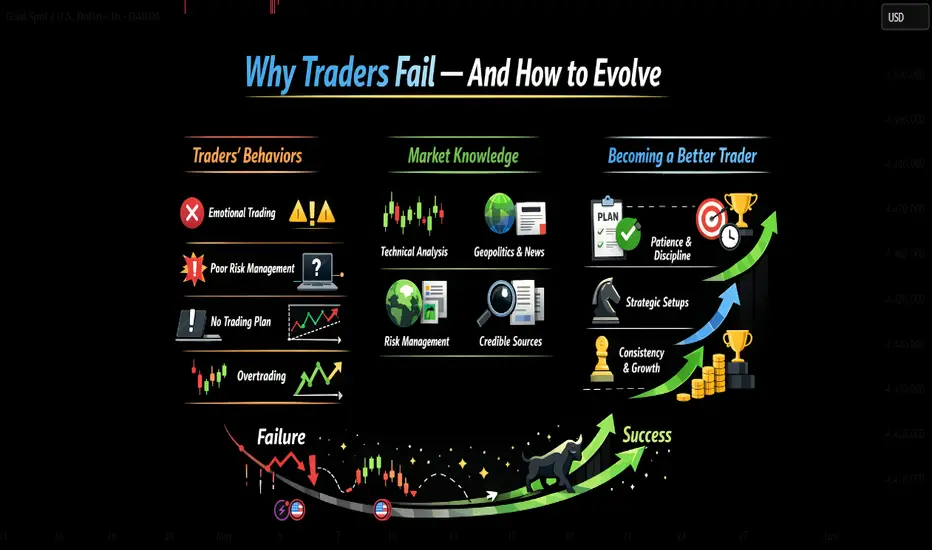
Why Traders Fail — And How to Evolve
Are you repeating the same mistakes? Many traders lose not because of market unpredictability, but because of poor habits, weak knowledge, and lack of discipline. Let’s break down the behaviors that fail traders, the knowledge they must keep, and the practices that can transform them into consistent performers.
Behaviors That Fail Traders
Trading without a structured plan or clear entry/exit rules.
Ignoring stop‑losses and risking too much capital per trade.
Emotional trading — revenge trades, panic exits, or overconfidence.
Overtrading, chasing every move, and burning out.
Neglecting diversification, concentrating risk in one asset.
Knowledge to Keep
Successful traders maintain a strong foundation:
Understanding market structure, support/resistance, and indicators.
Tracking macro and geopolitical drivers like wars, central bank policy, and oil shocks.
Applying risk/reward ratios and position sizing rules.
Staying updated through credentialed sources — Bloomberg, Reuters, central bank reports, institutional research.
Journaling trades to learn from past decisions.
Practices That Build Better Traders
Improvement comes from discipline and process:
Wait for high‑probability setups instead of forcing trades.
Apply strict stop‑losses and never widen them under pressure.
Balance lifestyle and trading hours to avoid burnout.
Review trades weekly to refine strategies.
Treat trading as a marathon, not a sprint.
Smart but Overlooked Trading Insights
Avoid confirmation bias: Don’t seek charts or opinions that only support your trade idea — challenge your own analysis.
Respect timeframes: A setup valid on the 4‑hour chart may fail on the 15‑minute; align your strategy with your timeframe.
Don’t trade boredom: Many losses come from forcing trades when the market is quiet. Patience is a position too.
Track volatility cycles: Learn when markets expand or contract; volatility compression often precedes explosive moves.
Use correlation awareness: Watch how gold reacts to USD, yields, and oil — correlations shift during geopolitical stress.
Master trade journaling: Record not just entries and exits, but emotions and reasoning; patterns of behavior reveal weaknesses.
Learn from losing trades: A well‑managed loss teaches more than a lucky win — analyze what went right in execution.
Stay data‑driven: Use institutional sources (Bloomberg, Reuters, CME data) to validate sentiment, not social media noise.
Summary
Trading success is built on discipline, risk control, and continuous learning. Avoiding common mistakes, applying structured strategies, and staying informed through credible resources can transform failure into consistency.
My Opinion
In my view, traders fail when they chase profits instead of building resilience. The market will always be unpredictable, but those who respect risk, stay updated with reliable information, and refine their process daily are the ones who endure. Becoming a better trader is about consistency, patience, and preparation — not shortcuts.
Are you repeating the same mistakes? Many traders lose not because of market unpredictability, but because of poor habits, weak knowledge, and lack of discipline. Let’s break down the behaviors that fail traders, the knowledge they must keep, and the practices that can transform them into consistent performers.
Behaviors That Fail Traders
Trading without a structured plan or clear entry/exit rules.
Ignoring stop‑losses and risking too much capital per trade.
Emotional trading — revenge trades, panic exits, or overconfidence.
Overtrading, chasing every move, and burning out.
Neglecting diversification, concentrating risk in one asset.
Knowledge to Keep
Successful traders maintain a strong foundation:
Understanding market structure, support/resistance, and indicators.
Tracking macro and geopolitical drivers like wars, central bank policy, and oil shocks.
Applying risk/reward ratios and position sizing rules.
Staying updated through credentialed sources — Bloomberg, Reuters, central bank reports, institutional research.
Journaling trades to learn from past decisions.
Practices That Build Better Traders
Improvement comes from discipline and process:
Wait for high‑probability setups instead of forcing trades.
Apply strict stop‑losses and never widen them under pressure.
Balance lifestyle and trading hours to avoid burnout.
Review trades weekly to refine strategies.
Treat trading as a marathon, not a sprint.
Smart but Overlooked Trading Insights
Avoid confirmation bias: Don’t seek charts or opinions that only support your trade idea — challenge your own analysis.
Respect timeframes: A setup valid on the 4‑hour chart may fail on the 15‑minute; align your strategy with your timeframe.
Don’t trade boredom: Many losses come from forcing trades when the market is quiet. Patience is a position too.
Track volatility cycles: Learn when markets expand or contract; volatility compression often precedes explosive moves.
Use correlation awareness: Watch how gold reacts to USD, yields, and oil — correlations shift during geopolitical stress.
Master trade journaling: Record not just entries and exits, but emotions and reasoning; patterns of behavior reveal weaknesses.
Learn from losing trades: A well‑managed loss teaches more than a lucky win — analyze what went right in execution.
Stay data‑driven: Use institutional sources (Bloomberg, Reuters, CME data) to validate sentiment, not social media noise.
Summary
Trading success is built on discipline, risk control, and continuous learning. Avoiding common mistakes, applying structured strategies, and staying informed through credible resources can transform failure into consistency.
My Opinion
In my view, traders fail when they chase profits instead of building resilience. The market will always be unpredictable, but those who respect risk, stay updated with reliable information, and refine their process daily are the ones who endure. Becoming a better trader is about consistency, patience, and preparation — not shortcuts.

Wyłączenie odpowiedzialności
Informacje i publikacje nie stanowią i nie powinny być traktowane jako porady finansowe, inwestycyjne, tradingowe ani jakiekolwiek inne rekomendacje dostarczane lub zatwierdzone przez TradingView. Więcej informacji znajduje się w Warunkach użytkowania.
Wyłączenie odpowiedzialności
Informacje i publikacje nie stanowią i nie powinny być traktowane jako porady finansowe, inwestycyjne, tradingowe ani jakiekolwiek inne rekomendacje dostarczane lub zatwierdzone przez TradingView. Więcej informacji znajduje się w Warunkach użytkowania.