
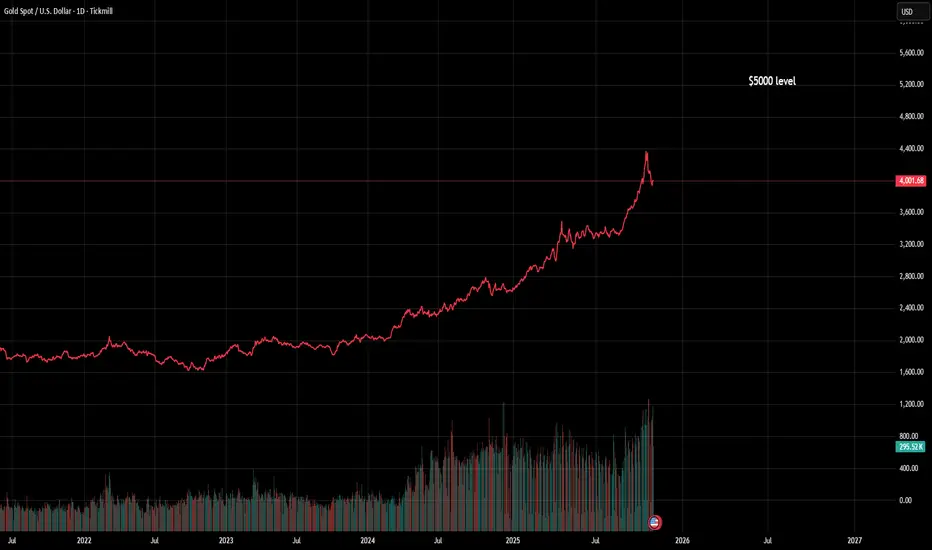
3 Nov 2025, Kuala Lumpur Malaysia - Why I Think Gold can Reach $5000/oz
Executive Summary
Macro tailwinds: The Federal Reserve has shifted dovish by cutting rates and pausing balance-sheet reduction, which lowers the opportunity cost of holding gold.
Institutional & central bank demand: Central banks remain meaningful net buyers ETFs and institutional flows are turning positive again.
Structural supply constraints: Mining grades are declining, capex rises, and new supply is sluggish making supply less responsive to price.
Market sentiment & risk climate: Despite the rally to ~US $4,000/oz, gold retains safe-haven appeal amid fiscal deficits, inflation uncertainty and geopolitical risks.
Current Market Landscape
Spot gold is trading near US $4,000/oz, after a strong 2025 advance. The market is in a “buy-the-dip” mode.
Media and analyst sentiment is “cautiously bullish” safe haven narrative remains intact even with mixed economic data.
Institutional positioning: Managed-money funds still carry net longs in the futures market; ETF flows recently slowed but positive structural trend remains.
Key Fundamental Drivers
Monetary policy & real yields
The Fed cut policy rate (e.g., Oct 29) and paused QT reducing the real cost of holding non-yielding gold.
Real yields (10-yr TIPS) remain around ~1.5–2%: such levels create a friendly backdrop for gold.
Fiscal deficits & debt dynamics
US federal deficit remains large (e.g., FY2025 > US$1.8T) and yields/duration risks are elevated. Investors increasingly view gold as a hedge.
Demand from central banks & institutions
Q3 2025: Central banks added ~220 tonnes of gold still well above long term averages.
ETFs and institutional flows are showing renewed interest an important supporting driver for price continuation.
Supply side constraints
Global gold mine production is increasing slowly but new supply is constrained by declining ore grades, higher capex, and permitting issues so gold supply is relatively inelastic.
Sentiment & Positioning
Managed-money net longs remain elevated, signaling structural bullishness but also warns of potential shakeouts during corrections.
ETF flows after strong inflows earlier in the year, some recent outflows could signal short-term consolidation rather than trend reversal.
Risk sentiment elevated geopolitical risk, inflation concerns, and economic uncertainty keep the safe haven bid for gold alive.
Supply–Demand Picture (2025)
Demand side: Central bank purchases + institutional/ETF inflows are major drivers.
Supply side: Mining output growth is limited; new, large scale expansions are rare and take many years. Less responsive supply = higher upside potential when demand ramps.
Path to US $5,000/Oz
Base case (bullish grind):
Real yields stable or falling (≤ ~1.5–1.8%)
Central banks continue buying, institutional flows turn net positive
Supply remains tight
→ A move to US $4,500-4,800/oz over next 3–6 months; $5,000 becomes realistic if momentum picks up.
Bull extension case (fast breakout):
Real yields drop sharply, Fed signals further cuts
Strong inflows into ETFs and increased physical demand
Geopolitical shock or inflation surprise
→ Potential overshoot to US $5,200-5,500/oz.
Risk (bear detour):
Real yields rise considerably (>2%)
Strong USD rally, large ETF outflows
→ Possible pullback to US $3,550-3,900/oz – still a structural buy zone if fundamental drivers remain intact.
What Are Institutions & Banks Doing?
Central banks: Still net buyers Q3 2025 saw ~+220t of purchases, indicating that official sector continues accumulating gold.
Institutions (ETFs, funds): After earlier strong inflows, there have been short-term outflows—a typical healthy consolidation in a larger uptrend.
Miners & producers: Higher gold prices improving margin, but many companies warn that future supply growth will be slow—supporting the tight supply narrative.
Technical & Action Plan
Key support zones: ~US $3,900-3,950 (last major pullback); if breached, next structural support is ~US $3,550-3,600.
Momentum trigger: A clear rebound and hold above ~US $4,250-4,300 would open space toward ~US $4,500-4,800.
Breakout validation: To aim for US $5,000, gold needs to clear its recent highs, hold above, and see confirmation via inflows & yield dynamics.
Suggested post headline:
“XAUUSD Structural Path to $5,000: Central-Bank Buying, Low Real Yields, Tight Supply. Pullbacks = Opportunity.”
Suggested call to action:
“Watch for support around 3,900–3,950; a clean rebound and hold above 4,300 could trigger the next leg. Managing risk with stop-loss below 3,550 in case of real-yield shock.”
Key Risks to Mention
-A surprise hawkish turn by the Fed (inflation too strong) → Real yields spike, USD rallies.
-Prolonged ETF outflows or liquidity crunch hitting gold.
-Rapid supply response (unlikely short-term but possible long term).
-Geopolitical de-escalation reducing safe-haven demand unexpectedly.
Zezu Zaza
2048
Executive Summary
Macro tailwinds: The Federal Reserve has shifted dovish by cutting rates and pausing balance-sheet reduction, which lowers the opportunity cost of holding gold.
Institutional & central bank demand: Central banks remain meaningful net buyers ETFs and institutional flows are turning positive again.
Structural supply constraints: Mining grades are declining, capex rises, and new supply is sluggish making supply less responsive to price.
Market sentiment & risk climate: Despite the rally to ~US $4,000/oz, gold retains safe-haven appeal amid fiscal deficits, inflation uncertainty and geopolitical risks.
Current Market Landscape
Spot gold is trading near US $4,000/oz, after a strong 2025 advance. The market is in a “buy-the-dip” mode.
Media and analyst sentiment is “cautiously bullish” safe haven narrative remains intact even with mixed economic data.
Institutional positioning: Managed-money funds still carry net longs in the futures market; ETF flows recently slowed but positive structural trend remains.
Key Fundamental Drivers
Monetary policy & real yields
The Fed cut policy rate (e.g., Oct 29) and paused QT reducing the real cost of holding non-yielding gold.
Real yields (10-yr TIPS) remain around ~1.5–2%: such levels create a friendly backdrop for gold.
Fiscal deficits & debt dynamics
US federal deficit remains large (e.g., FY2025 > US$1.8T) and yields/duration risks are elevated. Investors increasingly view gold as a hedge.
Demand from central banks & institutions
Q3 2025: Central banks added ~220 tonnes of gold still well above long term averages.
ETFs and institutional flows are showing renewed interest an important supporting driver for price continuation.
Supply side constraints
Global gold mine production is increasing slowly but new supply is constrained by declining ore grades, higher capex, and permitting issues so gold supply is relatively inelastic.
Sentiment & Positioning
Managed-money net longs remain elevated, signaling structural bullishness but also warns of potential shakeouts during corrections.
ETF flows after strong inflows earlier in the year, some recent outflows could signal short-term consolidation rather than trend reversal.
Risk sentiment elevated geopolitical risk, inflation concerns, and economic uncertainty keep the safe haven bid for gold alive.
Supply–Demand Picture (2025)
Demand side: Central bank purchases + institutional/ETF inflows are major drivers.
Supply side: Mining output growth is limited; new, large scale expansions are rare and take many years. Less responsive supply = higher upside potential when demand ramps.
Path to US $5,000/Oz
Base case (bullish grind):
Real yields stable or falling (≤ ~1.5–1.8%)
Central banks continue buying, institutional flows turn net positive
Supply remains tight
→ A move to US $4,500-4,800/oz over next 3–6 months; $5,000 becomes realistic if momentum picks up.
Bull extension case (fast breakout):
Real yields drop sharply, Fed signals further cuts
Strong inflows into ETFs and increased physical demand
Geopolitical shock or inflation surprise
→ Potential overshoot to US $5,200-5,500/oz.
Risk (bear detour):
Real yields rise considerably (>2%)
Strong USD rally, large ETF outflows
→ Possible pullback to US $3,550-3,900/oz – still a structural buy zone if fundamental drivers remain intact.
What Are Institutions & Banks Doing?
Central banks: Still net buyers Q3 2025 saw ~+220t of purchases, indicating that official sector continues accumulating gold.
Institutions (ETFs, funds): After earlier strong inflows, there have been short-term outflows—a typical healthy consolidation in a larger uptrend.
Miners & producers: Higher gold prices improving margin, but many companies warn that future supply growth will be slow—supporting the tight supply narrative.
Technical & Action Plan
Key support zones: ~US $3,900-3,950 (last major pullback); if breached, next structural support is ~US $3,550-3,600.
Momentum trigger: A clear rebound and hold above ~US $4,250-4,300 would open space toward ~US $4,500-4,800.
Breakout validation: To aim for US $5,000, gold needs to clear its recent highs, hold above, and see confirmation via inflows & yield dynamics.
Suggested post headline:
“XAUUSD Structural Path to $5,000: Central-Bank Buying, Low Real Yields, Tight Supply. Pullbacks = Opportunity.”
Suggested call to action:
“Watch for support around 3,900–3,950; a clean rebound and hold above 4,300 could trigger the next leg. Managing risk with stop-loss below 3,550 in case of real-yield shock.”
Key Risks to Mention
-A surprise hawkish turn by the Fed (inflation too strong) → Real yields spike, USD rallies.
-Prolonged ETF outflows or liquidity crunch hitting gold.
-Rapid supply response (unlikely short-term but possible long term).
-Geopolitical de-escalation reducing safe-haven demand unexpectedly.
Zezu Zaza
2048

Zezu Zaza
2048
2048
Powiązane publikacje
Wyłączenie odpowiedzialności
Informacje i publikacje nie stanowią i nie powinny być traktowane jako porady finansowe, inwestycyjne, tradingowe ani jakiekolwiek inne rekomendacje dostarczane lub zatwierdzone przez TradingView. Więcej informacji znajduje się w Warunkach użytkowania.
Zezu Zaza
2048
2048
Powiązane publikacje
Wyłączenie odpowiedzialności
Informacje i publikacje nie stanowią i nie powinny być traktowane jako porady finansowe, inwestycyjne, tradingowe ani jakiekolwiek inne rekomendacje dostarczane lub zatwierdzone przez TradingView. Więcej informacji znajduje się w Warunkach użytkowania.