
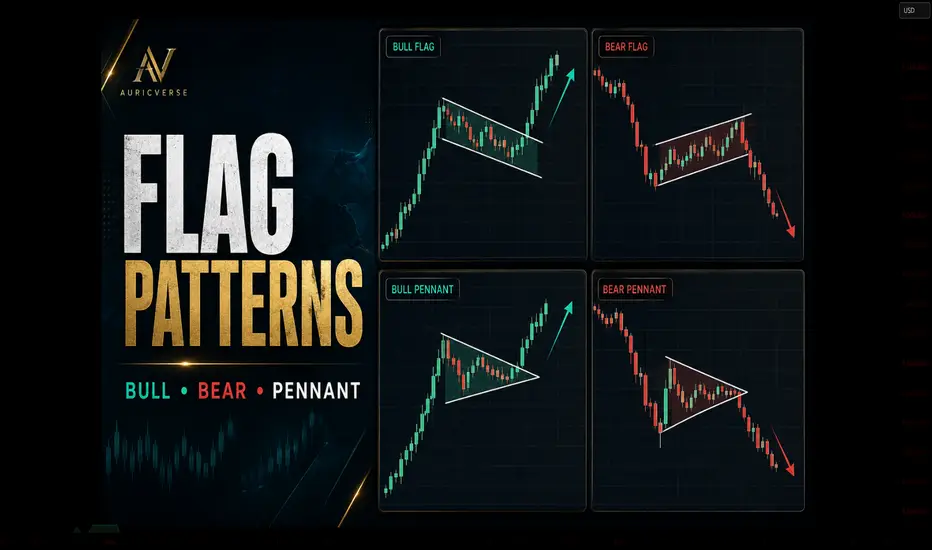
Flag patterns are continuation setups that usually appear after a strong directional move. The key is not the shape alone, but the sequence behind it:
Impulse → Consolidation → Breakout → Continuation
1. Bull Flag
A strong bullish impulse is followed by a controlled pullback inside a small downward or sideways channel. If buyers break the upper boundary while the broader trend remains bullish, continuation becomes more likely.
Strong push → controlled pullback → breakout higher
2. Bear Flag
After a sharp selloff, price recovers inside a small rising channel. The bounce can look bullish, but if the larger structure remains weak and price breaks the lower boundary, sellers may regain control.
Strong selloff → weak recovery → breakdown
3. Bull Pennant
Instead of forming a parallel channel, price compresses into a small triangle after a bullish impulse. Lower highs and higher lows show tightening conditions. A breakout higher can restart the original bullish move.
4. Bear Pennant
A strong bearish move is followed by tightening consolidation. If price breaks below the pennant while the broader bearish structure remains intact, continuation lower becomes the main scenario.
How AURICVERSE Reads Flags
1. A real impulse — weak momentum before the pattern usually means a weaker setup.
2. Controlled consolidation — not a messy, volatile range.
3. Trend alignment — continuation setups work better when they follow the larger structure.
4. A confirmed breakout — recognizing the pattern is not the same as having an entry.
My preferred sequence is:
Impulse → Pause → Breakout → Confirmation → Execution
Not:
Looks like a Flag → Enter immediately.
Flags can still fail. I become cautious when the pullback retraces too much of the original move, the breakout quickly returns inside the pattern, or the setup forms directly into major support or resistance.
AURICVERSE Takeaway
The Flag itself is not the edge.
The edge is recognizing when momentum pauses without losing structure.
Strong move. Controlled pause. Clean breakout. Clear invalidation.
Good traders do not trade every pattern they recognize. They wait for the ones that make sense in context.

AuricVerse Research | Crypto macro desk
Dominance · Stablecoin flows · Liquidity · BTC structure
Daily notes and setups, free on Telegram:
t.me/+3A2sr9LZDfY5Mzll
For education only. Not investment advice.
Dominance · Stablecoin flows · Liquidity · BTC structure
Daily notes and setups, free on Telegram:
t.me/+3A2sr9LZDfY5Mzll
For education only. Not investment advice.
Wyłączenie odpowiedzialności
Informacje i publikacje nie stanowią i nie powinny być traktowane jako porady finansowe, inwestycyjne, tradingowe ani jakiekolwiek inne rekomendacje dostarczane lub zatwierdzone przez TradingView. Więcej informacji znajduje się w Warunkach użytkowania.