Zaktualizowano
[blackcat] L2 Swing Oscillator Swing Meter
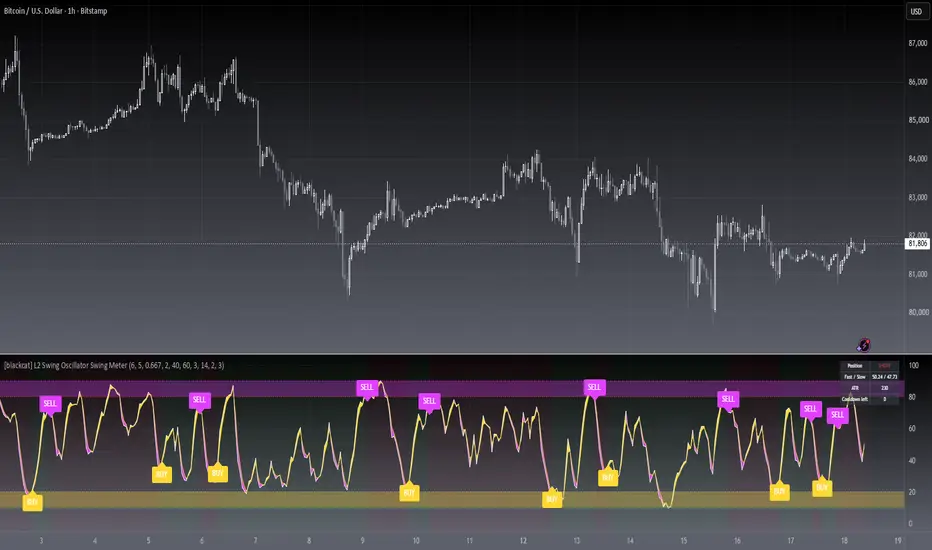
Level: 2
Background
Swing trading is a type of trading aimed at making short to medium term profits from a trading pair over a period of a few days to several weeks. Swing traders mainly use technical analysis to look for trading opportunities. In addition to analyzing price trends and patterns, these traders can also use fundamental analysis.
Function
[blackcat] L2 Swing Oscillator Swing Meter is an oscillator based on breakouts. Another important feature of it is the swing meter, which confirms the top or bottom's confidence level with different color candles. The higher of the candles stack up, the higher confidence level is indicated.
Key Signal
absolutebot ---> absolute bottom with very high confidence level
ltbot ---> long term bottom with high confidence level
mtbot ---> middle term bottom with moderate confidence level
stbot ---> short term bottom with low confidence level
absolutetop ---> absolute top with very high confidence level
lttop ---> long term top with high confidence level
mttop ---> middle term top with moderate confidence level
sttop ---> short term top with low confidence level
fastline ---> oscillator fast line
slowline ---> oscillator slow line
Pros and Cons
Pros:
1. reconfigurable swing oscillator based on breakouts
2. swing meter can confirm/validate the bottom and top signal
Cons:
1. not appliable with trading pairs without volume information
2. small time frame may not trigger swing meter function
Remarks
This is a simple but very comprehensive technical indicator
Readme
In real life, I am a prolific inventor. I have successfully applied for more than 60 international and regional patents in the past 12 years. But in the past two years or so, I have tried to transfer my creativity to the development of trading strategies. Tradingview is the ideal platform for me. I am selecting and contributing some of the hundreds of scripts to publish in Tradingview community. Welcome everyone to interact with me to discuss these interesting pine scripts.
The scripts posted are categorized into 5 levels according to my efforts or manhours put into these works.
Level 1 : interesting script snippets or distinctive improvement from classic indicators or strategy. Level 1 scripts can usually appear in more complex indicators as a function module or element.
Level 2 : composite indicator/strategy. By selecting or combining several independent or dependent functions or sub indicators in proper way, the composite script exhibits a resonance phenomenon which can filter out noise or fake trading signal to enhance trading confidence level.
Level 3 : comprehensive indicator/strategy. They are simple trading systems based on my strategies. They are commonly containing several or all of entry signal, close signal, stop loss, take profit, re-entry, risk management, and position sizing techniques. Even some interesting fundamental and mass psychological aspects are incorporated.
Level 4 : script snippets or functions that do not disclose source code. Interesting element that can reveal market laws and work as raw material for indicators and strategies. If you find Level 1~2 scripts are helpful, Level 4 is a private version that took me far more efforts to develop.
Level 5 : indicator/strategy that do not disclose source code. private version of Level 3 script with my accumulated script processing skills or a large number of custom functions. I had a private function library built in past two years. Level 5 scripts use many of them to achieve private trading strategy.
Informacje o Wersji
OVERVIEWThe "[blackcat] L2 Swing Oscillator Swing Meter" is a technical analysis tool designed to identify overbought/oversold market conditions through price-volume relationship calculations. It provides visual swing line signals and trading alerts based on adaptive thresholds.
FEATURES
• Dual moving average system: Fast (white) & Slow (yellow) swing lines
• Adaptive threshold detection via:
Volume profile weighted calculation
Price normalization algorithm • Interactive alert zones: • Fuchsia critical zone (>90) • Red warning zone (80-90) • Yellow neutral zone (20-80) • Lime bullish zone (<20) • Buy/Sell signal markers with dynamic colors: ✓ Green up-pointing arrows for bottoms ✓ Magenta down-pointing arrows for tops
HOW TO USE
Configure parameters:
Lookback Period 1 (default 6): Base cycle window
Lookback Period 2 (default 5): Smoothing parameter
Interpret readings:
Values between 20-80 indicate normal ranges
Crossings above/below these levels trigger warnings/critical states
Bullish divergence = rising prices with falling oscillator
Trade signals occur when:
→ Fast line crosses above slow line below 40 → BUY signal
→ Fast line crosses below slow line above 60 → SELL signal
LIMITATIONS
• High volatility periods may cause false signals due to rapid trend reversals
• Parameter optimization required for different timeframes/assets
• Not recommended as standalone indicator during news events
Informacje o Wersji
█ OVERVIEWL2 Swing Oscillator Swing Meter turns price range dynamics into a two-line swing oscillator and grades every swing with governed BUY/SELL signals, ATR-based take-profit and stop-loss reference levels, and a live position dashboard. This V2 polish adds a position state machine, signal cooldown, alert channels, and full on-chart visualization to the original concept.
█ CONCEPTS
The engine is a normalized range oscillator: the position of price inside the highest-high/lowest-low window is smoothed into a fast swing line, then blended with its previous value into a slow swing line. Crossovers of the two lines inside extreme zones define the trade signals.
Key principles:
• A BUY fires when the fast line crosses above the slow line below the bottom threshold (default 40)
• A SELL fires when the fast line crosses under the slow line above the top threshold (default 60)
• A position state machine allows one position at a time, resolves same-bar entry/exit conflicts in favor of reversals, and applies an optional cooldown between signals
• Stop-loss and take-profit reference levels scale with ATR, so distance adapts to each market's volatility
• Signals evaluate on bar close only — no intrabar repainting
█ HOW TO USE
1 — Add the script to the chart; it opens in its own pane below price with sensible defaults
2 — Tune Core Settings to your market: lookback windows shape the swing, thresholds shape where signals may fire
3 — Read the labels: a yellow BUY tag under the lines starts a long, a purple SELL tag above the lines starts a short, orange XL/XS crosses mark signal exits
4 — Watch the red/teal stepped lines for the ATR stop-loss and take-profit reference of the active position
5 — Open the alert dialog and pick one of the four conditions, or create an "Any alert() function call" alert for dynamic messages
Input Parameters
Core Settings
• Look back period 1 (6): window for the highest-high / lowest-low range
• Look back period 2 (5): EMA smoothing applied to the fast swing line
• Slow Line Weight (0.667): weight of the previous fast value inside the slow line
• Slow Line EMA Length (2): EMA length of the slow swing line
• Bottom Zone Threshold (40): fast line must sit below this for a BUY
• Top Zone Threshold (60): fast line must sit above this for a SELL
Signal Governance
• Same-bar Entry/Exit Exclusivity (on): when a reversal satisfies both sides on one bar, entry wins and the state flips directly
• Cooldown Bars (3, 0 = off): minimum number of bars required between two signals
Risk (ATR TP/SL)
• Show ATR TP/SL Levels (on): draws the reference lines while a position is active
• ATR Length (14): averaging window of the ATR
• Stop Loss (xATR) (2.0): stop distance as a multiple of ATR below/above entry close
• Take Profit (xATR) (3.0): target distance as a multiple of ATR beyond entry close
Visual
• Position Background (on): light green/red tint marks long/short state
• Show Dashboard (on): top-right panel with position, fast/slow values, ATR, and cooldown countdown
█ FEATURES
• Four alertcondition channels: Long Entry, Short Entry, Long Exit, Short Exit
• Dynamic alert() messages including ticker and timeframe placeholders, confirmed on bar close
• Position state machine with same-bar exclusivity and cooldown governance
• ATR-scaled stop-loss and take-profit reference levels per position
• On-chart dashboard and position background with independent switches
• Label management capped at 500 via max_labels_count
• A hidden volume-oscillator research series retained in the data window from the original version
█ SIGNALS
Visual Elements
• BUY (yellow label-up): fast swing line crossed above the slow line while below the bottom threshold, from a flat or short state
• SELL (purple label-down): fast swing line crossed under the slow line while above the top threshold, from a flat or long state
• XL / XS (orange cross): long/short closed by the opposite signal
• Red stepped line: ATR stop-loss reference from the entry close
• Teal stepped line: ATR take-profit reference from the entry close
• Green / red background tint: active long / active short state
• Data window extras: Position State (1 / 0 / -1) and the volume oscillator research value
█ IMPLEMENTATION NOTES
Built on ta.highest/ta.lowest for the range, ta.ema for smoothing, ta.crossover/ta.crossunder for edges, and ta.atr for risk distances. All stateful calls run unconditionally on every bar, so history stays consistent. Division guards protect the range and volume normalizations, and every alert fires with alert.freq_once_per_bar_close. The original single-shot labels were upgraded to a governed label flow with max_labels_count = 500.
█ LIMITATIONS
• Swing-crossover systems whipsaw in tight ranges; the cooldown reduces but does not eliminate noise
• TP/SL lines are reference levels drawn from the entry close, not executable orders — this is an indicator, not a strategy
• Oscillator output normalizes to 0-100; thresholds may need retuning per market and timeframe
• The hidden volume-oscillator series depends on reliable volume data
█ NOTES
• Original concept by blackcat; the V2 polish adds signal governance, risk levels, alerts, and visualization
• Source is provided under the Mozilla Public License 2.0
════════════════════════════════════════════════════════════════════════
For questions or feedback, please use the comments section below.
Feel free to use and modify — attribution appreciated.

Don't miss out! The first and most important thing to do is to join my Discord chat now! Click here to start your adventure: discord.com/invite/ZTGpQJq My new github for more pine development soon: github.com/wxt-coder
Wyłączenie odpowiedzialności
Informacje i publikacje nie stanowią i nie powinny być traktowane jako porady finansowe, inwestycyjne, tradingowe ani jakiekolwiek inne rekomendacje dostarczane lub zatwierdzone przez TradingView. Więcej informacji znajduje się w Warunkach użytkowania.