OPEN-SOURCE SCRIPT
Skippy the Indicator v1.8.4
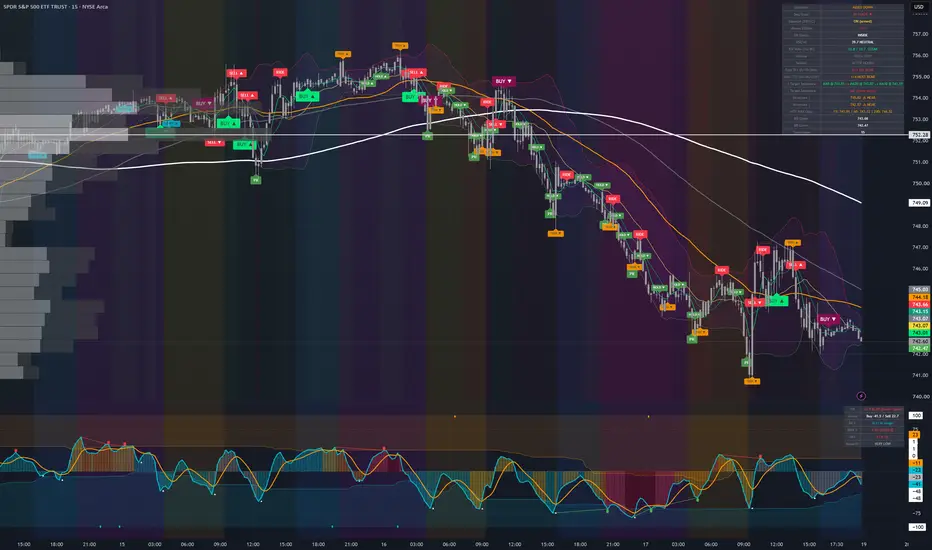
Multi-timeframe MA-structure framework for short-timeframe momentum trading. Codifies a full squeeze-to-exit sequence — squeeze arming, 50ma curl, MA-stack trigger, MA5 ride, staged exit — into plain-language labels, a state machine, and a dashboard.
THE SEQUENCE
The core logic walks one setup from start to finish:
WATCH → READY → BUY → HOLD → TRIM or SELL
WATCH — Squeeze armed. Bollinger Bands are inside the Keltner Channels; energy is compressing.
READY ▲/▼ — The 50ma has begun to curl in the trade direction. Early heads-up.
BUY ▲/▼ — Gamma trigger. MA5, MA10, and MA20 have all closed beyond the 50ma, with the required number of confirmation closes (user-set, default 1). A ★ on the BUY marks a full-sequence setup: squeeze → curl → cross.
HOLD ▲/▼ — Price retested the MA5 and held (the glue). Trend intact.
TRIM ▲/▼ — MA5 glue failed. The leg is done but the thesis is alive. Lighten and watch for re-entry. This is NOT an exit signal.
SELL ▲/▼ — Price rejected at the 50ma with confirmed closes. Thesis dead.
TRIM vs SELL is the one distinction not to blur: orange means the leg ended, red means the trade ended.
A Display toggle switches all labels to technical names (ARMED / CURL / GLUE ✓✗ / ✕50) if you prefer.
REVERSAL SIGNALS
PR — Potential Reversal at a Bollinger Band extreme, RSI-confirmed. As of v0.8.4, PR fires intrabar the moment the high/low touches the band — non-repainting, since a bar's high/low can only extend, never retract. A toggle restores close-confirmed firing. PR is a mean-reversion signal and misfires in strong trends by design — that is what HOLD and the Direction row are for.
RIDE logic converts a failed fade into a continuation read: PR fires, then MA5 holds on the retest — the fade failed and the prior trend is resuming.
DASHBOARD
Seq State in plain language (WAITING / WATCHING / GETTING READY / IN TRADE / LEG DONE — WATCH RE-ENTRY), Direction from full MA-stack alignment, RSI veto row, Fast TFs (5/15/30m) and Slow TFs (1h/4h/D/W) bullish counts, cascading three-level target sequence, structure proximity (previous highs/lows, necklines — wick-measured as of v0.8.4), session window, and volume (informational only — it never gates signals).
Display options: Full (19 rows) or Compact (9 rows), Tiny/Small/Normal text size, and position. On phones use Compact + Tiny + bottom right.
ALERTS
Every label has a matching alert, and push notifications lead with the action word ("BUY ▲ — MA5/10/20 closed above 50ma"). PR and structure alerts use touch semantics — set alert frequency to "Once per bar."
READING IT
Trigger and exit logic is close-confirmed on the chart timeframe: "through" a level means a confirmed close, not a wick. The state machine reads one chart — always check higher timeframes before acting. Fast/slow TF agreement is the conviction read; disagreement is information (fast bear + slow bull = pullback in an uptrend, fast bull + slow bear = bounce in a downtrend).
This is a study and visual-verification tool, not trade advice and not an executor. The label words are signal names, not instructions — nothing here is a recommendation to buy or sell anything. Judge the signals against what actually happens and size your own risk.
THE SEQUENCE
The core logic walks one setup from start to finish:
WATCH → READY → BUY → HOLD → TRIM or SELL
WATCH — Squeeze armed. Bollinger Bands are inside the Keltner Channels; energy is compressing.
READY ▲/▼ — The 50ma has begun to curl in the trade direction. Early heads-up.
BUY ▲/▼ — Gamma trigger. MA5, MA10, and MA20 have all closed beyond the 50ma, with the required number of confirmation closes (user-set, default 1). A ★ on the BUY marks a full-sequence setup: squeeze → curl → cross.
HOLD ▲/▼ — Price retested the MA5 and held (the glue). Trend intact.
TRIM ▲/▼ — MA5 glue failed. The leg is done but the thesis is alive. Lighten and watch for re-entry. This is NOT an exit signal.
SELL ▲/▼ — Price rejected at the 50ma with confirmed closes. Thesis dead.
TRIM vs SELL is the one distinction not to blur: orange means the leg ended, red means the trade ended.
A Display toggle switches all labels to technical names (ARMED / CURL / GLUE ✓✗ / ✕50) if you prefer.
REVERSAL SIGNALS
PR — Potential Reversal at a Bollinger Band extreme, RSI-confirmed. As of v0.8.4, PR fires intrabar the moment the high/low touches the band — non-repainting, since a bar's high/low can only extend, never retract. A toggle restores close-confirmed firing. PR is a mean-reversion signal and misfires in strong trends by design — that is what HOLD and the Direction row are for.
RIDE logic converts a failed fade into a continuation read: PR fires, then MA5 holds on the retest — the fade failed and the prior trend is resuming.
DASHBOARD
Seq State in plain language (WAITING / WATCHING / GETTING READY / IN TRADE / LEG DONE — WATCH RE-ENTRY), Direction from full MA-stack alignment, RSI veto row, Fast TFs (5/15/30m) and Slow TFs (1h/4h/D/W) bullish counts, cascading three-level target sequence, structure proximity (previous highs/lows, necklines — wick-measured as of v0.8.4), session window, and volume (informational only — it never gates signals).
Display options: Full (19 rows) or Compact (9 rows), Tiny/Small/Normal text size, and position. On phones use Compact + Tiny + bottom right.
ALERTS
Every label has a matching alert, and push notifications lead with the action word ("BUY ▲ — MA5/10/20 closed above 50ma"). PR and structure alerts use touch semantics — set alert frequency to "Once per bar."
READING IT
Trigger and exit logic is close-confirmed on the chart timeframe: "through" a level means a confirmed close, not a wick. The state machine reads one chart — always check higher timeframes before acting. Fast/slow TF agreement is the conviction read; disagreement is information (fast bear + slow bull = pullback in an uptrend, fast bull + slow bear = bounce in a downtrend).
This is a study and visual-verification tool, not trade advice and not an executor. The label words are signal names, not instructions — nothing here is a recommendation to buy or sell anything. Judge the signals against what actually happens and size your own risk.
Skrypt open-source
W zgodzie z duchem TradingView twórca tego skryptu udostępnił go jako open-source, aby użytkownicy mogli przejrzeć i zweryfikować jego działanie. Ukłony dla autora. Korzystanie jest bezpłatne, jednak ponowna publikacja kodu podlega naszym Zasadom serwisu.

Wyłączenie odpowiedzialności
Informacje i publikacje nie stanowią i nie powinny być traktowane jako porady finansowe, inwestycyjne, tradingowe ani jakiekolwiek inne rekomendacje dostarczane lub zatwierdzone przez TradingView. Więcej informacji znajduje się w Warunkach użytkowania.
Skrypt open-source
W zgodzie z duchem TradingView twórca tego skryptu udostępnił go jako open-source, aby użytkownicy mogli przejrzeć i zweryfikować jego działanie. Ukłony dla autora. Korzystanie jest bezpłatne, jednak ponowna publikacja kodu podlega naszym Zasadom serwisu.
Wyłączenie odpowiedzialności
Informacje i publikacje nie stanowią i nie powinny być traktowane jako porady finansowe, inwestycyjne, tradingowe ani jakiekolwiek inne rekomendacje dostarczane lub zatwierdzone przez TradingView. Więcej informacji znajduje się w Warunkach użytkowania.