OPEN-SOURCE SCRIPT
BK AK-Desert Eagle
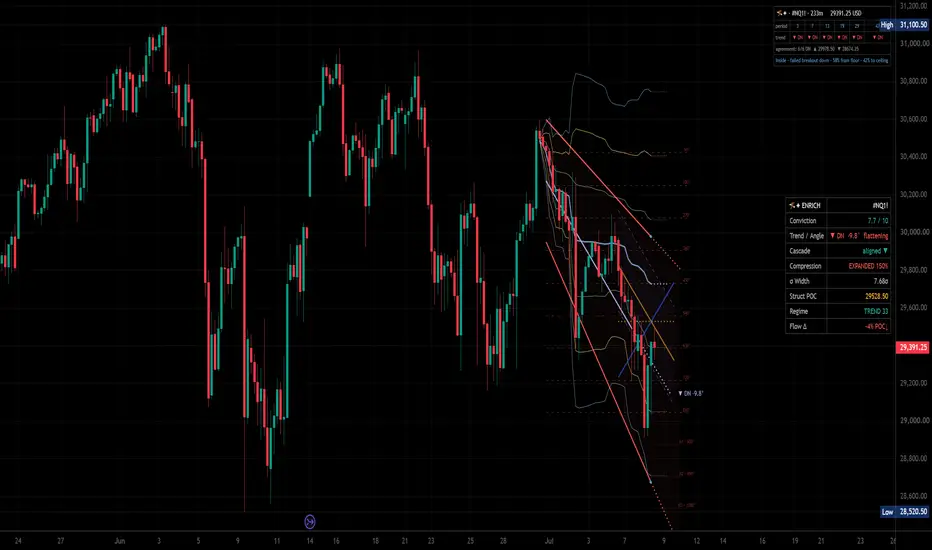
🦅✦ BK AK-Desert Eagle — Lock the Rail. Read the Angle. Fire the Level. ✦🦅
This one was built for traders who don’t want weak trendlines, lagging channels, random support/resistance, or useless structure reads.
They want the chart to answer:
What is the real structural direction?
Where are the active rails?
Is price inside, breaking out, retesting, failing, or extending?
Where are the Gann/Square of 9 levels, VWAP pressure points, POC zones, and compression triggers?
Is this move clean, trapped, exhausted, or ready to fire?
BK AK-Desert Eagle is a tactical structural-trend engine built around σ-normalized geometry, multi-scale consensus, channel rails, breakout/retest logic, Square of 9 targeting, structural AVWAP, footprint POC/value area, compression/cascade warnings, regime logic, and adaptive learning.
This is not just another trend channel.
This is a precision structure weapon.
🎖 Full Credit — Respect the Origin
This script is an expanded BK fork/evolution of ST-EP06 — Smart Trader, Episode 06: Isotropic Trend Lines, originally derived from TradingView author ata_sabanci.
Full respect and credit to ata_sabanci for the original inspiration/source contribution. He is one of my favorite creators in the entire TradingView community — one of the rare coders whose work combines out-of-the-box thinking, structural intelligence, and real chart performance. His trendline and support/resistance logic doesn’t just look good; it understands how price actually moves.
The original ST-EP06 framework built the foundation: Isotropic Coordinate System (ICS), Yang-Zhang volatility normalization, block-based geometric mean structure, multi-scale channels, and breakout/retest state logic. The original ST-EP06 notes define the ICS framework as normalizing log-price by Yang-Zhang volatility σ so trend angles become comparable across symbols, timeframes, and volatility regimes.
This release is not meant to claim ownership over his work. It is meant to show how that foundation was expanded into a larger BK tactical engine.
On top of that original architecture, I added the BK expansion layer: Structural Square of 9 targeting, Structural Anchored VWAP, Footprint POC / Value Area logic, Compression / Cascade warnings, Adaptive Learning / Ranker logic, regime gating, continuation levels, and tactical signal/dashboard upgrades. The BK AK-Desert Eagle script itself states this lineage and lists these BK-added modules directly in the header.
And as always, AK honors my mentor A.K. His standard of discipline, patience, restraint, and precision sits behind every serious tool I build.
Above all, full credit and gratitude to Gd — the source of wisdom, timing, endurance, and the ability to survive this game without losing your soul.
🧠 What BK AK-Desert Eagle Actually Does
BK AK-Desert Eagle reads market structure through volatility-normalized geometry.
It takes price, transforms it through σ, builds multi-scale structural rails, checks cross-scale agreement, tracks breakout/retest states, and then adds BK-level tactical confluence through Gann, VWAP, POC, compression, regime, and adaptive learning.
It is designed to answer:
Is the market trending or ranging?
Where is the real channel ceiling?
Where is the real channel floor?
Is the breakout clean, failed, retested, or confirmed?
Are Gann/SQ9 levels lining up with structure?
Is VWAP supporting or invalidating the move?
Is footprint POC confirming or fighting the direction?
Is compression building before expansion?
Is the current move gaining conviction or losing internal structure?
This is structure first.
Confluence second.
Execution last.
No random shots.
🧱 Core Weapon Systems
ICS Structural Channel Engine
The heart of the tool is the Isotropic Coordinate System, or ICS.
Price is transformed into:
y = log(price) / σ
That means the indicator is not just drawing visual trendlines. It is reading price through volatility-normalized structural space.
A move on NQ, CL, GC, BTC, ES, or a stock can be compared through the same normalized framework because the move is measured relative to realized volatility.
Raw price movement lies.
Volatility-adjusted movement tells the truth.
Yang-Zhang σ Normalization
The original ST-EP06 framework uses Yang-Zhang volatility σ as the normalization engine. That matters because Yang-Zhang uses a deeper volatility model than simple close-to-close movement, incorporating gap behavior, open-close movement, and range-based variance.
BK AK-Desert Eagle keeps that foundation because it makes the rails more meaningful.
Instead of asking:
How far did price move?
It asks:
How far did price move relative to actual volatility?
That is what separates noise from structural expansion.
Block-Based Geometric Mean Structure
The original framework partitions price history into blocks and reduces each block into a geometric mean using the log-midpoint of high and low.
That gives the engine a cleaner structural center than close-only methods.
Instead of reacting to one candle’s closing price, it reads the block’s high-low structure and finds the central tendency inside the move.
This helps the rails form from structure, not noise.
6-Scale Structural Consensus
BK AK-Desert Eagle analyzes structure across multiple scales:
3 · 7 · 13 · 19 · 29 · 47
These scales create the battlefield map.
A single scale turning is information.
Multiple scales agreeing is structure.
Five or six scales aligned is serious.
The dashboard shows whether the market is aligned, mixed, ranging, compressing, or shifting.
That is where the indicator stops being a simple channel tool and starts acting like a structural command panel.
🎯 Breakout / Retest State Machine
The original ST-EP06 framework uses a breakout/retest state engine that tracks whether price is inside the channel, breaking out, breaking down, or retesting after a break.
BK AK-Desert Eagle keeps that core state logic and builds around it.
The goal is simple:
Do not just mark that price crossed a line.
Understand what happened after the cross.
Did price break and run?
Did it retest?
Did it fail?
Did it reclaim?
Did it trap?
Did it lose structure?
A breakout without follow-through is not the same as a breakout with confirmation.
A breakdown into support is not the same as a breakdown with continuation.
This tool is built to separate the two.
📐 Structural Rails — Ceiling, Floor, and Extension
BK AK-Desert Eagle builds active channel rails from structure.
The rails are not random drawings. They are calculated from the active multi-scale channel logic and projected forward so the trader can see where structure should matter next.
The key reads are:
Ceiling
Floor
Mid-structure
Extension
Distance from rail
Breakout state
Retest state
This lets you read price in context.
A candle by itself is just a candle.
A candle at a structural rail is information.
🦅 Square of 9 Targeting — Gann Structure Layer
This is one of the major BK additions.
BK AK-Desert Eagle can draw Structural Square of 9 levels from the active channel structure.
In a downtrend, it can anchor from the structural high and project lower Gann levels.
In an uptrend, it can anchor from the structural low and project higher Gann levels.
It supports:
90° / 180° / 270° / 360°
45° levels
22.5° fine levels
Continuation levels beyond market
ATR-based density control
Auto-cleaning by pattern invalidation
This gives the chart a Gann-based targeting grid that is not floating randomly.
The levels are fired from structure.
That matters.
A Square of 9 level without context is just a number.
A Square of 9 level aligned with active rails, VWAP, POC, and compression is a target zone.
📍 Structural Anchored VWAP
BK AK-Desert Eagle includes a Structural Anchored VWAP module.
The AVWAP can anchor from the active structure line-start:
Down-channel → anchor from structural high
Up-channel → anchor from structural low
That gives the trader institutional mean context after a structural move.
The questions become:
Is price respecting the anchored mean?
Did price reclaim VWAP?
Did price break down through VWAP?
Are the VWAP bands acting as pressure, support, or rejection?
A channel break without VWAP context can be a trap.
A channel break with AVWAP confirmation deserves more respect.
📊 Footprint POC / Value Area Logic
The indicator includes a footprint-based structure module designed around:
Structure POC
Value Area High
Value Area Low
Sloped POC
Horizontal POC
Opposite-slope POC
POC migration
This brings order-flow context into structural geometry.
A channel tells you where price structure is.
POC tells you where value is being accepted.
When structure and value agree, the shot is cleaner.
When price breaks structure but POC refuses to migrate, that can warn of weakness.
When POC migrates with the rail, the move has better internal support.
That is why the POC module matters.
It is not decoration.
It is value confirmation.
⚡ Compression / Cascade Warnings
BK AK-Desert Eagle tracks ICS channel compression and cross-scale cascade behavior.
Compression tells you when structure is tightening.
Cascade tells you when faster scales begin diverging from slower scales.
That matters because reversals often do not begin with a giant candle.
They begin with internal disagreement.
The fast structure turns first.
The slow structure confirms later.
The public sees it last.
This module is designed to warn you before the move becomes obvious.
🧬 Adaptive Learning / Ranker
The adaptive learning system tracks structural outcomes.
It can log breakouts, resolve them against σ-normalized targets/stops, measure duration, track win rate, separate stronger consensus setups from weaker ones, and then feed that learned edge back into live conviction.
Translation:
The indicator does not just identify structure.
It studies whether that structure is actually working on the current symbol and timeframe.
No fake certainty.
No magic prediction.
Just structure, outcome, memory, and weighting.
The market changes.
The tool adapts.
🛡 Regime Gating
Not every market should be read the same way.
A trend channel in a strong trend regime is not the same as a trend channel in a dead range.
BK AK-Desert Eagle uses regime gating to classify the environment and tilt conviction.
The goal is to stop treating every signal equally.
Because they are not equal.
Some breaks deserve execution.
Some breaks deserve suspicion.
Some breaks are traps waiting for traders who only see the line and not the regime.
🧭 Dashboard — The Command Center
The dashboard is the command panel.
It gives the live structural read:
Trend / Angle
Conviction
Cascade
Compression
σ Width
Structure POC
Regime
Flow Delta
Channel Ceiling
Channel Floor
Breakout / Retest Narrative
This is not there to decorate the chart.
It is there to answer the question:
What is the structure doing right now?
The dashboard helps the trader stay locked onto the real read instead of reacting emotionally to every candle.
🔔 Alerts — Let the Chart Call You
BK AK-Desert Eagle includes alert logic for major structural events.
Use alerts for:
Breakout Up
Breakout Down
Retest Events
Direction Shifts
Compression Release
Cascade Warnings
VWAP Reclaim / Breakdown Behavior
Structural State Changes
The point is not to stare at every candle.
The point is to let the chart call you when something real changes.
🔧 Tuning the Desert Eagle — Share Your Best Settings
This indicator has serious depth, and the best settings will depend on symbol, session, timeframe, volatility, and trading style.
I want serious traders to share what they find for:
Trend Block Period
Trend Block Groups
Range Threshold
Yang-Zhang Sigma Length
SQ9 Degree Mode
SQ9 Auto Density
SQ9 ATR Multipliers
SQ9 Continuation Levels
AVWAP Direction
AVWAP Removal Mode
Footprint Ticks Per Row
POC / VA Bins
POC Migration Lookback
ADX Regime Threshold
Learning Target / Stop σ
Ranker Sensitivity
Dashboard Layout
Post your symbol, timeframe, settings, and chart examples.
If you find a killer profile for NQ, ES, CL, GC, BTC, equities, or swing trading, share it.
Do not just take from the community.
Add to the arsenal.
🤝 Pay It Forward
If BK AK-Desert Eagle sharpens your structural read:
Teach someone how to read real rails.
Show the difference between a breakout and a failed breakout.
Explain why volatility-normalized structure matters.
Show how Square of 9 levels line up with active channels.
Explain when VWAP confirms structure and when it invalidates it.
Share the settings that actually worked.
Post the lessons, not just the wins.
Karma in.
Karma out.
If a tool helps you see clearer, use it to help someone else see clearer.
📜 King Solomon’s Lens
King Solomon taught:
“The lot is cast into the lap; but the whole disposing thereof is of the LORD.”
That is one of the deepest truths a trader can carry.
A man can measure the rail.
He can mark the angle.
He can map the Square of 9.
He can anchor VWAP.
He can read POC, compression, regime, and consensus.
He can prepare the shot with everything he knows.
But he does not control the outcome.
That is the line between discipline and arrogance.
BK AK-Desert Eagle was not built to make a trader think he is Gd.
It was built to stop him from gambling blind.
The lot is the uncertainty.
The chart is the battlefield.
The rail is the boundary.
The angle is the intent.
The VWAP is the mean.
The POC is the auction’s memory.
The Square of 9 is the hidden geometry of price.
The compression is the pressure before release.
But the final judgment belongs above the trader.
That means the serious trader does not worship the signal.
He prepares.
He waits.
He measures.
He risks only what he can survive.
He accepts that even the cleanest setup can fail.
That acceptance is not weakness.
It is wisdom.
The fool needs certainty before he acts.
The gambler acts without counsel.
The disciplined trader stands between them.
He does not need certainty.
He needs structure, timing, risk control, and humility.
That is the deeper purpose of this tool:
Not to promise the future,
but to prepare the trader for it.
🦅✦ BK AK-Desert Eagle — Cast the lot with discipline. Measure the field with wisdom. Leave the outcome to Gd. ✦🦅
This one was built for traders who don’t want weak trendlines, lagging channels, random support/resistance, or useless structure reads.
They want the chart to answer:
What is the real structural direction?
Where are the active rails?
Is price inside, breaking out, retesting, failing, or extending?
Where are the Gann/Square of 9 levels, VWAP pressure points, POC zones, and compression triggers?
Is this move clean, trapped, exhausted, or ready to fire?
BK AK-Desert Eagle is a tactical structural-trend engine built around σ-normalized geometry, multi-scale consensus, channel rails, breakout/retest logic, Square of 9 targeting, structural AVWAP, footprint POC/value area, compression/cascade warnings, regime logic, and adaptive learning.
This is not just another trend channel.
This is a precision structure weapon.
🎖 Full Credit — Respect the Origin
This script is an expanded BK fork/evolution of ST-EP06 — Smart Trader, Episode 06: Isotropic Trend Lines, originally derived from TradingView author ata_sabanci.
Full respect and credit to ata_sabanci for the original inspiration/source contribution. He is one of my favorite creators in the entire TradingView community — one of the rare coders whose work combines out-of-the-box thinking, structural intelligence, and real chart performance. His trendline and support/resistance logic doesn’t just look good; it understands how price actually moves.
The original ST-EP06 framework built the foundation: Isotropic Coordinate System (ICS), Yang-Zhang volatility normalization, block-based geometric mean structure, multi-scale channels, and breakout/retest state logic. The original ST-EP06 notes define the ICS framework as normalizing log-price by Yang-Zhang volatility σ so trend angles become comparable across symbols, timeframes, and volatility regimes.
This release is not meant to claim ownership over his work. It is meant to show how that foundation was expanded into a larger BK tactical engine.
On top of that original architecture, I added the BK expansion layer: Structural Square of 9 targeting, Structural Anchored VWAP, Footprint POC / Value Area logic, Compression / Cascade warnings, Adaptive Learning / Ranker logic, regime gating, continuation levels, and tactical signal/dashboard upgrades. The BK AK-Desert Eagle script itself states this lineage and lists these BK-added modules directly in the header.
And as always, AK honors my mentor A.K. His standard of discipline, patience, restraint, and precision sits behind every serious tool I build.
Above all, full credit and gratitude to Gd — the source of wisdom, timing, endurance, and the ability to survive this game without losing your soul.
🧠 What BK AK-Desert Eagle Actually Does
BK AK-Desert Eagle reads market structure through volatility-normalized geometry.
It takes price, transforms it through σ, builds multi-scale structural rails, checks cross-scale agreement, tracks breakout/retest states, and then adds BK-level tactical confluence through Gann, VWAP, POC, compression, regime, and adaptive learning.
It is designed to answer:
Is the market trending or ranging?
Where is the real channel ceiling?
Where is the real channel floor?
Is the breakout clean, failed, retested, or confirmed?
Are Gann/SQ9 levels lining up with structure?
Is VWAP supporting or invalidating the move?
Is footprint POC confirming or fighting the direction?
Is compression building before expansion?
Is the current move gaining conviction or losing internal structure?
This is structure first.
Confluence second.
Execution last.
No random shots.
🧱 Core Weapon Systems
ICS Structural Channel Engine
The heart of the tool is the Isotropic Coordinate System, or ICS.
Price is transformed into:
y = log(price) / σ
That means the indicator is not just drawing visual trendlines. It is reading price through volatility-normalized structural space.
A move on NQ, CL, GC, BTC, ES, or a stock can be compared through the same normalized framework because the move is measured relative to realized volatility.
Raw price movement lies.
Volatility-adjusted movement tells the truth.
Yang-Zhang σ Normalization
The original ST-EP06 framework uses Yang-Zhang volatility σ as the normalization engine. That matters because Yang-Zhang uses a deeper volatility model than simple close-to-close movement, incorporating gap behavior, open-close movement, and range-based variance.
BK AK-Desert Eagle keeps that foundation because it makes the rails more meaningful.
Instead of asking:
How far did price move?
It asks:
How far did price move relative to actual volatility?
That is what separates noise from structural expansion.
Block-Based Geometric Mean Structure
The original framework partitions price history into blocks and reduces each block into a geometric mean using the log-midpoint of high and low.
That gives the engine a cleaner structural center than close-only methods.
Instead of reacting to one candle’s closing price, it reads the block’s high-low structure and finds the central tendency inside the move.
This helps the rails form from structure, not noise.
6-Scale Structural Consensus
BK AK-Desert Eagle analyzes structure across multiple scales:
3 · 7 · 13 · 19 · 29 · 47
These scales create the battlefield map.
A single scale turning is information.
Multiple scales agreeing is structure.
Five or six scales aligned is serious.
The dashboard shows whether the market is aligned, mixed, ranging, compressing, or shifting.
That is where the indicator stops being a simple channel tool and starts acting like a structural command panel.
🎯 Breakout / Retest State Machine
The original ST-EP06 framework uses a breakout/retest state engine that tracks whether price is inside the channel, breaking out, breaking down, or retesting after a break.
BK AK-Desert Eagle keeps that core state logic and builds around it.
The goal is simple:
Do not just mark that price crossed a line.
Understand what happened after the cross.
Did price break and run?
Did it retest?
Did it fail?
Did it reclaim?
Did it trap?
Did it lose structure?
A breakout without follow-through is not the same as a breakout with confirmation.
A breakdown into support is not the same as a breakdown with continuation.
This tool is built to separate the two.
📐 Structural Rails — Ceiling, Floor, and Extension
BK AK-Desert Eagle builds active channel rails from structure.
The rails are not random drawings. They are calculated from the active multi-scale channel logic and projected forward so the trader can see where structure should matter next.
The key reads are:
Ceiling
Floor
Mid-structure
Extension
Distance from rail
Breakout state
Retest state
This lets you read price in context.
A candle by itself is just a candle.
A candle at a structural rail is information.
🦅 Square of 9 Targeting — Gann Structure Layer
This is one of the major BK additions.
BK AK-Desert Eagle can draw Structural Square of 9 levels from the active channel structure.
In a downtrend, it can anchor from the structural high and project lower Gann levels.
In an uptrend, it can anchor from the structural low and project higher Gann levels.
It supports:
90° / 180° / 270° / 360°
45° levels
22.5° fine levels
Continuation levels beyond market
ATR-based density control
Auto-cleaning by pattern invalidation
This gives the chart a Gann-based targeting grid that is not floating randomly.
The levels are fired from structure.
That matters.
A Square of 9 level without context is just a number.
A Square of 9 level aligned with active rails, VWAP, POC, and compression is a target zone.
📍 Structural Anchored VWAP
BK AK-Desert Eagle includes a Structural Anchored VWAP module.
The AVWAP can anchor from the active structure line-start:
Down-channel → anchor from structural high
Up-channel → anchor from structural low
That gives the trader institutional mean context after a structural move.
The questions become:
Is price respecting the anchored mean?
Did price reclaim VWAP?
Did price break down through VWAP?
Are the VWAP bands acting as pressure, support, or rejection?
A channel break without VWAP context can be a trap.
A channel break with AVWAP confirmation deserves more respect.
📊 Footprint POC / Value Area Logic
The indicator includes a footprint-based structure module designed around:
Structure POC
Value Area High
Value Area Low
Sloped POC
Horizontal POC
Opposite-slope POC
POC migration
This brings order-flow context into structural geometry.
A channel tells you where price structure is.
POC tells you where value is being accepted.
When structure and value agree, the shot is cleaner.
When price breaks structure but POC refuses to migrate, that can warn of weakness.
When POC migrates with the rail, the move has better internal support.
That is why the POC module matters.
It is not decoration.
It is value confirmation.
⚡ Compression / Cascade Warnings
BK AK-Desert Eagle tracks ICS channel compression and cross-scale cascade behavior.
Compression tells you when structure is tightening.
Cascade tells you when faster scales begin diverging from slower scales.
That matters because reversals often do not begin with a giant candle.
They begin with internal disagreement.
The fast structure turns first.
The slow structure confirms later.
The public sees it last.
This module is designed to warn you before the move becomes obvious.
🧬 Adaptive Learning / Ranker
The adaptive learning system tracks structural outcomes.
It can log breakouts, resolve them against σ-normalized targets/stops, measure duration, track win rate, separate stronger consensus setups from weaker ones, and then feed that learned edge back into live conviction.
Translation:
The indicator does not just identify structure.
It studies whether that structure is actually working on the current symbol and timeframe.
No fake certainty.
No magic prediction.
Just structure, outcome, memory, and weighting.
The market changes.
The tool adapts.
🛡 Regime Gating
Not every market should be read the same way.
A trend channel in a strong trend regime is not the same as a trend channel in a dead range.
BK AK-Desert Eagle uses regime gating to classify the environment and tilt conviction.
The goal is to stop treating every signal equally.
Because they are not equal.
Some breaks deserve execution.
Some breaks deserve suspicion.
Some breaks are traps waiting for traders who only see the line and not the regime.
🧭 Dashboard — The Command Center
The dashboard is the command panel.
It gives the live structural read:
Trend / Angle
Conviction
Cascade
Compression
σ Width
Structure POC
Regime
Flow Delta
Channel Ceiling
Channel Floor
Breakout / Retest Narrative
This is not there to decorate the chart.
It is there to answer the question:
What is the structure doing right now?
The dashboard helps the trader stay locked onto the real read instead of reacting emotionally to every candle.
🔔 Alerts — Let the Chart Call You
BK AK-Desert Eagle includes alert logic for major structural events.
Use alerts for:
Breakout Up
Breakout Down
Retest Events
Direction Shifts
Compression Release
Cascade Warnings
VWAP Reclaim / Breakdown Behavior
Structural State Changes
The point is not to stare at every candle.
The point is to let the chart call you when something real changes.
🔧 Tuning the Desert Eagle — Share Your Best Settings
This indicator has serious depth, and the best settings will depend on symbol, session, timeframe, volatility, and trading style.
I want serious traders to share what they find for:
Trend Block Period
Trend Block Groups
Range Threshold
Yang-Zhang Sigma Length
SQ9 Degree Mode
SQ9 Auto Density
SQ9 ATR Multipliers
SQ9 Continuation Levels
AVWAP Direction
AVWAP Removal Mode
Footprint Ticks Per Row
POC / VA Bins
POC Migration Lookback
ADX Regime Threshold
Learning Target / Stop σ
Ranker Sensitivity
Dashboard Layout
Post your symbol, timeframe, settings, and chart examples.
If you find a killer profile for NQ, ES, CL, GC, BTC, equities, or swing trading, share it.
Do not just take from the community.
Add to the arsenal.
🤝 Pay It Forward
If BK AK-Desert Eagle sharpens your structural read:
Teach someone how to read real rails.
Show the difference between a breakout and a failed breakout.
Explain why volatility-normalized structure matters.
Show how Square of 9 levels line up with active channels.
Explain when VWAP confirms structure and when it invalidates it.
Share the settings that actually worked.
Post the lessons, not just the wins.
Karma in.
Karma out.
If a tool helps you see clearer, use it to help someone else see clearer.
📜 King Solomon’s Lens
King Solomon taught:
“The lot is cast into the lap; but the whole disposing thereof is of the LORD.”
That is one of the deepest truths a trader can carry.
A man can measure the rail.
He can mark the angle.
He can map the Square of 9.
He can anchor VWAP.
He can read POC, compression, regime, and consensus.
He can prepare the shot with everything he knows.
But he does not control the outcome.
That is the line between discipline and arrogance.
BK AK-Desert Eagle was not built to make a trader think he is Gd.
It was built to stop him from gambling blind.
The lot is the uncertainty.
The chart is the battlefield.
The rail is the boundary.
The angle is the intent.
The VWAP is the mean.
The POC is the auction’s memory.
The Square of 9 is the hidden geometry of price.
The compression is the pressure before release.
But the final judgment belongs above the trader.
That means the serious trader does not worship the signal.
He prepares.
He waits.
He measures.
He risks only what he can survive.
He accepts that even the cleanest setup can fail.
That acceptance is not weakness.
It is wisdom.
The fool needs certainty before he acts.
The gambler acts without counsel.
The disciplined trader stands between them.
He does not need certainty.
He needs structure, timing, risk control, and humility.
That is the deeper purpose of this tool:
Not to promise the future,
but to prepare the trader for it.
🦅✦ BK AK-Desert Eagle — Cast the lot with discipline. Measure the field with wisdom. Leave the outcome to Gd. ✦🦅
Skrypt open-source
W zgodzie z duchem TradingView twórca tego skryptu udostępnił go jako open-source, aby użytkownicy mogli przejrzeć i zweryfikować jego działanie. Ukłony dla autora. Korzystanie jest bezpłatne, jednak ponowna publikacja kodu podlega naszym Zasadom serwisu.

Wyłączenie odpowiedzialności
Informacje i publikacje nie stanowią i nie powinny być traktowane jako porady finansowe, inwestycyjne, tradingowe ani jakiekolwiek inne rekomendacje dostarczane lub zatwierdzone przez TradingView. Więcej informacji znajduje się w Warunkach użytkowania.
Skrypt open-source
W zgodzie z duchem TradingView twórca tego skryptu udostępnił go jako open-source, aby użytkownicy mogli przejrzeć i zweryfikować jego działanie. Ukłony dla autora. Korzystanie jest bezpłatne, jednak ponowna publikacja kodu podlega naszym Zasadom serwisu.
Wyłączenie odpowiedzialności
Informacje i publikacje nie stanowią i nie powinny być traktowane jako porady finansowe, inwestycyjne, tradingowe ani jakiekolwiek inne rekomendacje dostarczane lub zatwierdzone przez TradingView. Więcej informacji znajduje się w Warunkach użytkowania.