OPEN-SOURCE SCRIPT
Liquidity Risk Score (SPX)
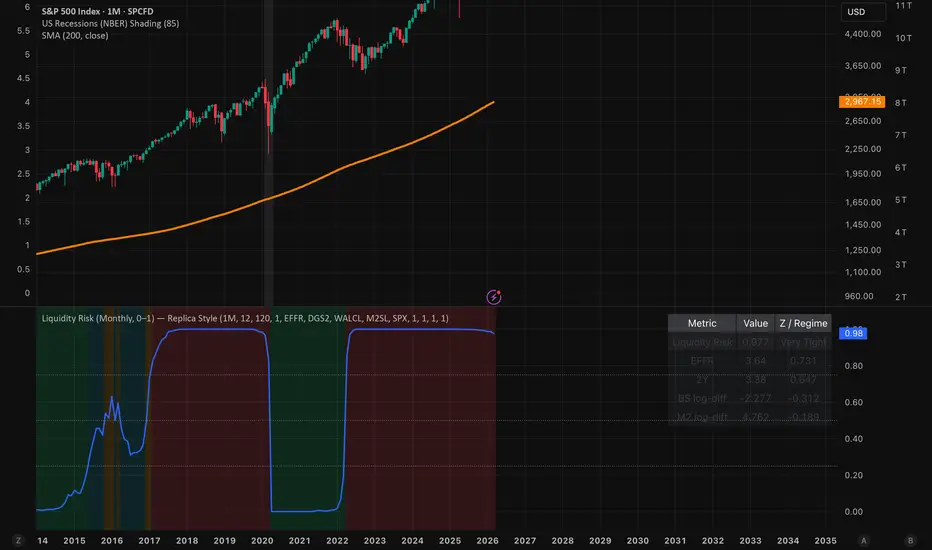
This tool is a macro “liquidity regime” indicator designed to help you understand whether conditions are broadly supportive or restrictive for risk assets. It combines a small set of well-known US liquidity inputs (policy rate and short-dated yields, plus measures of money and central bank liquidity growth) into a single score that ranges from loose to very tight. The goal is not to predict exact turning points, but to provide context for the backdrop Bitcoin is trading in.
For BTC, the main use is framing expectations. Bitcoin can still perform well during tight policy, especially relative to the rest of crypto, because it tends to be treated as the “highest quality” asset in the space. In restrictive regimes, liquidity often concentrates into the least risky and most liquid assets first, which can mean BTC holds up better while higher-beta altcoins struggle. This tool helps you spot when you are likely in that type of environment, where the market may reward quality and liquidity over speculation.
It’s best used as a regime filter rather than a standalone trading signal. If the score stays elevated for a sustained period, it suggests tighter conditions where breakouts may be harder to sustain, volatility can be sharper, and rallies may be narrower. If the score trends lower over time, it suggests improving conditions where broader risk-on behavior and stronger follow-through become more likely.
Finally, the indicator should be treated as a starting point. The same liquidity regime can produce different outcomes depending on the asset’s structure, positioning, and narrative. For Bitcoin, you still need to layer in asset-specific analysis such as market structure, volatility, dominance, on-chain behavior, and where you are in the broader cycle.
EDIT - Please use this on SPX due to the way the code works
For BTC, the main use is framing expectations. Bitcoin can still perform well during tight policy, especially relative to the rest of crypto, because it tends to be treated as the “highest quality” asset in the space. In restrictive regimes, liquidity often concentrates into the least risky and most liquid assets first, which can mean BTC holds up better while higher-beta altcoins struggle. This tool helps you spot when you are likely in that type of environment, where the market may reward quality and liquidity over speculation.
It’s best used as a regime filter rather than a standalone trading signal. If the score stays elevated for a sustained period, it suggests tighter conditions where breakouts may be harder to sustain, volatility can be sharper, and rallies may be narrower. If the score trends lower over time, it suggests improving conditions where broader risk-on behavior and stronger follow-through become more likely.
Finally, the indicator should be treated as a starting point. The same liquidity regime can produce different outcomes depending on the asset’s structure, positioning, and narrative. For Bitcoin, you still need to layer in asset-specific analysis such as market structure, volatility, dominance, on-chain behavior, and where you are in the broader cycle.
EDIT - Please use this on SPX due to the way the code works
Skrypt open-source
W zgodzie z duchem TradingView twórca tego skryptu udostępnił go jako open-source, aby użytkownicy mogli przejrzeć i zweryfikować jego działanie. Ukłony dla autora. Korzystanie jest bezpłatne, jednak ponowna publikacja kodu podlega naszym Zasadom serwisu.

Wyłączenie odpowiedzialności
Informacje i publikacje nie stanowią i nie powinny być traktowane jako porady finansowe, inwestycyjne, tradingowe ani jakiekolwiek inne rekomendacje dostarczane lub zatwierdzone przez TradingView. Więcej informacji znajduje się w Warunkach użytkowania.
Skrypt open-source
W zgodzie z duchem TradingView twórca tego skryptu udostępnił go jako open-source, aby użytkownicy mogli przejrzeć i zweryfikować jego działanie. Ukłony dla autora. Korzystanie jest bezpłatne, jednak ponowna publikacja kodu podlega naszym Zasadom serwisu.
Wyłączenie odpowiedzialności
Informacje i publikacje nie stanowią i nie powinny być traktowane jako porady finansowe, inwestycyjne, tradingowe ani jakiekolwiek inne rekomendacje dostarczane lub zatwierdzone przez TradingView. Więcej informacji znajduje się w Warunkach użytkowania.