Zaktualizowano
Narrative OB | Context + Inducement v5.1
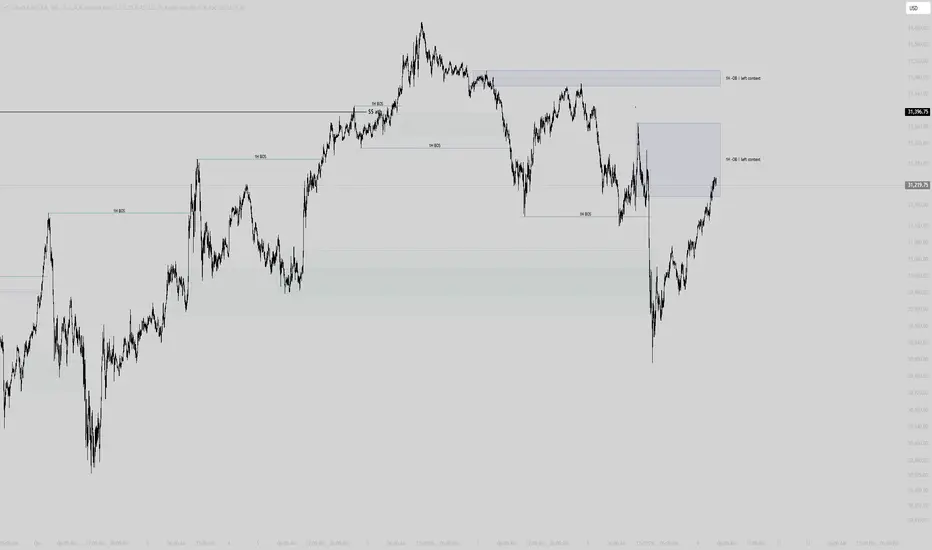
**Narrative OB | Context + Inducement**
Narrative OB is a higher-timeframe indicator built around how I read market structure: identify the meaningful break, connect the move to its relevant order block to the left, and watch how price behaves when it returns.
The default model uses **1-hour structure and order blocks**, with additional inducement markings inside selected zones.
**Break of structure requires a candle close.** A bullish BOS requires a close above the tracked major structural high. A bearish BOS requires a close below the tracked major structural low. A wick through the level alone does not confirm BOS.
The structure engine maintains protected levels through internal pullbacks. Confirmed swings help establish those levels, so smaller internal movements do not automatically change the broader structural direction. ATR thresholds apply to OB qualification; they do not determine whether a BOS occurred.
**Order-block selection follows the relationship between structure and its source.** When a BOS occurs, the indicator searches previously qualified zones that existed before the breaking leg began. It prioritizes a parent zone the leg originated in or revisited, then the most recent eligible source to the left.
This keeps the selection connected to the broader sequence. A new internal base within the current breaking leg cannot replace missing historical context. If no source qualifies, the BOS can appear without an accompanying OB.
**Formation inducement and return inducement serve different purposes.** Formation inducement is required for an OB to qualify. The default “Internal take” setting requires qualifying liquidity to have been taken around the source formation. “Take and reclaim” adds a reclaim requirement.
The optional 5-minute evidence feed supplements this formation check. It does not create a separate lower-timeframe entry model.
The **× markings** represent an additional event when price returns to a selected parent OB. An OB can qualify without having a visible ×.
Within supply, the indicator tracks the **highest eligible, unswept internal high formed after the OB’s departure**. Price must trade above that high and close back below it while the parent remains valid. Within demand, the logic mirrors this: take the lowest eligible internal low and close back above it.
The original OB formation high or low is excluded from this return-liquidity reference. A smaller internal pivot does not replace the eligible outer reference.
| Chart marking | Meaning |
|---|---|
| Blue/lavender box | Selected supply OB, using default colors. |
| Teal box | Selected demand OB, using default colors. |
| BOS | Confirmed close beyond tracked major structure, unless classified as parent-zone inducement. |
| ? | Internal liquidity has been taken; a qualifying reclaim is still pending. |
| × | The taken level was reclaimed while its parent OB remained valid. |
| OB midpoint | The center of the displayed zone. |
| Dotted vertical marker | When the selected OB first became available on the chart. |
Inducement labels are centered over their reference-to-take interval. If the parent invalidates before a pending reclaim, that pending inducement is removed. An × confirms the reclaim event; it does not establish that the next move will continue in the expected direction.
**OB boundaries adjust as wicks are mitigated.** A consumed upper wick trims the upper boundary to the source body high. A consumed lower wick trims the lower boundary to the body low. If both are consumed, the remaining zone is the body.
“Reach wick tip” is the default mitigation rule. “Enter wick” applies refinement when price enters the wick’s interior. These updates use completed source-timeframe candles.
Supply invalidates on a close above its remaining upper boundary; demand invalidates on a close below its remaining lower boundary. Zones can also retire through expiry and history limits.
For setup:
- Use standard time-based candles at or below the selected structure timeframe.
- With the default 1H model, a lower chart timeframe still displays hourly structure.
- Both swing-width settings default to 3 bars on each side. Increasing them requires wider swings and adds confirmation delay.
- OB filters control departure strength, directional candle size, path efficiency, zone width, and minimum score.
- The default score of 70 is a qualification threshold, not a 70% success rate.
**Historical placement and live availability are different.** With origin tracing enabled, a box extends back to its source candle even though selection occurs later. Inducement lines also reference earlier liquidity events. Use the availability marker and label tooltips to distinguish the source, take, reclaim, and first-display times.
The model uses confirmed candles and confirmed pivots. Those confirmations introduce delay, and lower-timeframe displays can update after the hourly close. Drawings can refine or change classification as conditions develop; their historical position should not be treated as an earlier live signal.
Available alerts cover bullish BOS, bearish BOS, newly selected left-context OBs, wick refinement, and confirmed parent inducement. Previously confirmed inducement displayed after a later parent selection does not generate a backdated alert.
Narrative OB provides structure, context, and confluence. Entries, stops, targets, position sizing, and trade management remain part of your own execution model.
Informacje o Wersji
Bug fixes** -OB's populating far too late and runtime error when attempting to enter replay mode Informacje o Wersji
VERY MANY BUG FIXES
Wyłączenie odpowiedzialności
Informacje i publikacje nie stanowią i nie powinny być traktowane jako porady finansowe, inwestycyjne, tradingowe ani jakiekolwiek inne rekomendacje dostarczane lub zatwierdzone przez TradingView. Więcej informacji znajduje się w Warunkach użytkowania.
Wyłączenie odpowiedzialności
Informacje i publikacje nie stanowią i nie powinny być traktowane jako porady finansowe, inwestycyjne, tradingowe ani jakiekolwiek inne rekomendacje dostarczane lub zatwierdzone przez TradingView. Więcej informacji znajduje się w Warunkach użytkowania.