ICT Entry Model Liquidity Sweep, MSS & FVG [LunqFX]
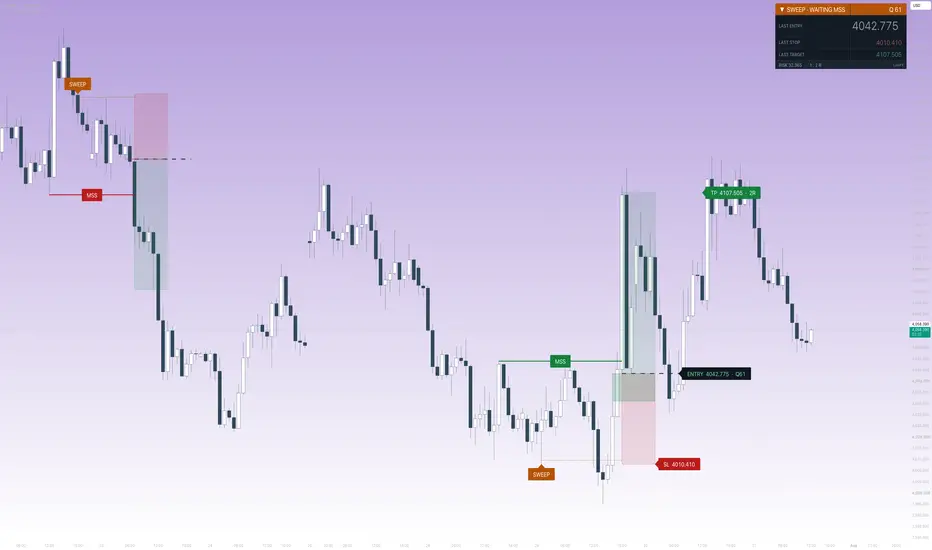
A smart-money entry is never a single signal — it is a sequence. Price runs the stops beyond a swing, structure shifts the other way, and the entry is taken from the imbalance that shift left behind. Most ICT indicators draw one of those pieces and leave you to assemble the rest by hand. This one tracks the whole sequence live and finishes it with an actual trade: entry, stop, target and a quality score that tells you whether the setup was worth taking at all.
❶ THE FOUR STAGES
▸ LIQUIDITY SWEEP — price trades beyond a swing high or low, takes the stops resting there, and closes back inside. The sweep is marked and the level it raided is drawn. This is the manipulation leg, and it is where the stop for the trade will sit.
▸ MSS (MARKET STRUCTURE SHIFT) — after the sweep, price closes through the last short-term swing in the opposite direction. This is the confirmation that the sweep was a reversal and not a continuation. Note that the shift is measured against internal structure, not the major swing: waiting for a major swing to break would put the entry far too late, which is the single most common mistake in automated ICT tools.
▸ FVG ENTRY — the displacement that broke structure leaves a three-candle imbalance. That gap is the entry zone, drawn as a box, because price commonly returns to fill it before continuing.
▸ RISK AND TARGET — the stop goes beyond the sweep extreme, the target is your chosen R multiple. Both are drawn as filled zones running back to the entry, so the whole trade reads as one object instead of a set of loose lines.
❷ SETUP QUALITY 0–100
Not every sequence deserves a trade, and this is where the indicator does something no other entry tool does. Every setup is graded on four measurable properties:
▸ SWEEP DEPTH — how far beyond the level price actually ran, in ATR. A deeper raid means more stops were genuinely taken. ▸ DISPLACEMENT — how decisively the structure was broken, in ATR. A weak break is a weak setup. ▸ FVG SIZE — how large the imbalance is. A bigger gap is a stronger entry. ▸ SPEED — how quickly the shift followed the sweep. A fast reversal is aggressive; a slow one has lost its edge.
The four are blended into a single 0–100 score shown on every entry tag and in the dashboard. Set the minimum quality in the settings and weak sequences simply stop being drawn — you trade the good ones instead of every arrow.
❸ HOW TO TRADE IT
1 — Wait for the SWEEP marker. The dashboard turns amber and reads SWEEP · WAITING MSS. Nothing to do yet: the manipulation has happened but it is not confirmed.
2 — Wait for MSS. When structure shifts, the setup is drawn and the dashboard turns green for a long or red for a short. If structure does not shift within the allowed window, the sweep is discarded and the model resets — no stale signals.
3 — Check the quality score before committing. High scores come from a deep sweep, a decisive break and a clean imbalance. If the number is low, the sequence was technically valid but structurally weak.
4 — Place the trade from the ticket. Entry at the FVG edge, stop beyond the sweep, target at your R multiple. The dashboard shows all three plus the exact risk in price, so the position size follows directly.
5 — Let price come to you. The FVG is a limit entry, not a market entry. If price never returns to the gap, the setup is simply skipped — that is the model working as intended.
❹ HOW IT WORKS
Liquidity swings and internal structure are detected with confirmed pivots, so a level only exists once the bars on both sides of it have closed. A sweep requires a bar to trade beyond the swing and close back inside it, and it is only registered when the shift level is still unbroken — otherwise the sequence could confirm itself on the very next bar. The structure shift requires a close through that internal level within your chosen window. The imbalance is found in the displacement leg using the standard three-candle definition. The stop is the sweep extreme, the target is the entry plus or minus the risk times your R multiple, and setups whose stop would be smaller than a fraction of ATR are rejected as untradeable. The quality score is a weighted blend of the four properties above, each normalised by ATR so the score behaves the same on every symbol and timeframe.
Works on any market and timeframe — forex, gold, indices, crypto and stocks. Intraday charts from 5m to 4h suit the model best, since that is where liquidity raids and structure shifts happen most often.
SETTINGS — liquidity swing length, internal structure length, maximum bars from sweep to shift, R multiple for the target, minimum stop distance, minimum quality, number of setups kept, level extension, FVG and level visibility, candle colouring and dashboard position.
ALERTS — long setup confirmed, short setup confirmed, and any setup confirmed. All fire on closed bars only.
NON-REPAINTING — every stage is validated on bar close and built from confirmed pivots. A setup that has printed never moves, never changes its levels and never disappears.
The four stages are not four indicators bundled together — they are four steps of one entry model, and none of them is tradeable alone. The sweep without the shift is just a wick; the shift without the sweep is just a break; the imbalance without either is just a gap. That is why they belong in a single tool.
This indicator is an educational market-analysis tool, not financial advice. The quality score describes the structure of a setup and does not predict its outcome. Always confirm with your own analysis and manage your risk.

Trade setups with clear entry, stop, target and risk logic. Built for traders who want structure, not guessing.
💬 t.me/lunqfx
🌐 lunqfx.com/premium
💬 t.me/lunqfx
🌐 lunqfx.com/premium
Wyłączenie odpowiedzialności
Informacje i publikacje nie stanowią i nie powinny być traktowane jako porady finansowe, inwestycyjne, tradingowe ani jakiekolwiek inne rekomendacje dostarczane lub zatwierdzone przez TradingView. Więcej informacji znajduje się w Warunkach użytkowania.