OPEN-SOURCE SCRIPT
Quant Confluence Engine [JOAT]
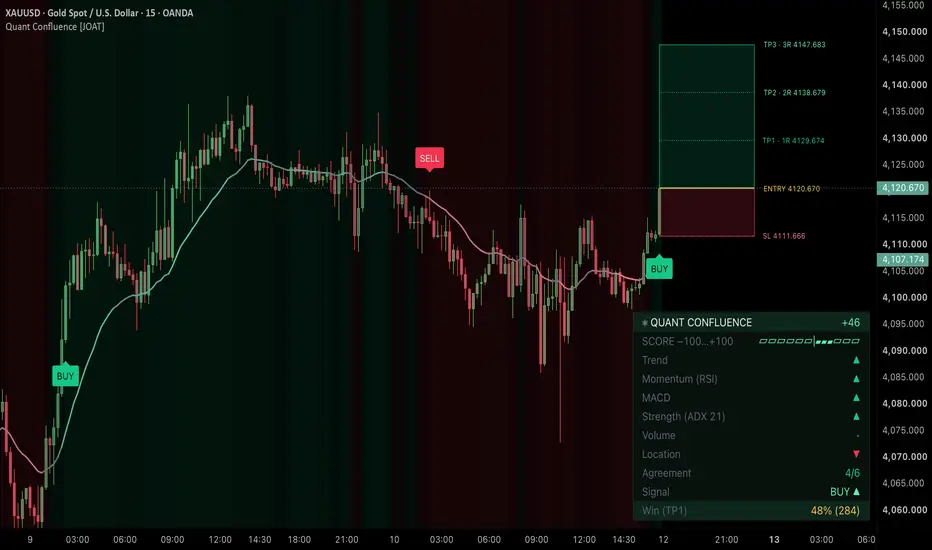
Quant Confluence Engine [JOAT]
Scores several independent market factors into one weighted composite, so signals fire on agreement across dimensions rather than on any single trigger.

What it is
Single-factor signals are fragile: a momentum cross, a moving-average flip or a volume spike each fails often on its own. This engine measures several independent factors, normalises them to a common scale, and blends them into one bipolar confluence score. A signal is produced only when enough factors line up, and the transparency of the score lets you see exactly why. It is an original scoring framework, not a bundle of overlaid classic indicators.
How it works
• The factors — the engine evaluates a set of complementary dimensions, each capturing a different aspect of the tape: trend alignment, momentum, volatility regime, volume behaviour, price structure and stretch relative to a mean. Each factor is computed with a standard, well-understood method and then scaled so it contributes fairly.
• Normalisation — every factor is converted to a bounded contribution, so no single input can dominate the composite purely because of its raw magnitude.
• Composite score — the contributions are combined into one signed 0-centred score. Positive means the factors lean bullish, negative bearish, and the magnitude expresses how strong the agreement is.
• State-machine signals — a Buy fires when the score crosses into sufficient bullish agreement from a non-bullish state; a Sell is the mirror. Because a signal requires a genuine state change, the engine will not re-fire the same direction bar after bar — signals are self-spacing by construction.
Trade levels
Each signal draws a red risk box to the ATR stop and a green reward box to the third target, with inner dividers and right-edge labels for entry, stop and each take-profit at your R multiples.
The dashboard
An adjustable factor-grid panel shows each factor's current lean (up or down) alongside a bipolar composite-score headline, the active signal, a conviction reading, and a live first-target-before-stop tally from closed bars only. The grid makes it obvious which factors are driving or vetoing a setup.
How to use it
• Works on any asset and timeframe; the factors adapt to the data.
• Read the grid before acting — a signal backed by broad agreement differs from one carried by a single strong factor.
• Raise the agreement requirement for fewer, higher-conviction signals, or lower it for more frequent ones.
Settings
Per-factor lengths and weights, the agreement threshold, ATR risk multiple and target R multiples, plus visual and dashboard controls.
Originality and usefulness
The value is the framework itself: a normalised, weighted multi-factor score with a transparent per-factor readout and a state-machine trigger that prevents signal spam. It is designed so a trader can inspect the reasoning, not just accept a label — which is precisely what a confluence approach should offer.
Notes and limitations
• Confluence reduces some false signals but does not remove them; correlated factors can all be wrong together in unusual conditions.
• Weighting is a design choice — different weights suit different markets, so treat the defaults as a starting point.
• The tally reflects only past bars on the current chart and is not a prediction.
• Educational and analytical tool, not financial advice.
— made with passion by officialjackofalltrades
Scores several independent market factors into one weighted composite, so signals fire on agreement across dimensions rather than on any single trigger.
What it is
Single-factor signals are fragile: a momentum cross, a moving-average flip or a volume spike each fails often on its own. This engine measures several independent factors, normalises them to a common scale, and blends them into one bipolar confluence score. A signal is produced only when enough factors line up, and the transparency of the score lets you see exactly why. It is an original scoring framework, not a bundle of overlaid classic indicators.
How it works
• The factors — the engine evaluates a set of complementary dimensions, each capturing a different aspect of the tape: trend alignment, momentum, volatility regime, volume behaviour, price structure and stretch relative to a mean. Each factor is computed with a standard, well-understood method and then scaled so it contributes fairly.
• Normalisation — every factor is converted to a bounded contribution, so no single input can dominate the composite purely because of its raw magnitude.
• Composite score — the contributions are combined into one signed 0-centred score. Positive means the factors lean bullish, negative bearish, and the magnitude expresses how strong the agreement is.
• State-machine signals — a Buy fires when the score crosses into sufficient bullish agreement from a non-bullish state; a Sell is the mirror. Because a signal requires a genuine state change, the engine will not re-fire the same direction bar after bar — signals are self-spacing by construction.
Trade levels
Each signal draws a red risk box to the ATR stop and a green reward box to the third target, with inner dividers and right-edge labels for entry, stop and each take-profit at your R multiples.
The dashboard
An adjustable factor-grid panel shows each factor's current lean (up or down) alongside a bipolar composite-score headline, the active signal, a conviction reading, and a live first-target-before-stop tally from closed bars only. The grid makes it obvious which factors are driving or vetoing a setup.
How to use it
• Works on any asset and timeframe; the factors adapt to the data.
• Read the grid before acting — a signal backed by broad agreement differs from one carried by a single strong factor.
• Raise the agreement requirement for fewer, higher-conviction signals, or lower it for more frequent ones.
Settings
Per-factor lengths and weights, the agreement threshold, ATR risk multiple and target R multiples, plus visual and dashboard controls.
Originality and usefulness
The value is the framework itself: a normalised, weighted multi-factor score with a transparent per-factor readout and a state-machine trigger that prevents signal spam. It is designed so a trader can inspect the reasoning, not just accept a label — which is precisely what a confluence approach should offer.
Notes and limitations
• Confluence reduces some false signals but does not remove them; correlated factors can all be wrong together in unusual conditions.
• Weighting is a design choice — different weights suit different markets, so treat the defaults as a starting point.
• The tally reflects only past bars on the current chart and is not a prediction.
• Educational and analytical tool, not financial advice.
— made with passion by officialjackofalltrades
Skrypt open-source
W zgodzie z duchem TradingView twórca tego skryptu udostępnił go jako open-source, aby użytkownicy mogli przejrzeć i zweryfikować jego działanie. Ukłony dla autora. Korzystanie jest bezpłatne, jednak ponowna publikacja kodu podlega naszym Zasadom serwisu.

The Institutional Grade Trading Ecosystem, Built to win trades 📈
Get Access 👇
jackofalltrades.vip 🌐
t.me/jackofalltradesvip 🃏
Get Access 👇
jackofalltrades.vip 🌐
t.me/jackofalltradesvip 🃏
Wyłączenie odpowiedzialności
Informacje i publikacje nie stanowią i nie powinny być traktowane jako porady finansowe, inwestycyjne, tradingowe ani jakiekolwiek inne rekomendacje dostarczane lub zatwierdzone przez TradingView. Więcej informacji znajduje się w Warunkach użytkowania.
Skrypt open-source
W zgodzie z duchem TradingView twórca tego skryptu udostępnił go jako open-source, aby użytkownicy mogli przejrzeć i zweryfikować jego działanie. Ukłony dla autora. Korzystanie jest bezpłatne, jednak ponowna publikacja kodu podlega naszym Zasadom serwisu.
The Institutional Grade Trading Ecosystem, Built to win trades 📈
Get Access 👇
jackofalltrades.vip 🌐
t.me/jackofalltradesvip 🃏
Get Access 👇
jackofalltrades.vip 🌐
t.me/jackofalltradesvip 🃏
Wyłączenie odpowiedzialności
Informacje i publikacje nie stanowią i nie powinny być traktowane jako porady finansowe, inwestycyjne, tradingowe ani jakiekolwiek inne rekomendacje dostarczane lub zatwierdzone przez TradingView. Więcej informacji znajduje się w Warunkach użytkowania.