OPEN-SOURCE SCRIPT
Confluence Hunter
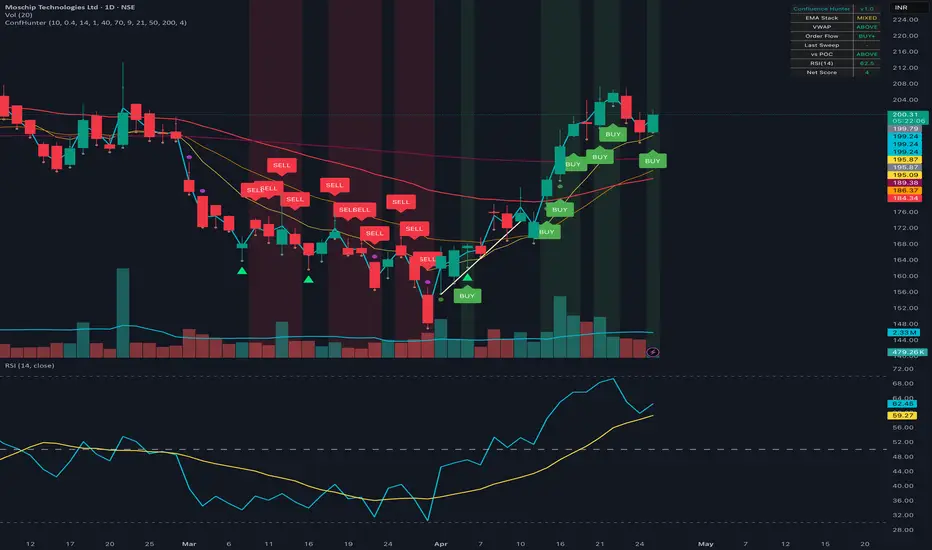
Confluence Hunter is a multi-factor confluence engine that fuses six independent dimensions of market behavior into one signal. Instead of firing on a single condition (a moving average cross, an RSI level), it only triggers when at least 4 of 6 factors agree on the same bar — dramatically cutting false signals.
THE SIX FACTORS
1. EMA STACK (Trend) — 9 / 21 / 50 / 200 EMAs. Stacked up = uptrend; stacked down = downtrend; mixed = chop, stay out.
2. SESSION VWAP (Fair Value) — Volume-weighted average price anchored to the daily session, with a configurable ±σ band. Price above VWAP = bulls in control.
3. LIQUIDITY SWEEPS (Structure) — Detects stop hunts: bars that pierce a recent swing high/low and snap back with a strong rejection wick (≥40% of range by default). These are the highest-edge structural events on the chart and act as the trigger.
4. ORDER FLOW DELTA (Intent) — Bar-by-bar buy/sell pressure derived from close position within range × volume, smoothed with an EMA. Strong-delta bars are highlighted with circle markers below/above.
5. SESSION VOLUME PROFILE (Acceptance) — Plots POC, VAH, and VAL for the active session using a configurable bin count (default 40 rows) and Value Area % (default 70%). Trading above POC with the trend = strong continuation; below POC against the trend = caution.
6. RSI(14) (Momentum) — Tiebreaker confirming momentum supports the bias.
CONFLUENCE SCORING
Each factor returns +1 (bullish), 0 (neutral), or −1 (bearish). The dashboard in the top-right shows the live status of each. A green BUY label fires only when bullish count ≥ 4 AND bearish count ≤ 1 (defaults). The same logic mirrors for SELL labels.
HOW TO USE FOR STOCK SELECTION
Step 1 — Filter by regime: throw it on the daily chart of every name in your watchlist. Skip anything with a MIXED EMA stack or trading on the wrong side of the 200 EMA.
Step 2 — Rank by Net Score: cycle the survivors and rank by the dashboard's Net Score (bullCount − bearCount, max ±6). +5 or +6 = A-tier setup.
Step 3 — Wait for a structural trigger: don't enter at +6 alone (you're late). Wait for either a fresh BUY/SELL label or a sweep arrow near a key level (VWAP, POC, or VAL).
Step 4 — Confirm on lower timeframe: drop to 1H/15m and require the same bullish/bearish state. Multi-timeframe alignment cuts losers significantly.
ENTRY / STOP / TARGET FRAMEWORK
- Entry: close of the BUY/SELL bar, or pullback to VWAP / 9-21 EMA on the next bar.
- Stop: just beyond the wick of the sweep bar.
- Target 1: opposite VWAP band (take 50% off).
- Target 2: prior session POC or next swing high; trail rest with 21 EMA.
INPUTS
All factors are tunable: swing lookback, sweep strictness (wick ratio), VWAP band width, volume profile rows and value area %, EMA lengths, and minimum confluence threshold (default 4 of 6 — raise to 5 for fewer/cleaner signals, lower to 3 for more visual analysis).
ALERTS
Built-in alerts for: Confluence BUY, Confluence SELL, Bullish Liquidity Sweep, Bearish Liquidity Sweep.
LIMITATIONS
- The order-flow delta is a proxy from close-position-in-range × volume. Pine Script does not have access to real exchange tick/footprint data. It is directionally useful but not equivalent to true CVD.
- Volume Profile is session-anchored (resets daily), not visible-range. For multi-day profiles, layer TradingView's built-in Volume Profile Visible Range on top.
- For Forex (where volume is tick-based, not real volume) the OF and VP factors are weaker — lean more on EMAs + VWAP + sweeps.
Works on any market: equities, futures, commodities, crypto, forex. Best on 1H, 4H, and Daily timeframes.
This script is free and open-source. Feedback and forks welcome.
THE SIX FACTORS
1. EMA STACK (Trend) — 9 / 21 / 50 / 200 EMAs. Stacked up = uptrend; stacked down = downtrend; mixed = chop, stay out.
2. SESSION VWAP (Fair Value) — Volume-weighted average price anchored to the daily session, with a configurable ±σ band. Price above VWAP = bulls in control.
3. LIQUIDITY SWEEPS (Structure) — Detects stop hunts: bars that pierce a recent swing high/low and snap back with a strong rejection wick (≥40% of range by default). These are the highest-edge structural events on the chart and act as the trigger.
4. ORDER FLOW DELTA (Intent) — Bar-by-bar buy/sell pressure derived from close position within range × volume, smoothed with an EMA. Strong-delta bars are highlighted with circle markers below/above.
5. SESSION VOLUME PROFILE (Acceptance) — Plots POC, VAH, and VAL for the active session using a configurable bin count (default 40 rows) and Value Area % (default 70%). Trading above POC with the trend = strong continuation; below POC against the trend = caution.
6. RSI(14) (Momentum) — Tiebreaker confirming momentum supports the bias.
CONFLUENCE SCORING
Each factor returns +1 (bullish), 0 (neutral), or −1 (bearish). The dashboard in the top-right shows the live status of each. A green BUY label fires only when bullish count ≥ 4 AND bearish count ≤ 1 (defaults). The same logic mirrors for SELL labels.
HOW TO USE FOR STOCK SELECTION
Step 1 — Filter by regime: throw it on the daily chart of every name in your watchlist. Skip anything with a MIXED EMA stack or trading on the wrong side of the 200 EMA.
Step 2 — Rank by Net Score: cycle the survivors and rank by the dashboard's Net Score (bullCount − bearCount, max ±6). +5 or +6 = A-tier setup.
Step 3 — Wait for a structural trigger: don't enter at +6 alone (you're late). Wait for either a fresh BUY/SELL label or a sweep arrow near a key level (VWAP, POC, or VAL).
Step 4 — Confirm on lower timeframe: drop to 1H/15m and require the same bullish/bearish state. Multi-timeframe alignment cuts losers significantly.
ENTRY / STOP / TARGET FRAMEWORK
- Entry: close of the BUY/SELL bar, or pullback to VWAP / 9-21 EMA on the next bar.
- Stop: just beyond the wick of the sweep bar.
- Target 1: opposite VWAP band (take 50% off).
- Target 2: prior session POC or next swing high; trail rest with 21 EMA.
INPUTS
All factors are tunable: swing lookback, sweep strictness (wick ratio), VWAP band width, volume profile rows and value area %, EMA lengths, and minimum confluence threshold (default 4 of 6 — raise to 5 for fewer/cleaner signals, lower to 3 for more visual analysis).
ALERTS
Built-in alerts for: Confluence BUY, Confluence SELL, Bullish Liquidity Sweep, Bearish Liquidity Sweep.
LIMITATIONS
- The order-flow delta is a proxy from close-position-in-range × volume. Pine Script does not have access to real exchange tick/footprint data. It is directionally useful but not equivalent to true CVD.
- Volume Profile is session-anchored (resets daily), not visible-range. For multi-day profiles, layer TradingView's built-in Volume Profile Visible Range on top.
- For Forex (where volume is tick-based, not real volume) the OF and VP factors are weaker — lean more on EMAs + VWAP + sweeps.
Works on any market: equities, futures, commodities, crypto, forex. Best on 1H, 4H, and Daily timeframes.
This script is free and open-source. Feedback and forks welcome.
Skrypt open-source
W zgodzie z duchem TradingView twórca tego skryptu udostępnił go jako open-source, aby użytkownicy mogli przejrzeć i zweryfikować jego działanie. Ukłony dla autora. Korzystanie jest bezpłatne, jednak ponowna publikacja kodu podlega naszym Zasadom serwisu.

Wyłączenie odpowiedzialności
Informacje i publikacje nie stanowią i nie powinny być traktowane jako porady finansowe, inwestycyjne, tradingowe ani jakiekolwiek inne rekomendacje dostarczane lub zatwierdzone przez TradingView. Więcej informacji znajduje się w Warunkach użytkowania.
Skrypt open-source
W zgodzie z duchem TradingView twórca tego skryptu udostępnił go jako open-source, aby użytkownicy mogli przejrzeć i zweryfikować jego działanie. Ukłony dla autora. Korzystanie jest bezpłatne, jednak ponowna publikacja kodu podlega naszym Zasadom serwisu.
Wyłączenie odpowiedzialności
Informacje i publikacje nie stanowią i nie powinny być traktowane jako porady finansowe, inwestycyjne, tradingowe ani jakiekolwiek inne rekomendacje dostarczane lub zatwierdzone przez TradingView. Więcej informacji znajduje się w Warunkach użytkowania.