
(The Mental Game of Trading Summary)
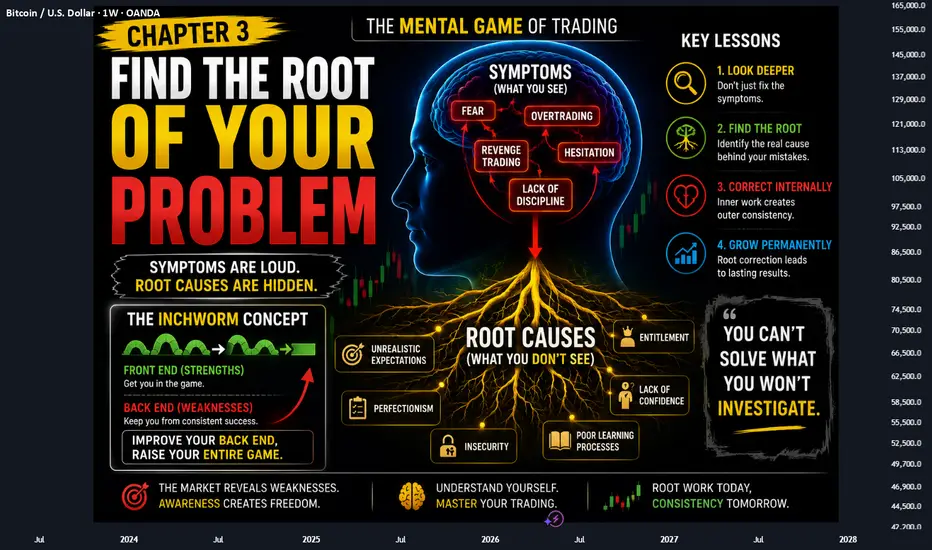
Most traders try to fix symptoms instead of fixing the root cause.
That is the core lesson of Chapter 3.
Fear, greed, hesitation, revenge trading, and lack of discipline are usually not the REAL problem.
They are symptoms of deeper flaws underneath:
unrealistic expectations
perfectionism
insecurity
entitlement
lack of confidence
poor learning processes
Jared Tendler explains that many traders remain stuck because they focus only on surface-level mistakes instead of identifying what is driving those mistakes internally.
The Inchworm Concept
One of the most powerful ideas in this chapter is the “Inchworm Concept.”
Your performance is divided into:
Front-end performance (your strengths)
Back-end performance (your weaknesses)
Most traders obsess over improving strengths while ignoring weaknesses.
But real growth happens when you improve the BACK END of your game:
emotional reactions
impulsive execution
inconsistency
discipline problems
As your weaknesses improve, your entire performance level rises.
Learning Mistakes vs Emotional Mistakes
The chapter also explains the difference between:
mistakes caused by lack of knowledge
mistakes caused by emotional instability
Not every mistake means your strategy is bad.
Sometimes:
You already know what to do…
but emotions prevent proper execution.
Key Lesson
You cannot permanently solve a trading problem unless you identify:
WHAT is causing it,
WHY it repeats,
and WHAT emotional flaw is feeding it.
Surface fixes create temporary relief.
Root correction creates long-term consistency.
Final Thought
The market exposes weaknesses.
Trading is not just about finding setups.
It is about identifying the hidden flaws that appear when pressure, uncertainty, and risk are involved.
The better you understand your weaknesses,
the more consistent your execution becomes
Most traders try to fix symptoms instead of fixing the root cause.
That is the core lesson of Chapter 3.
Fear, greed, hesitation, revenge trading, and lack of discipline are usually not the REAL problem.
They are symptoms of deeper flaws underneath:
unrealistic expectations
perfectionism
insecurity
entitlement
lack of confidence
poor learning processes
Jared Tendler explains that many traders remain stuck because they focus only on surface-level mistakes instead of identifying what is driving those mistakes internally.
The Inchworm Concept
One of the most powerful ideas in this chapter is the “Inchworm Concept.”
Your performance is divided into:
Front-end performance (your strengths)
Back-end performance (your weaknesses)
Most traders obsess over improving strengths while ignoring weaknesses.
But real growth happens when you improve the BACK END of your game:
emotional reactions
impulsive execution
inconsistency
discipline problems
As your weaknesses improve, your entire performance level rises.
Learning Mistakes vs Emotional Mistakes
The chapter also explains the difference between:
mistakes caused by lack of knowledge
mistakes caused by emotional instability
Not every mistake means your strategy is bad.
Sometimes:
You already know what to do…
but emotions prevent proper execution.
Key Lesson
You cannot permanently solve a trading problem unless you identify:
WHAT is causing it,
WHY it repeats,
and WHAT emotional flaw is feeding it.
Surface fixes create temporary relief.
Root correction creates long-term consistency.
Final Thought
The market exposes weaknesses.
Trading is not just about finding setups.
It is about identifying the hidden flaws that appear when pressure, uncertainty, and risk are involved.
The better you understand your weaknesses,
the more consistent your execution becomes

Похожие публикации
Отказ от ответственности
Информация и публикации не предназначены для предоставления и не являются финансовыми, инвестиционными, торговыми или другими видами советов или рекомендаций, предоставленных или одобренных TradingView. Подробнее читайте в Условиях использования.
Отказ от ответственности
Информация и публикации не предназначены для предоставления и не являются финансовыми, инвестиционными, торговыми или другими видами советов или рекомендаций, предоставленных или одобренных TradingView. Подробнее читайте в Условиях использования.