
Disclaimer: This article was originally written in Spanish. Therefore, I cannot guarantee that the English translation is completely free of errors or inaccuracies.
Trading has existed for thousands of years, just like people with limited financial resources. That is precisely why credit was born. If you needed to finance an expedition, you borrowed money; if you wanted to expand a business, you borrowed money; if you believed an investment was going to work out perfectly, you borrowed money...
Loans fueled great periods of economic prosperity, but they also incubated some of the biggest financial crises in history, such as the Crash of 1929.
In the past, lenders' capital carried a certain degree of risk. A bad harvest, war, catastrophe, or an inbred monarch could ruin everything. But over time, financial mechanisms evolved, and since the 19th century, leverage has become a highly profitable business for "intermediaries." They rarely lose, while the average investor gets their capital burned.
What Is Leverage in Financial Markets?
Leverage is, essentially, a loan.
Saying that "the higher the leverage, the higher the profits and the higher the losses" would simply repeat the usual cliché preached by gurus before sending their apprentices to the slaughterhouse.
To understand what actually happens, we will rely on market logic and use my friend Juan as a laboratory rat.
Juan has watched The Wolf of Wall Street fifteen times and wants to make an honest living as an investor.
The problem is that he only has $100.
No matter how confident he is in his analysis, with such little capital, his absolute returns will be minimal. While a well-capitalized investor may see a 20% return as a golden opportunity, for Juan, 20% on $100 means just $20.
Imagine waiting weeks (or months) to make so little.
Trading platforms — especially in the crypto sector — offer a "solution" for profiles like Juan: leverage.
Thanks to this mechanism, retail investors can multiply their capital through borrowing and turn their $100 into $1,000, $10,000, or more.
The sky is the limit — especially when crypto and deregulation enter the picture.
What Juan doesn't realize is that the larger the loan, the higher the fees and, above all, the greater the probability of losing all his money.
For example, if Juan leverages his $100 at 10x, he enters the market controlling a $1,000 position ($100 × 10).
This is also known as trading with a 10% margin, since his own capital covers only one-tenth of the position ($900 is borrowed).
At 10x leverage, Juan backs a $1,000 position with just $100 of his own money.
If the market moves against him, a relatively small 10% move is enough to wipe out his entire capital.
Both the percentage gains and losses are calculated on the total position size ($1,000), but the losses are not absorbed by the intermediary simply because the money was borrowed. Juan absorbs them with his own $100.
To make matters worse, because Juan is an uninformed investor — like most people — he won't just use leverage "self-taught." He will also place a Stop Loss (SL), which may reduce his probability of success even further.
If he sets a 20% SL on his $100 margin (risking $20), what he is actually doing is giving the asset price barely 2% of breathing room relative to the $1,000 position.
Taking that level of exposure with such a narrow margin against the market's normal noise is less efficient than trying to achieve financial health in a casino.
As you can see, trying to double your capital in a single shot is usually a terrible business.
Markets move through impulses and retracements, and on lower timeframes, volatility and the impact of manipulation multiply.
Try the open-source systems I have given away to the community across different timeframes and you'll know exactly what I'm talking about.
Why do you think scalping courses sell so well, accompanied by aggressive advertising such as:
"Hurry up and get rich for just $20, $30, $100, or $200!"
If the industry promoted consistent long-term growth, the business of selling miracle courses, signal channels, trendy indicators, and subscriptions would collapse.
But let's not pretend we're going to change the world...
Instead, let's look at efficient ways to use leverage under different approaches.
Before that, however, we need to clarify two fundamental concepts: the risk-to-reward ratio and the Stop Loss.
Risk-to-Reward Ratio
This is a tool used to measure the relationship between what we are willing to risk and what we expect to gain from a trade.
• 1:1 ratio: For every unit of risk, we seek one unit of profit. If we risk $10, we aim to make $10; if we risk $100, we aim to make $100.
• 1:2 ratio: For every unit of risk, we seek two units of profit. If we risk $10, we aim to make $20; if we risk $100, we aim to make $200.
Stop Loss (SL)
A Stop Loss is an automatic order programmed into the platform to close a position when the price reaches a predetermined level.
Its purpose is to limit risk.
For example, if we open a $1,000 position but are only willing to lose $300, we place the SL at the exact price level where the loss will not exceed that amount.
This way, we protect the remaining 70% of our capital.
1. Leverage With a 1:1 Risk-to-Reward Ratio (Without Using a Stop Loss)
In this scenario, Juan exposes the entirety of his $100 to the possibility that his analysis is correct.
Since he is not using a Stop Loss (SL), he seeks to make exactly the same amount he is risking: $100.
To achieve this, he first measures the percentage move or volatility between his entry price and his target price using TradingView's Price Range tool. As you can see on the screen, determining this value is very simple.
Let's assume the projected move to the target is 20%.
Juan would apply the following formula:
Leverage = Capital at risk (100% of the account) / % move to target
Substituting the values:
Leverage = 100% / 20% = 5x
This means that if Juan invests his $100 with 5x leverage, he will control a total position of $500 ($100 × 5).
If the asset rises by the projected 20%, he will earn a 20% return on the $500 position — $100 in profit, effectively doubling his initial margin.
However, because he is not using a Stop Loss, his liquidation point is effectively set at the equivalent decline: if the price falls 20%, the $500 position will lose $100 and Juan will lose his entire capital.

2. Leverage Based on the Liquidation Price
In this second example, Juan again risks his entire $100 without placing an explicit Stop Loss.
He wants to increase his potential profits, but this time he prioritizes survival:
Instead of forcing a 1:1 risk-to-reward ratio, he will calculate the leverage necessary to keep his liquidation price far enough away to absorb normal market volatility.
Looking at the chart, Juan determines that it is extremely unlikely for the price to fall 30% from his entry point.
To calculate the maximum leverage he can use without being liquidated before reaching that level, he applies the same logic:
Maximum leverage = 100% / % decline at which we are willing to be liquidated
Maximum leverage = 100% / 30% = 3.33
Juan rounds down to 3x to trade more conservatively.
By reducing leverage to 3x, the liquidation price moves even farther away: the asset would have to fall 33.3% for the broker to close his position due to insufficient margin.
This is a much more sensible use of leverage.
Trading at 3x on a projected 20% upside move, Juan would make $60 (20% of $300).
In exchange, he gives the market room for a 33.3% decline before being wiped out — a scenario his previous analysis considered unlikely.

3. Using Leverage With a Stop Loss (SL)
Case A
In this scenario, Juan is not willing to risk all of his $100.
He only wants to expose 20% of his capital ($20 maximum loss if the trade goes wrong).
This necessarily requires the use of a Stop Loss.
What should he do first?
First, he must determine the technical location where the Stop Loss will be placed. Juan must identify the price level at which his market analysis becomes invalid.
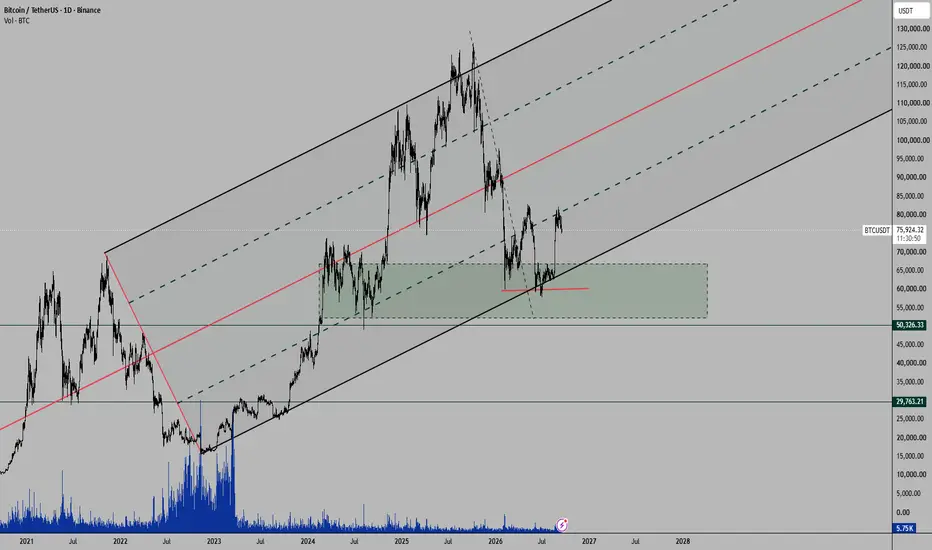
After analyzing the chart, Juan determines that his trade will fail if BTCUSD falls to $53,250.
By marking that level as his invalidation point, he has just defined the exact price at which he is willing to accept his $20 loss.
How do we calculate the leverage allowed based on the risk being assumed?
To avoid risking more than 20% of his margin ($20), Juan must relate his target risk to the percentage distance between his entry price and the Stop Loss:
Allowed leverage = % of capital willing to be risked / % distance to Stop Loss
Let's assume that the distance between his entry price and $53,250 represents a 17% decline in the underlying asset.
Applying the formula:
Allowed leverage = 20% / 17% ≈ 1.18
Result:
Juan can only accept 1x leverage.
This means that, in order to respect his risk management rules and lose only $20 if the price reaches $53,250, Juan should not use leverage.
If Juan wants to maintain the safety of risking only 20% of his capital with a Stop Loss 17% below his entry, he should place his sell order at $53,250 while using 1x.

Case B
Now let's consider a second scenario in which the chart structure offers a closer invalidation level, located at $58,120.
In this case, the distance between the entry price and the Stop Loss is only 10%.
Applying the same risk-management formula:
Allowed leverage = % of capital willing to be risked / % distance to Stop Loss
Allowed leverage = 20% / 10% = 2
Result: The calculation allows Juan to use 2x leverage.
With 2x leverage, Juan enters the market with $200 ($100 of his own money and $100 borrowed).
If the price falls 10% to $58,120 and his Stop Loss is triggered, his $200 position will lose 10%, which equals exactly $20 in losses, respecting his risk limit.
However, if the price rises 20%, Juan will make $40 (20% of $200).

4. Trading Without Leverage
For this final scenario, a more experienced Juan tells us that trading without leverage is the safest and most consistent way to invest because it eliminates the risk of margin liquidation.
However, if Juan's goal is to make a living from the market, he knows that this approach necessarily requires a large amount of capital.
Without leverage, the market's percentage returns translate directly into actual dollar gains without multipliers.
If the capital is small, the absolute gains will be insignificant relative to the cost of living.
In this scenario, there are only two ways Juan could lose all of his money:
1. By his own decision: Closing the position manually at a loss.
2. Through the bankruptcy or collapse of the asset (if Juan does not diversify): If the company declares bankruptcy (stocks), if the project falls to $0 (crypto/tokens), or if the issuer/custodian backing the instrument goes bankrupt (commodities).
The Risk-Management Challenges Juan Faces
Despite having no liquidation risk, trading without leverage still requires managing time and liquidity risk.
A poor entry decision can leave his money tied up for months or even years in a losing position before he can exit at breakeven.
While his capital is trapped, Juan will be unable to take advantage of other major opportunities the market may offer.
To prevent a single frozen position from paralyzing — or destroying — his entire wealth, Juan must diversify his capital across different assets.
This form of capital management can also be implemented in various ways, but I'll talk about those investment tricks another time.
Trading has existed for thousands of years, just like people with limited financial resources. That is precisely why credit was born. If you needed to finance an expedition, you borrowed money; if you wanted to expand a business, you borrowed money; if you believed an investment was going to work out perfectly, you borrowed money...
Loans fueled great periods of economic prosperity, but they also incubated some of the biggest financial crises in history, such as the Crash of 1929.
In the past, lenders' capital carried a certain degree of risk. A bad harvest, war, catastrophe, or an inbred monarch could ruin everything. But over time, financial mechanisms evolved, and since the 19th century, leverage has become a highly profitable business for "intermediaries." They rarely lose, while the average investor gets their capital burned.
What Is Leverage in Financial Markets?
Leverage is, essentially, a loan.
Saying that "the higher the leverage, the higher the profits and the higher the losses" would simply repeat the usual cliché preached by gurus before sending their apprentices to the slaughterhouse.
To understand what actually happens, we will rely on market logic and use my friend Juan as a laboratory rat.
Juan has watched The Wolf of Wall Street fifteen times and wants to make an honest living as an investor.
The problem is that he only has $100.
No matter how confident he is in his analysis, with such little capital, his absolute returns will be minimal. While a well-capitalized investor may see a 20% return as a golden opportunity, for Juan, 20% on $100 means just $20.
Imagine waiting weeks (or months) to make so little.
Trading platforms — especially in the crypto sector — offer a "solution" for profiles like Juan: leverage.
Thanks to this mechanism, retail investors can multiply their capital through borrowing and turn their $100 into $1,000, $10,000, or more.
The sky is the limit — especially when crypto and deregulation enter the picture.
What Juan doesn't realize is that the larger the loan, the higher the fees and, above all, the greater the probability of losing all his money.
For example, if Juan leverages his $100 at 10x, he enters the market controlling a $1,000 position ($100 × 10).
This is also known as trading with a 10% margin, since his own capital covers only one-tenth of the position ($900 is borrowed).
At 10x leverage, Juan backs a $1,000 position with just $100 of his own money.
If the market moves against him, a relatively small 10% move is enough to wipe out his entire capital.
Both the percentage gains and losses are calculated on the total position size ($1,000), but the losses are not absorbed by the intermediary simply because the money was borrowed. Juan absorbs them with his own $100.
To make matters worse, because Juan is an uninformed investor — like most people — he won't just use leverage "self-taught." He will also place a Stop Loss (SL), which may reduce his probability of success even further.
If he sets a 20% SL on his $100 margin (risking $20), what he is actually doing is giving the asset price barely 2% of breathing room relative to the $1,000 position.
Taking that level of exposure with such a narrow margin against the market's normal noise is less efficient than trying to achieve financial health in a casino.
As you can see, trying to double your capital in a single shot is usually a terrible business.
Markets move through impulses and retracements, and on lower timeframes, volatility and the impact of manipulation multiply.
Try the open-source systems I have given away to the community across different timeframes and you'll know exactly what I'm talking about.
Why do you think scalping courses sell so well, accompanied by aggressive advertising such as:
"Hurry up and get rich for just $20, $30, $100, or $200!"
If the industry promoted consistent long-term growth, the business of selling miracle courses, signal channels, trendy indicators, and subscriptions would collapse.
But let's not pretend we're going to change the world...
Instead, let's look at efficient ways to use leverage under different approaches.
Before that, however, we need to clarify two fundamental concepts: the risk-to-reward ratio and the Stop Loss.
Risk-to-Reward Ratio
This is a tool used to measure the relationship between what we are willing to risk and what we expect to gain from a trade.
• 1:1 ratio: For every unit of risk, we seek one unit of profit. If we risk $10, we aim to make $10; if we risk $100, we aim to make $100.
• 1:2 ratio: For every unit of risk, we seek two units of profit. If we risk $10, we aim to make $20; if we risk $100, we aim to make $200.
Stop Loss (SL)
A Stop Loss is an automatic order programmed into the platform to close a position when the price reaches a predetermined level.
Its purpose is to limit risk.
For example, if we open a $1,000 position but are only willing to lose $300, we place the SL at the exact price level where the loss will not exceed that amount.
This way, we protect the remaining 70% of our capital.
1. Leverage With a 1:1 Risk-to-Reward Ratio (Without Using a Stop Loss)
In this scenario, Juan exposes the entirety of his $100 to the possibility that his analysis is correct.
Since he is not using a Stop Loss (SL), he seeks to make exactly the same amount he is risking: $100.
To achieve this, he first measures the percentage move or volatility between his entry price and his target price using TradingView's Price Range tool. As you can see on the screen, determining this value is very simple.
Let's assume the projected move to the target is 20%.
Juan would apply the following formula:
Leverage = Capital at risk (100% of the account) / % move to target
Substituting the values:
Leverage = 100% / 20% = 5x
This means that if Juan invests his $100 with 5x leverage, he will control a total position of $500 ($100 × 5).
If the asset rises by the projected 20%, he will earn a 20% return on the $500 position — $100 in profit, effectively doubling his initial margin.
However, because he is not using a Stop Loss, his liquidation point is effectively set at the equivalent decline: if the price falls 20%, the $500 position will lose $100 and Juan will lose his entire capital.
2. Leverage Based on the Liquidation Price
In this second example, Juan again risks his entire $100 without placing an explicit Stop Loss.
He wants to increase his potential profits, but this time he prioritizes survival:
Instead of forcing a 1:1 risk-to-reward ratio, he will calculate the leverage necessary to keep his liquidation price far enough away to absorb normal market volatility.
Looking at the chart, Juan determines that it is extremely unlikely for the price to fall 30% from his entry point.
To calculate the maximum leverage he can use without being liquidated before reaching that level, he applies the same logic:
Maximum leverage = 100% / % decline at which we are willing to be liquidated
Maximum leverage = 100% / 30% = 3.33
Juan rounds down to 3x to trade more conservatively.
By reducing leverage to 3x, the liquidation price moves even farther away: the asset would have to fall 33.3% for the broker to close his position due to insufficient margin.
This is a much more sensible use of leverage.
Trading at 3x on a projected 20% upside move, Juan would make $60 (20% of $300).
In exchange, he gives the market room for a 33.3% decline before being wiped out — a scenario his previous analysis considered unlikely.
3. Using Leverage With a Stop Loss (SL)
Case A
In this scenario, Juan is not willing to risk all of his $100.
He only wants to expose 20% of his capital ($20 maximum loss if the trade goes wrong).
This necessarily requires the use of a Stop Loss.
What should he do first?
First, he must determine the technical location where the Stop Loss will be placed. Juan must identify the price level at which his market analysis becomes invalid.
After analyzing the chart, Juan determines that his trade will fail if BTCUSD falls to $53,250.
By marking that level as his invalidation point, he has just defined the exact price at which he is willing to accept his $20 loss.
How do we calculate the leverage allowed based on the risk being assumed?
To avoid risking more than 20% of his margin ($20), Juan must relate his target risk to the percentage distance between his entry price and the Stop Loss:
Allowed leverage = % of capital willing to be risked / % distance to Stop Loss
Let's assume that the distance between his entry price and $53,250 represents a 17% decline in the underlying asset.
Applying the formula:
Allowed leverage = 20% / 17% ≈ 1.18
Result:
Juan can only accept 1x leverage.
This means that, in order to respect his risk management rules and lose only $20 if the price reaches $53,250, Juan should not use leverage.
If Juan wants to maintain the safety of risking only 20% of his capital with a Stop Loss 17% below his entry, he should place his sell order at $53,250 while using 1x.
Case B
Now let's consider a second scenario in which the chart structure offers a closer invalidation level, located at $58,120.
In this case, the distance between the entry price and the Stop Loss is only 10%.
Applying the same risk-management formula:
Allowed leverage = % of capital willing to be risked / % distance to Stop Loss
Allowed leverage = 20% / 10% = 2
Result: The calculation allows Juan to use 2x leverage.
With 2x leverage, Juan enters the market with $200 ($100 of his own money and $100 borrowed).
If the price falls 10% to $58,120 and his Stop Loss is triggered, his $200 position will lose 10%, which equals exactly $20 in losses, respecting his risk limit.
However, if the price rises 20%, Juan will make $40 (20% of $200).
4. Trading Without Leverage
For this final scenario, a more experienced Juan tells us that trading without leverage is the safest and most consistent way to invest because it eliminates the risk of margin liquidation.
However, if Juan's goal is to make a living from the market, he knows that this approach necessarily requires a large amount of capital.
Without leverage, the market's percentage returns translate directly into actual dollar gains without multipliers.
If the capital is small, the absolute gains will be insignificant relative to the cost of living.
In this scenario, there are only two ways Juan could lose all of his money:
1. By his own decision: Closing the position manually at a loss.
2. Through the bankruptcy or collapse of the asset (if Juan does not diversify): If the company declares bankruptcy (stocks), if the project falls to $0 (crypto/tokens), or if the issuer/custodian backing the instrument goes bankrupt (commodities).
The Risk-Management Challenges Juan Faces
Despite having no liquidation risk, trading without leverage still requires managing time and liquidity risk.
A poor entry decision can leave his money tied up for months or even years in a losing position before he can exit at breakeven.
While his capital is trapped, Juan will be unable to take advantage of other major opportunities the market may offer.
To prevent a single frozen position from paralyzing — or destroying — his entire wealth, Juan must diversify his capital across different assets.
This form of capital management can also be implemented in various ways, but I'll talk about those investment tricks another time.

Отказ от ответственности
Информация и публикации не предназначены для предоставления и не являются финансовыми, инвестиционными, торговыми или другими видами советов или рекомендаций, предоставленных или одобренных TradingView. Подробнее читайте в Условиях использования.
Отказ от ответственности
Информация и публикации не предназначены для предоставления и не являются финансовыми, инвестиционными, торговыми или другими видами советов или рекомендаций, предоставленных или одобренных TradingView. Подробнее читайте в Условиях использования.