
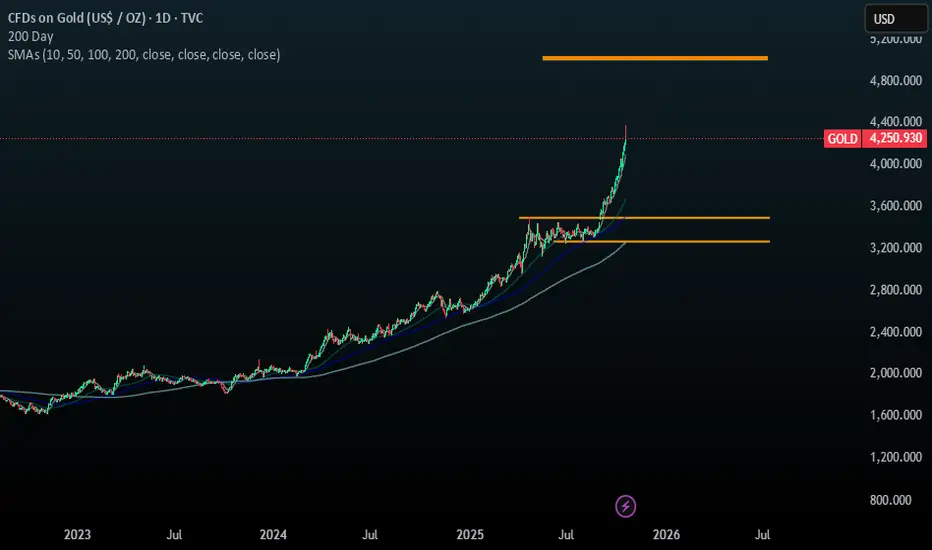
The global financial landscape is sending a clear signal that the old rules are broken. On October 17, gold prices shattered all-time records, surging to nearly $4,400 per ounce, just days after breaking the $4,000 barrier for the first time in history.
This isn't a temporary spike; it's a fundamental re-pricing of wealth. Investors are fleeing traditional "safe havens" in search of real security, and they've found it in the one asset that has preserved wealth for 5,000 years.
For those watching from the sidelines, this raises two urgent questions: Why is this happening now, and is it too late to act?
As a 14-year veteran in the gold market, I can tell you this rally is far from over. Here’s a breakdown of what’s driving the surge and why gold remains the most critical investment for the future.
A Perfect Storm: The 10 Drivers Behind Gold's Historic Rise
The current price surge isn't due to one single factor but a powerful convergence of economic, political, and psychological forces.
1. Geopolitical Chaos: From the ongoing war in Ukraine to conflict in the Middle East and the persistent US-China trade tensions, the world is in a state of turmoil. During times of crisis, gold is the ultimate "crisis hedge." Major investment banks note that significant geopolitical events consistently drive gold 10-15% higher as investors seek stability.
2. US Political & Economic Uncertainty: Unpredictable policies, pressure on the Federal Reserve, and mounting political division in the U.S. have eroded global trust in American leadership and its assets. Investors no longer view US bonds with the same confidence, and that capital is flowing directly into gold.
3. Massive Central Bank Buying: This is one of the biggest stories. Central banks around the world—led by China, Russia, India, and Turkey—bought a record 3,200 tonnes of gold between 2022 and 2024. These are not speculators; they are "price-insensitive buyers" seeking long-term security, and they are permanently removing massive amounts of supply from the market.
4. The Rise of De-Dollarization: When Western nations sanctioned Russia and froze $300 billion of its dollar reserves, it sent a shockwave through the global south. Nations realized that holding dollars is a political risk. This has triggered a massive, long-term trend of "de-dollarization," where countries are actively dumping US dollars and replacing them with neutral, sanction-proof gold.
5. A Fundamental Shift in Reserves: For the first time since 1996, central banks' gold reserves have surpassed their holdings of US Treasury bonds. This isn't just diversification; it's a strategic replacement. Gold is being re-throned as the world's primary reserve asset, replacing the US dollar.
6. Expected Interest Rate Cuts: The U.S. Federal Reserve is signaling an end to its rate-hiking cycle, with cuts expected. When interest rates fall, the return (yield) on bonds and savings accounts drops, making non-yielding gold more attractive. Investors are front-running this move.
7. The Crushing Weight of Global Debt: The United States government is now over $37 trillion in debt. This mountain of debt is unpayable. The only way for governments to manage it is to devalue their currencies by printing more money, which causes inflation. Gold is the direct antidote to this currency debasement.
8. The Ultimate Inflation Hedge: While inflation has cooled slightly, the damage is done, and the threat remains. Decades of money printing have destroyed the purchasing power of fiat currencies. Gold is the ultimate "inflation hedge" because its value is intrinsic and cannot be inflated away by a central bank.
9. Surging ETF and Investment Demand: Exchange-Traded Funds (ETFs) have made it simple for average investors to buy gold. This has opened the floodgates to a new class of investor, adding to the demand from central banks and traditional buyers.
10. Market Psychology (FOMO): Success breeds success. As prices hit new records daily, investors who were on the fence are now experiencing a powerful "Fear of Missing Out" (FOMO). This psychological driver creates a feedback loop, pulling more and more money into the market and pushing prices even higher.
Beyond the Headlines: The Hidden Drivers
On top of those 10 reasons, other powerful factors are adding fuel to the fire:
• Physical Supply Constraints: "Peak Gold" is a real concept. The easiest-to-find gold in the world has already been mined. New discoveries are rare, and it is becoming increasingly difficult and expensive to extract new supply from the ground.
• Rising Energy Costs: Gold mining is an incredibly energy-intensive process. As the cost of oil and energy rises, the "all-in-sustaining cost" (the floor price to produce an ounce of gold) also rises, pulling the market price up with it.
• Loss of Faith in Alternatives: After years of extreme volatility, regulatory crackdowns, and high-profile frauds, the cryptocurrency market has failed to prove itself as a reliable "digital gold." Many investors who sought an alternative to the fiat system are now returning to the original, 5,000-year-old decentralized asset.
The Future Forecast: Why $5,000 Gold is the Next Target
The world's top financial institutions believe this rally is just getting started. The core drivers—de-dollarization, central bank buying, and unmanageable debt—are not short-term trends; they are multi-decade structural shifts.
• Goldman Sachs predicts gold will reach $5,000 per ounce by December 2026.
• Bank of America has also released a forecast, stating that a $5,000 target is possible within the same timeframe.
• UBS sees prices remaining elevated above $4,200 throughout 2026.
These forecasts are based on the simple fact that the fundamental problems driving investors to gold are only getting worse.
In an Uncertain Future, Gold is Your Financial Anchor
In the coming years, "safety" will be redefined. A safe asset is not one that is merely stable; it's one that cannot fail.
Gold is the ultimate safe-haven investment for one simple reason: it has zero counterparty risk.
• When you buy a stock, you are trusting a CEO and a management team. The company can go bankrupt.
• When you buy a bond, you are trusting a government or corporation to pay you back, in a currency that is worth less every day.
• When you hold cash, you are trusting a central bank not to devalue it to zero (a promise they have broken time and time again).
When you hold physical gold, you are trusting no one. It is an asset that is not simultaneously someone else's liability. It cannot go bankrupt, and it cannot be printed into oblivion. It has preserved wealth through every war, plague, and financial collapse in human history.
Why Gold is the Only True Asset
We have come to confuse currency with money and digital entries with wealth. Gold is the only true asset.
Fiat currency (USD, EUR, etc.) is a medium of exchange, but it is a liability of the central bank that issues it. It is backed only by faith in a political system—a faith that is clearly eroding.
Real estate is a tangible asset, but it is illiquid, expensive to maintain, and can be taxed or seized by the government.
Gold is different. It is elemental wealth. It is the only asset that is durable, divisible, portable, has intrinsic value, and is recognized as money everywhere on Earth by every culture.
The current price surge is not a "bubble." It is a "Great Re-Pricing"—the market's slow, dawning realization that paper currencies are failing and that gold is the only reliable measure of value. The question is no longer if you should own gold, but how much of your savings you can afford not to protect with it.
Gold Technical Analysis: When Technical Analysis Deviates from Its Conventional Path
The current state of the gold market presents a significant challenge for technical analysts. A look at the charts reveals a clear anomaly. From a technical standpoint, particularly using momentum indicators like the RSI (Relative Strength Index), gold has entered the "overbought" territory on nearly every timeframe, from the 5-minute to the daily chart.
Under normal circumstances, this "overbought" status would signal that a major price correction is imminent. However, the gold market has recently deviated significantly from its long-established behaviors and phenomena.
Why Traditional Technical Analysis is Failing
Despite the market being severely overbought, we are not witnessing any meaningful correction. Traditional "Price Action" signals, such as bearish engulfing candles or divergences, are failing to gain traction against this powerful upward momentum.
The only discernible pullbacks are occurring at the end of the week or month, which can be attributed to short-term traders "profit-taking." These brief sell-offs are now what pass for "corrections." Beyond this, significant price revisions are almost non-existent.
The primary reason for this is that the market is far more influenced by fundamental factors than by technical indicators at this moment.
The One Reliable Tool: The Moving Average
Despite this erratic behavior, one technical tool has remained surprisingly effective: the Moving Average (MA).
It is evident that as gold's price climbs, it is closely respecting various MA periods. On short-term timeframes (like the 5-minute, 15-minute, or 1-hour), different MA lines are acting as robust "dynamic support." Whenever the price dips to touch an MA line, new buyers become active, pushing the price back up.
For the past several months, most popular technical indicators and chart patterns—aside from moving averages—have become largely ineffective in this one-sided market.
What Should the Trading Strategy Be?
Analyzing the current market conditions, a logical trading strategy is to follow the adage, "The trend is your friend."
Since other indicators are failing and the market is in a powerful uptrend, the most prudent approach is to remain in "buy mode," using the moving averages as a guide. Every dip to an MA support level can be viewed as a new buying opportunity. This strategy remains valid until the primary uptrend is decisively broken.
When Could a Major Correction Signal Appear?
However, buying blindly into this rally is also risky. We must be prepared for signs of a major correction. The first sign of weakness in this powerful uptrend—and a signal for a significant price drop—would likely come when gold closes firmly below its long-term 200-period Moving Average (200 MA) or its primary up-trend line on a higher timeframe, such as the 1-hour (H1) or H4 (H4) chart.
Until that happens, any minor declines should be treated merely as "profit-taking" or temporary pullbacks, not as a trend reversal.
Conclusion: Fundamentals Are the Core Driver
We must remember that regardless of what the technical charts say, this historic rise in gold is backed by extremely powerful "fundamental" reasons. Geopolitical instability, the weakening of the dollar, record-breaking purchases by central banks, and the unpredictable policies of the US (Trump) administration have all solidified gold's status as the ultimate "safe haven."
If there is a major change in any of these underlying fundamentals (such as the announcement of a major ceasefire or sudden economic stabilization), gold's fall could be just as rapid and severe as its rise.
Therefore, trading based on technical charts alone is insufficient in this market. To make the right move at the right time, we must stay constantly abreast of global news and economic data. The next major move is unlikely to be signaled by a chart pattern; it will most likely be triggered by a "news headline."
This isn't a temporary spike; it's a fundamental re-pricing of wealth. Investors are fleeing traditional "safe havens" in search of real security, and they've found it in the one asset that has preserved wealth for 5,000 years.
For those watching from the sidelines, this raises two urgent questions: Why is this happening now, and is it too late to act?
As a 14-year veteran in the gold market, I can tell you this rally is far from over. Here’s a breakdown of what’s driving the surge and why gold remains the most critical investment for the future.
A Perfect Storm: The 10 Drivers Behind Gold's Historic Rise
The current price surge isn't due to one single factor but a powerful convergence of economic, political, and psychological forces.
1. Geopolitical Chaos: From the ongoing war in Ukraine to conflict in the Middle East and the persistent US-China trade tensions, the world is in a state of turmoil. During times of crisis, gold is the ultimate "crisis hedge." Major investment banks note that significant geopolitical events consistently drive gold 10-15% higher as investors seek stability.
2. US Political & Economic Uncertainty: Unpredictable policies, pressure on the Federal Reserve, and mounting political division in the U.S. have eroded global trust in American leadership and its assets. Investors no longer view US bonds with the same confidence, and that capital is flowing directly into gold.
3. Massive Central Bank Buying: This is one of the biggest stories. Central banks around the world—led by China, Russia, India, and Turkey—bought a record 3,200 tonnes of gold between 2022 and 2024. These are not speculators; they are "price-insensitive buyers" seeking long-term security, and they are permanently removing massive amounts of supply from the market.
4. The Rise of De-Dollarization: When Western nations sanctioned Russia and froze $300 billion of its dollar reserves, it sent a shockwave through the global south. Nations realized that holding dollars is a political risk. This has triggered a massive, long-term trend of "de-dollarization," where countries are actively dumping US dollars and replacing them with neutral, sanction-proof gold.
5. A Fundamental Shift in Reserves: For the first time since 1996, central banks' gold reserves have surpassed their holdings of US Treasury bonds. This isn't just diversification; it's a strategic replacement. Gold is being re-throned as the world's primary reserve asset, replacing the US dollar.
6. Expected Interest Rate Cuts: The U.S. Federal Reserve is signaling an end to its rate-hiking cycle, with cuts expected. When interest rates fall, the return (yield) on bonds and savings accounts drops, making non-yielding gold more attractive. Investors are front-running this move.
7. The Crushing Weight of Global Debt: The United States government is now over $37 trillion in debt. This mountain of debt is unpayable. The only way for governments to manage it is to devalue their currencies by printing more money, which causes inflation. Gold is the direct antidote to this currency debasement.
8. The Ultimate Inflation Hedge: While inflation has cooled slightly, the damage is done, and the threat remains. Decades of money printing have destroyed the purchasing power of fiat currencies. Gold is the ultimate "inflation hedge" because its value is intrinsic and cannot be inflated away by a central bank.
9. Surging ETF and Investment Demand: Exchange-Traded Funds (ETFs) have made it simple for average investors to buy gold. This has opened the floodgates to a new class of investor, adding to the demand from central banks and traditional buyers.
10. Market Psychology (FOMO): Success breeds success. As prices hit new records daily, investors who were on the fence are now experiencing a powerful "Fear of Missing Out" (FOMO). This psychological driver creates a feedback loop, pulling more and more money into the market and pushing prices even higher.
Beyond the Headlines: The Hidden Drivers
On top of those 10 reasons, other powerful factors are adding fuel to the fire:
• Physical Supply Constraints: "Peak Gold" is a real concept. The easiest-to-find gold in the world has already been mined. New discoveries are rare, and it is becoming increasingly difficult and expensive to extract new supply from the ground.
• Rising Energy Costs: Gold mining is an incredibly energy-intensive process. As the cost of oil and energy rises, the "all-in-sustaining cost" (the floor price to produce an ounce of gold) also rises, pulling the market price up with it.
• Loss of Faith in Alternatives: After years of extreme volatility, regulatory crackdowns, and high-profile frauds, the cryptocurrency market has failed to prove itself as a reliable "digital gold." Many investors who sought an alternative to the fiat system are now returning to the original, 5,000-year-old decentralized asset.
The Future Forecast: Why $5,000 Gold is the Next Target
The world's top financial institutions believe this rally is just getting started. The core drivers—de-dollarization, central bank buying, and unmanageable debt—are not short-term trends; they are multi-decade structural shifts.
• Goldman Sachs predicts gold will reach $5,000 per ounce by December 2026.
• Bank of America has also released a forecast, stating that a $5,000 target is possible within the same timeframe.
• UBS sees prices remaining elevated above $4,200 throughout 2026.
These forecasts are based on the simple fact that the fundamental problems driving investors to gold are only getting worse.
In an Uncertain Future, Gold is Your Financial Anchor
In the coming years, "safety" will be redefined. A safe asset is not one that is merely stable; it's one that cannot fail.
Gold is the ultimate safe-haven investment for one simple reason: it has zero counterparty risk.
• When you buy a stock, you are trusting a CEO and a management team. The company can go bankrupt.
• When you buy a bond, you are trusting a government or corporation to pay you back, in a currency that is worth less every day.
• When you hold cash, you are trusting a central bank not to devalue it to zero (a promise they have broken time and time again).
When you hold physical gold, you are trusting no one. It is an asset that is not simultaneously someone else's liability. It cannot go bankrupt, and it cannot be printed into oblivion. It has preserved wealth through every war, plague, and financial collapse in human history.
Why Gold is the Only True Asset
We have come to confuse currency with money and digital entries with wealth. Gold is the only true asset.
Fiat currency (USD, EUR, etc.) is a medium of exchange, but it is a liability of the central bank that issues it. It is backed only by faith in a political system—a faith that is clearly eroding.
Real estate is a tangible asset, but it is illiquid, expensive to maintain, and can be taxed or seized by the government.
Gold is different. It is elemental wealth. It is the only asset that is durable, divisible, portable, has intrinsic value, and is recognized as money everywhere on Earth by every culture.
The current price surge is not a "bubble." It is a "Great Re-Pricing"—the market's slow, dawning realization that paper currencies are failing and that gold is the only reliable measure of value. The question is no longer if you should own gold, but how much of your savings you can afford not to protect with it.
Gold Technical Analysis: When Technical Analysis Deviates from Its Conventional Path
The current state of the gold market presents a significant challenge for technical analysts. A look at the charts reveals a clear anomaly. From a technical standpoint, particularly using momentum indicators like the RSI (Relative Strength Index), gold has entered the "overbought" territory on nearly every timeframe, from the 5-minute to the daily chart.
Under normal circumstances, this "overbought" status would signal that a major price correction is imminent. However, the gold market has recently deviated significantly from its long-established behaviors and phenomena.
Why Traditional Technical Analysis is Failing
Despite the market being severely overbought, we are not witnessing any meaningful correction. Traditional "Price Action" signals, such as bearish engulfing candles or divergences, are failing to gain traction against this powerful upward momentum.
The only discernible pullbacks are occurring at the end of the week or month, which can be attributed to short-term traders "profit-taking." These brief sell-offs are now what pass for "corrections." Beyond this, significant price revisions are almost non-existent.
The primary reason for this is that the market is far more influenced by fundamental factors than by technical indicators at this moment.
The One Reliable Tool: The Moving Average
Despite this erratic behavior, one technical tool has remained surprisingly effective: the Moving Average (MA).
It is evident that as gold's price climbs, it is closely respecting various MA periods. On short-term timeframes (like the 5-minute, 15-minute, or 1-hour), different MA lines are acting as robust "dynamic support." Whenever the price dips to touch an MA line, new buyers become active, pushing the price back up.
For the past several months, most popular technical indicators and chart patterns—aside from moving averages—have become largely ineffective in this one-sided market.
What Should the Trading Strategy Be?
Analyzing the current market conditions, a logical trading strategy is to follow the adage, "The trend is your friend."
Since other indicators are failing and the market is in a powerful uptrend, the most prudent approach is to remain in "buy mode," using the moving averages as a guide. Every dip to an MA support level can be viewed as a new buying opportunity. This strategy remains valid until the primary uptrend is decisively broken.
When Could a Major Correction Signal Appear?
However, buying blindly into this rally is also risky. We must be prepared for signs of a major correction. The first sign of weakness in this powerful uptrend—and a signal for a significant price drop—would likely come when gold closes firmly below its long-term 200-period Moving Average (200 MA) or its primary up-trend line on a higher timeframe, such as the 1-hour (H1) or H4 (H4) chart.
Until that happens, any minor declines should be treated merely as "profit-taking" or temporary pullbacks, not as a trend reversal.
Conclusion: Fundamentals Are the Core Driver
We must remember that regardless of what the technical charts say, this historic rise in gold is backed by extremely powerful "fundamental" reasons. Geopolitical instability, the weakening of the dollar, record-breaking purchases by central banks, and the unpredictable policies of the US (Trump) administration have all solidified gold's status as the ultimate "safe haven."
If there is a major change in any of these underlying fundamentals (such as the announcement of a major ceasefire or sudden economic stabilization), gold's fall could be just as rapid and severe as its rise.
Therefore, trading based on technical charts alone is insufficient in this market. To make the right move at the right time, we must stay constantly abreast of global news and economic data. The next major move is unlikely to be signaled by a chart pattern; it will most likely be triggered by a "news headline."

Forex Signals:
Youtube:
youtube.com/channel/UCMRAU6KDZOro-KmFFSKlfYA
Linkedin:
linkedin.com/company/investor-tipster
Website:
investortipster.com/
Youtube:
youtube.com/channel/UCMRAU6KDZOro-KmFFSKlfYA
Linkedin:
linkedin.com/company/investor-tipster
Website:
investortipster.com/
Отказ от ответственности
Информация и публикации не предназначены для предоставления и не являются финансовыми, инвестиционными, торговыми или другими видами советов или рекомендаций, предоставленных или одобренных TradingView. Подробнее читайте в Условиях использования.
Forex Signals:
Youtube:
youtube.com/channel/UCMRAU6KDZOro-KmFFSKlfYA
Linkedin:
linkedin.com/company/investor-tipster
Website:
investortipster.com/
Youtube:
youtube.com/channel/UCMRAU6KDZOro-KmFFSKlfYA
Linkedin:
linkedin.com/company/investor-tipster
Website:
investortipster.com/
Отказ от ответственности
Информация и публикации не предназначены для предоставления и не являются финансовыми, инвестиционными, торговыми или другими видами советов или рекомендаций, предоставленных или одобренных TradingView. Подробнее читайте в Условиях использования.