
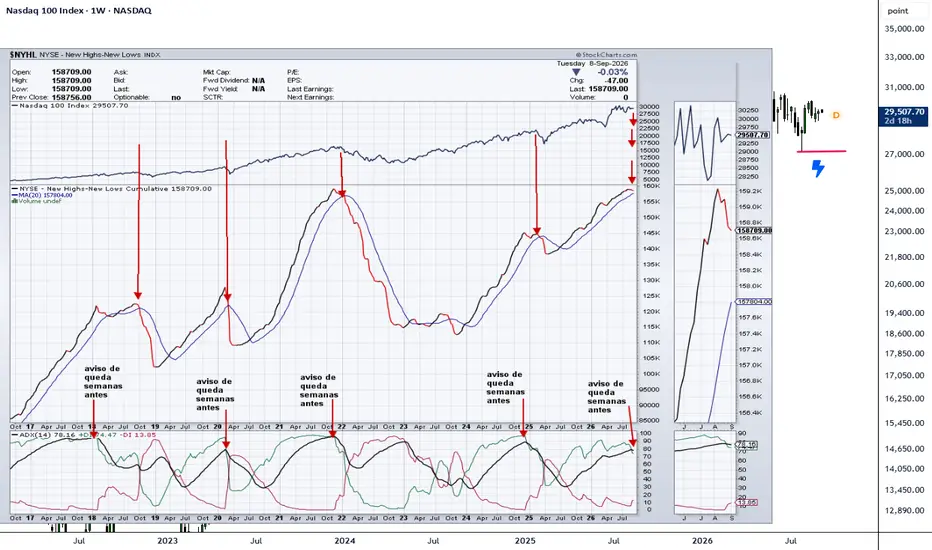
The Nasdaq continues to trade near historically elevated levels, but beneath the surface of the index, something is beginning to catch my attention.
This analysis is not an attempt to call the exact top of the market.
Instead, I am looking at **market breadth** and asking a different question:
**Is the internal structure of the market beginning to deteriorate before price itself shows obvious weakness?**
The chart above compares the Nasdaq 100 with the **NYSE Cumulative New Highs – New Lows**, together with the **ADX/DMI** structure.
Historically, similar configurations have appeared before some relevant market corrections.
That does not mean the same outcome must happen again.
But when a pattern has repeatedly preceded periods of weakness, I believe it deserves attention.
## What Is Market Breadth Telling Us?
An index such as the Nasdaq 100 can remain strong even when participation underneath the surface begins to deteriorate.
This happens because large-cap stocks can continue pushing the index higher while an increasing number of individual stocks stop making new highs or begin making new lows.
That is why I like to monitor the **Cumulative New Highs – New Lows**.
Instead of looking only at the index price, this indicator helps us understand how broadly the market is participating in the move.
A healthy bull market should ideally show both:
**Price making new highs + broad participation across stocks.**
The warning begins when these two components stop moving together.
And that is what I am currently watching.
## A Pattern That Has Appeared Before
Looking back through the chart, there are several moments where the breadth indicator reached an extended condition and subsequently began to roll over.
The ADX/DMI structure also changed around those periods.
I marked some of these occurrences directly on the chart.
What makes the current situation interesting is that we are once again approaching a similar configuration.
Historically, these signals did not necessarily identify the exact market top.
In some cases, price continued higher for several weeks.
That distinction is extremely important.
This is not a timing indicator saying:
**"Sell the market today."**
It is better interpreted as:
**"The internal risk of the market may be increasing."**
And sometimes the deterioration underneath the market begins well before it becomes obvious on the index itself.
## Price Is Still Strong
This is where discipline becomes important.
The Nasdaq itself has not confirmed a major bearish reversal.
Price remains structurally strong.
Therefore, I am not treating this breadth signal as confirmation that a crash or major correction has already begun.
The market could simply consolidate, breadth could recover, and the bull trend could continue.
That scenario must remain on the table.
But I also don't want to ignore what is happening underneath the index simply because price remains near the highs.
Markets often deteriorate internally before the weakness becomes visible in the headline index.
## What Would Confirm the Warning?
For this thesis to become more relevant, I want price to begin confirming what breadth appears to be suggesting.
Some of the developments I will be watching are:
- Continued deterioration in the Cumulative New Highs – New Lows.
- A bearish change in the ADX/DMI structure.
- Failure of the Nasdaq to sustain new highs.
- Formation of lower highs and lower lows.
- Breakdown of important support levels.
- Increasing downside participation across the broader market.
If several of these conditions begin appearing together, the probability that we are dealing with something more significant than normal market noise increases.
Until then, this remains a **warning signal, not a confirmed bearish trend.**
## Why This Matters
One of the biggest mistakes traders make is waiting until everyone can see the problem.
By the time price has already fallen significantly, the risk/reward relationship may have changed completely.
Breadth analysis is useful because it allows us to observe the internal health of the market before price necessarily confirms the move.
It doesn't predict the future.
It helps identify when conditions are becoming less favorable.
And right now, I believe the current configuration deserves attention.
## What Could This Mean for Crypto?
There is another important reason why I am paying close attention to this signal:
**the potential impact on the cryptocurrency market.**
Crypto does not trade in isolation.
During periods of risk aversion, Bitcoin and the broader crypto market can become highly sensitive to weakness in U.S. equities, particularly technology and other risk assets.
If the deterioration in market breadth eventually develops into a meaningful correction in the Nasdaq, I believe there is a real possibility that **Bitcoin and the crypto market could be dragged lower with it.**
And the effect could be amplified in altcoins.
Bitcoin does not necessarily need to collapse for this to become relevant.
A sufficiently strong risk-off move in equities, combined with weakness in BTC, could trigger deleveraging, stop losses and forced liquidations across the crypto market.
That is particularly important for altcoins, where liquidity is generally thinner and downside moves can become much more aggressive.
So I am currently watching two markets as part of the same risk environment:
**U.S. Equities → Bitcoin → Altcoins**
If the Nasdaq begins confirming the weakness currently suggested by market breadth, and Bitcoin simultaneously loses important support levels, I would expect the probability of a broader crypto sell-off to increase considerably.
## The Altcoin Risk
This is where I believe the situation becomes particularly interesting.
When Bitcoin experiences a relatively controlled correction, the impact on altcoins can be disproportionately larger.
A moderate decline in BTC can translate into significantly larger percentage losses across smaller and less liquid cryptocurrencies.
This can happen because of leverage, thinner order books, forced liquidations and investors rapidly reducing exposure to higher-beta assets.
Therefore, if Nasdaq weakness eventually produces a broader risk-off environment and Bitcoin confirms that move, I would be particularly cautious with leveraged altcoin positions.
A sharp liquidation event could potentially create exactly the kind of capitulation that often appears near important market bottoms.
Paradoxically, that could eventually become an opportunity rather than something to fear.
## A Sell-Off Could Eventually Create the Opportunity
This is an important distinction in my current view.
I am not structurally bearish on crypto simply because I see short-term downside risk.
In fact, a significant liquidation event could potentially create a much more attractive environment for building long-term positions.
Markets rarely offer the best opportunities when everything feels comfortable.
Sometimes the best risk/reward appears after leverage has been flushed, weak hands have capitulated and price reaches areas where sellers become exhausted.
If Bitcoin is dragged lower by a broader risk-off event and altcoins experience an accelerated sell-off, I will be watching very carefully for signs of capitulation and accumulation.
But I don't want to anticipate that bottom.
First, I want the market to show me whether this risk scenario is actually developing.
## My Approach From Here
This is not the moment, in my opinion, to become emotionally bullish or bearish.
It is a moment to observe the evidence.
If breadth recovers and the Nasdaq continues higher with stronger participation, this warning can simply disappear.
If breadth continues deteriorating and price begins confirming that weakness, I will become increasingly defensive.
And if that weakness spreads into Bitcoin and eventually produces a liquidation event across altcoins, I will start looking for asymmetric buying opportunities at lower prices.
The sequence matters.
**Breadth deterioration → Nasdaq confirmation → Risk-off → Bitcoin weakness → Altcoin deleveraging → Potential capitulation → Opportunity**
I don't need every part of this scenario to happen.
I only need to recognize it early enough to manage risk if it does.
## Final Thoughts
The Nasdaq is still strong and price has not confirmed a major bearish reversal.
But underneath the surface, market breadth is beginning to show a condition that historically deserved attention.
The NYSE Cumulative New Highs – New Lows, combined with the current ADX/DMI configuration, is approaching a setup that appeared before several important market corrections.
This time could be different.
Breadth could recover and the bull market could continue.
But if instead the Nasdaq begins confirming this internal deterioration through price, I will not look at it as an isolated equity-market event.
I will also be watching Bitcoin very closely.
A meaningful risk-off move in U.S. equities could put additional pressure on BTC, and weakness in Bitcoin could be amplified across altcoins through leverage, liquidations and deteriorating liquidity.
That is why, for me, this is a moment for **caution rather than prediction**.
I don't need to know exactly where the top is.
I don't need to know exactly where the bottom will be.
I need to understand when the risk/reward relationship is changing and preserve capital until the market offers a clearer asymmetric opportunity.
Sometimes the best opportunities appear immediately after the market forces everyone else to give up.
Until then:
**Watch breadth. Watch Nasdaq. Watch Bitcoin. And respect the risk.**

Отказ от ответственности
Информация и публикации не предназначены для предоставления и не являются финансовыми, инвестиционными, торговыми или другими видами советов или рекомендаций, предоставленных или одобренных TradingView. Подробнее читайте в Условиях использования.
Отказ от ответственности
Информация и публикации не предназначены для предоставления и не являются финансовыми, инвестиционными, торговыми или другими видами советов или рекомендаций, предоставленных или одобренных TradingView. Подробнее читайте в Условиях использования.