
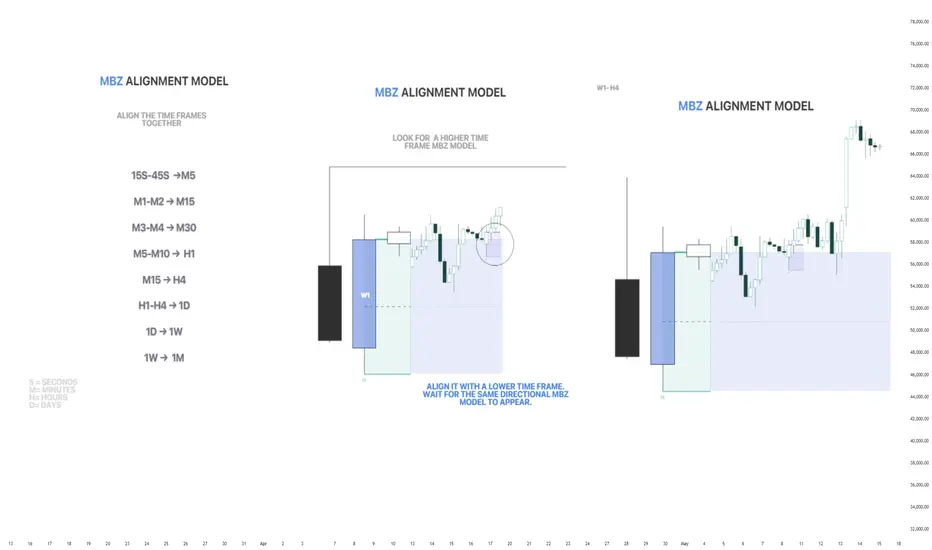
The MBZ Alignment Model is a multi-timeframe framework built around one core principle: when two timeframes produce the same directional MBZ model, the probability of continuation increases significantly. One timeframe sets the context. The other confirms it.
This is not a single-timeframe strategy. It is a structural alignment process that filters out low-quality setups by requiring agreement across fractal layers before any trade idea is considered.
What Is an MBZ?
An MBZ (Median Body Zone) forms when price interacts with a key level — a liquidity sweep or a Fair Value Gap — and the next candle closes beyond the median of the previous candle's body in the opposing direction. The zone is drawn from the extreme of the pattern to that confirmation close.
The median of the body is the midpoint between the open and close — not the wick. When price closes past that midpoint after tapping liquidity or filling a gap, it signals that the opposing side has taken control. The zone left behind becomes an area of interest when price returns to it.
There are four types of MBZ formations, each triggered by a different structural condition but sharing the same core confirmation logic — a close beyond the body median after a key interaction.
Type 1 forms when the confirmation candle itself sweeps liquidity and reverses.
Type 2 forms when price taps a level and the following candle reverses past the body midpoint.
Type 3 involves a deeper sweep where price closes through the level before reversing.
Type 4 forms when price returns into a Fair Value Gap and the reversal pattern prints inside the gap.
Same confirmation pattern. Different trigger. Different context.
The Timeframe Pairing Structure
The foundation of the Alignment Model is proper timeframe pairing. Each execution timeframe has a corresponding higher timeframe that provides directional context:
15 Second to 45 Second charts align with the 5 Minute.
1 Minute to 2 Minute charts align with the 15 Minute.
3 Minute to 4 Minute charts align with the 30 Minute.
5 Minute to 10 Minute charts align with the 1 Hour.
15 Minute aligns with the 4 Hour.
1 Hour to 4 Hour charts align with the Daily.
Daily aligns with the Weekly.
Weekly aligns with the Monthly.
These pairings represent the fractal relationship between institutional timeframes and their sub-structures. The higher timeframe is where the narrative lives. The lower timeframe is where the execution happens.
Step 1 — Identify the Higher Timeframe MBZ Model
Start on the higher timeframe. You are looking for a complete MBZ to form — price sweeps liquidity or trades into an FVG, and the confirmation candle closes beyond the body median of the reference candle. This is your directional bias. If the HTF MBZ is bullish, you only look for bullish setups on the lower timeframe. If bearish, only bearish.
The higher timeframe is the filter. It tells you what direction to trade. It does not tell you when to enter. That comes from the lower timeframe.
Do not skip this step. Trading the lower timeframe without higher timeframe context is trading without direction.
Step 2 — Drop to the Lower Timeframe and Wait
Once the HTF MBZ is in place, move to your paired lower timeframe. Now you wait. You are looking for the same directional MBZ to form on the lower timeframe — ideally within or near the HTF zone.
This is the alignment. Two timeframes, same direction, same confirmation pattern. The HTF provides the narrative. The LTF provides the timing.
If the lower timeframe produces an MBZ in the opposite direction of the higher timeframe, there is no alignment. No alignment means no setup. Walk away and wait for the next opportunity.
Step 3 — The Fractal Confirmation
When the LTF MBZ forms in the same direction as the HTF model, that is your fractal confirmation. Two layers of the market are agreeing on direction. This is where the framework produces its highest quality trade ideas.
The entry, stop, and target are all derived from the LTF MBZ. The conviction comes from the HTF alignment. Without both, the setup is incomplete.
Not every HTF MBZ will produce an LTF confirmation. That is by design. The model is meant to filter, not to force. Patience is not optional in this framework — it is the framework.
Why Fractal Alignment Matters
Markets are fractal. The same patterns that appear on the Weekly chart also appear on the 5 Minute chart. The difference is context. A 5 Minute MBZ by itself is noise. A 5 Minute MBZ that aligns with a 1 Hour MBZ is a structural event.
The Alignment Model exploits this relationship by requiring both layers to agree before a trade idea is valid. This naturally eliminates the majority of low-probability setups and keeps the focus on moments where institutional order flow is visible across multiple timeframes.
Key Rules of the Framework
The higher timeframe always sets the directional bias. Never trade against it.
The lower timeframe must produce the same directional MBZ. If it does not, there is no trade.
Timeframe pairing must be respected. Skipping timeframes breaks the fractal relationship.
Patience is the primary filter. The best setups come to you — you do not chase them.
Disclaimer
This publication is for educational purposes only and does not constitute financial advice. Trading involves significant risk, and past performance is not indicative of future results. Always conduct your own analysis and manage risk appropriately. This content describes a conceptual framework and should not be interpreted as a guarantee of any specific outcome.
This is not a single-timeframe strategy. It is a structural alignment process that filters out low-quality setups by requiring agreement across fractal layers before any trade idea is considered.
What Is an MBZ?
An MBZ (Median Body Zone) forms when price interacts with a key level — a liquidity sweep or a Fair Value Gap — and the next candle closes beyond the median of the previous candle's body in the opposing direction. The zone is drawn from the extreme of the pattern to that confirmation close.
The median of the body is the midpoint between the open and close — not the wick. When price closes past that midpoint after tapping liquidity or filling a gap, it signals that the opposing side has taken control. The zone left behind becomes an area of interest when price returns to it.
There are four types of MBZ formations, each triggered by a different structural condition but sharing the same core confirmation logic — a close beyond the body median after a key interaction.
Type 1 forms when the confirmation candle itself sweeps liquidity and reverses.
Type 2 forms when price taps a level and the following candle reverses past the body midpoint.
Type 3 involves a deeper sweep where price closes through the level before reversing.
Type 4 forms when price returns into a Fair Value Gap and the reversal pattern prints inside the gap.
Same confirmation pattern. Different trigger. Different context.
The Timeframe Pairing Structure
The foundation of the Alignment Model is proper timeframe pairing. Each execution timeframe has a corresponding higher timeframe that provides directional context:
15 Second to 45 Second charts align with the 5 Minute.
1 Minute to 2 Minute charts align with the 15 Minute.
3 Minute to 4 Minute charts align with the 30 Minute.
5 Minute to 10 Minute charts align with the 1 Hour.
15 Minute aligns with the 4 Hour.
1 Hour to 4 Hour charts align with the Daily.
Daily aligns with the Weekly.
Weekly aligns with the Monthly.
These pairings represent the fractal relationship between institutional timeframes and their sub-structures. The higher timeframe is where the narrative lives. The lower timeframe is where the execution happens.
Step 1 — Identify the Higher Timeframe MBZ Model
Start on the higher timeframe. You are looking for a complete MBZ to form — price sweeps liquidity or trades into an FVG, and the confirmation candle closes beyond the body median of the reference candle. This is your directional bias. If the HTF MBZ is bullish, you only look for bullish setups on the lower timeframe. If bearish, only bearish.
The higher timeframe is the filter. It tells you what direction to trade. It does not tell you when to enter. That comes from the lower timeframe.
Do not skip this step. Trading the lower timeframe without higher timeframe context is trading without direction.
Step 2 — Drop to the Lower Timeframe and Wait
Once the HTF MBZ is in place, move to your paired lower timeframe. Now you wait. You are looking for the same directional MBZ to form on the lower timeframe — ideally within or near the HTF zone.
This is the alignment. Two timeframes, same direction, same confirmation pattern. The HTF provides the narrative. The LTF provides the timing.
If the lower timeframe produces an MBZ in the opposite direction of the higher timeframe, there is no alignment. No alignment means no setup. Walk away and wait for the next opportunity.
Step 3 — The Fractal Confirmation
When the LTF MBZ forms in the same direction as the HTF model, that is your fractal confirmation. Two layers of the market are agreeing on direction. This is where the framework produces its highest quality trade ideas.
The entry, stop, and target are all derived from the LTF MBZ. The conviction comes from the HTF alignment. Without both, the setup is incomplete.
Not every HTF MBZ will produce an LTF confirmation. That is by design. The model is meant to filter, not to force. Patience is not optional in this framework — it is the framework.
Why Fractal Alignment Matters
Markets are fractal. The same patterns that appear on the Weekly chart also appear on the 5 Minute chart. The difference is context. A 5 Minute MBZ by itself is noise. A 5 Minute MBZ that aligns with a 1 Hour MBZ is a structural event.
The Alignment Model exploits this relationship by requiring both layers to agree before a trade idea is valid. This naturally eliminates the majority of low-probability setups and keeps the focus on moments where institutional order flow is visible across multiple timeframes.
Key Rules of the Framework
The higher timeframe always sets the directional bias. Never trade against it.
The lower timeframe must produce the same directional MBZ. If it does not, there is no trade.
Timeframe pairing must be respected. Skipping timeframes breaks the fractal relationship.
Patience is the primary filter. The best setups come to you — you do not chase them.
Disclaimer
This publication is for educational purposes only and does not constitute financial advice. Trading involves significant risk, and past performance is not indicative of future results. Always conduct your own analysis and manage risk appropriately. This content describes a conceptual framework and should not be interpreted as a guarantee of any specific outcome.

The Blueprint | Get Access to indicators, an automatic trading journal, market outlooks and more: whop.com/the-blueprinttrading
Отказ от ответственности
Информация и публикации не предназначены для предоставления и не являются финансовыми, инвестиционными, торговыми или другими видами советов или рекомендаций, предоставленных или одобренных TradingView. Подробнее читайте в Условиях использования.
The Blueprint | Get Access to indicators, an automatic trading journal, market outlooks and more: whop.com/the-blueprinttrading
Отказ от ответственности
Информация и публикации не предназначены для предоставления и не являются финансовыми, инвестиционными, торговыми или другими видами советов или рекомендаций, предоставленных или одобренных TradingView. Подробнее читайте в Условиях использования.