
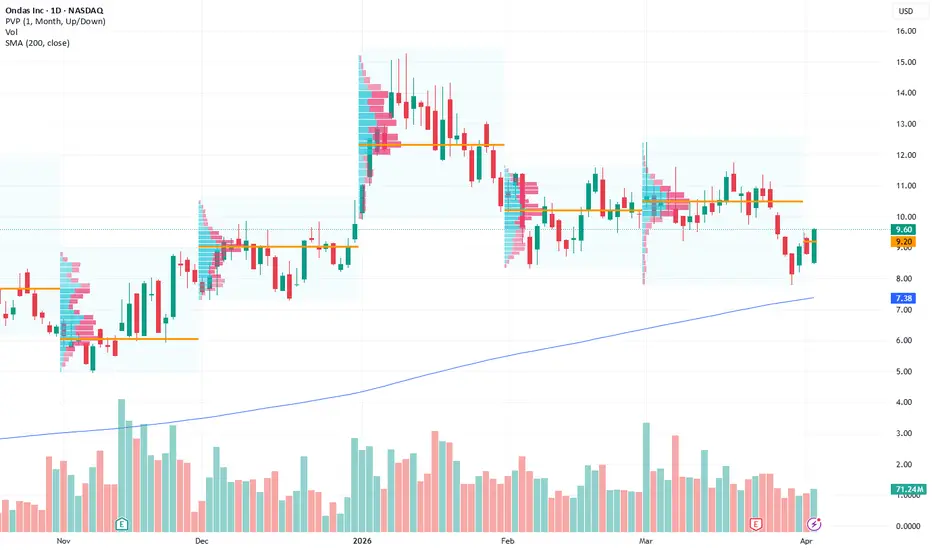
Executive Summary:
Ondas Holdings is trying to assemble a vertically integrated platform in autonomous defense technology that spans drone systems, propulsion, and secure wireless infrastructure. Strategically, the vision makes sense. Economically, however, the company is still far from proving that the model works.
Margin of safety verdict: at roughly $8.9 per share, the market already reflects a meaningful probability that management’s aggressive revenue and profitability ramp actually happens. Given the absence of proven ROIC, ongoing negative free cash flow, and a strategy that relies heavily on acquisitions and equity financing, the stock does not currently offer a dependable margin of safety.
One Stock, Dozens of Voices:
This is not the view of a single analyst. CrowdWisdom aggregated 28 independent inputs for ONDS, including 2 retail investor discussions (Reddit), 20 financial research articles from the web, 1 live market intelligence feed, 4 prior CrowdWisdom analysis snapshots from its internal archive, and 1 verified financial data check using Yahoo Finance. The goal was to distill what a wide set of traders, investors, and researchers broadly agree on, where opinions diverge, and what the market may be overlooking.
Those inputs were then pushed through an adversarial review process: a bull case, a contrarian bear case, and a variant‑perception exercise aimed at identifying what expectations are already embedded in the price. All financial metrics were cross‑checked against live market data.
What follows reflects where the crowd broadly converges, where it disagrees, and whether the current price leaves investors with any meaningful margin of safety.
Business Quality and Moat Durability:
Ondas operates in a specialized but fast‑moving corner of the defense technology landscape. The company focuses on autonomous aerial systems, counter‑drone interception platforms, and private industrial wireless networks.
Management’s ambition is to build an integrated infrastructure layer for autonomous security and surveillance. Through acquisitions such as Mistral Defense, Rotron Aerospace, and BIRD, Ondas now owns pieces across propulsion, drone hardware, and command‑and‑control systems.
In principle, that kind of vertical integration can create advantages.
Defense procurement ecosystems tend to favor vendors that deliver integrated systems rather than isolated components. Governments often prefer contractors capable of providing the full stack: hardware, control software, and communications infrastructure.
There are also potential switching costs. Once a system is validated in real operational settings, military and infrastructure operators frequently standardize on platforms that have already passed certification and testing.
Geopolitics adds another tailwind. Drone warfare, border monitoring, and infrastructure protection are becoming larger priorities for defense and security agencies around the world.
Still, these advantages are largely theoretical at this stage.
The counter‑drone and autonomous defense market includes some of the largest contractors in the industry. Lockheed Martin, Northrop Grumman, Raytheon, and Boeing all bring enormous research budgets, long‑standing procurement relationships, and deep regulatory expertise.
For a smaller player like Ondas, the real question is not whether the market exists. It clearly does. The question is whether the company can secure durable program positions before the large incumbents crowd the field.
Today the moat is best described as still forming. Operational deployments could eventually create switching costs, but the company has not yet demonstrated a durable economic moat.
Moat trajectory: currently uncertain, with risk of narrowing if large defense primes internalize competing capabilities.
Return on Invested Capital (ROIC):
ROIC is the key measure of long‑term compounding power. For Ondas, it is also the hardest metric to evaluate.
The company is currently operating with deeply negative operating margins. Operating losses exceed revenue by a wide margin, which makes meaningful ROIC analysis impossible.
Meanwhile, the capital base continues to grow.
Recent acquisitions and a major equity raise have brought substantial capital into the business. The company raised approximately $1 billion in equity financing and has signaled the possibility of additional offerings. While that provides a significant cash buffer, it also expands the pool of capital that eventually must earn a return.
Historically, capital expenditures have been minimal. Over the past twelve months, capex totaled only about $2 million, roughly four percent of revenue. If the business scales successfully, that suggests the model could eventually remain relatively capital light.
Acquisition‑driven growth complicates the picture. When companies expand primarily through acquisitions before reaching profitability, incremental ROIC often deteriorates because goodwill and integration costs increase invested capital faster than operating profits.
The optimistic view assumes that once autonomous systems enter scaled procurement cycles, operating leverage will drive a sharp improvement in returns on capital.
That outcome is possible. But investors today are underwriting a future ROIC profile that does not yet appear in the financial statements.
Quality of Earnings:
Ondas’ earnings quality can be summarized simply: the company is currently burning cash while projecting future profitability.
Trailing twelve month operating cash flow is roughly negative $38.8 million. After modest capital expenditures of about $2 million, free cash flow stands at approximately negative $40.8 million.
At the same time, management has outlined a potential transition to positive net income once revenue reaches the hundreds of millions of dollars.
That type of inflection is not unheard of in defense technology. Many firms spend years in development phases before programs move into full production. When that transition happens, revenue can accelerate while engineering expenses stabilize.
Until free cash flow actually turns positive, however, accounting projections deserve caution. Forecast net income depends on assumptions about operating leverage, program adoption, and cost control that have yet to be proven.
For investors who prioritize real cash generation over narrative projections, the current earnings profile remains weak.
Capital Allocation Scorecard:
Management’s capital allocation strategy has been aggressive and expansion focused.
Over the past several years, the company has completed multiple acquisitions intended to assemble a vertically integrated autonomous defense stack. Mistral Defense, Rotron Aerospace, and BIRD expanded the company’s capabilities across propulsion, defense electronics, and UAV platforms.
The objective is to accelerate technological capability while gaining access to defense procurement channels.
The financing side, however, warrants attention.
The company raised approximately $1 billion in equity in early 2026 and has indicated that additional capital raises may follow. Although the balance sheet now holds substantial net cash, this funding approach is highly dilutive for existing shareholders.
There are no dividends and no share repurchase programs, which is typical for a growth‑stage company. The central issue is whether the capital raised today will eventually generate returns above the cost of that capital.
So far, that result remains unproven.
Capital allocation grade: uncertain, with elevated dilution risk.
Customer and Revenue Concentration:
The available data does not disclose precise customer concentration figures. That absence is notable.
Early‑stage defense technology companies often generate a large share of revenue from a small number of contracts or pilot programs. If a single defense program or government customer accounts for a significant portion of revenue, the business becomes exposed to delays, procurement shifts, or contract cancellations.
The company’s narrative points to relationships with defense agencies and special operations customers. Those connections could become durable if they turn into multi‑year procurement programs.
Without clear disclosure of customer concentration percentages, however, investors cannot fully assess the stability of the revenue base.
For value investors accustomed to predictable customer structures, that gap represents a meaningful analytical limitation.
Management Alignment:
Insider activity over the past year shows a net decline in insider ownership. Several executives and directors sold shares following strong stock performance.
Insider selling is not automatically a negative signal. Executives often sell shares for diversification or tax reasons.
The optics become more complicated when insider selling occurs alongside large equity issuance. When insiders are reducing their exposure while shareholders face dilution from new offerings, questions about alignment inevitably arise.
Ultimately, confidence in management will depend on whether the capital raised today translates into durable shareholder value over time.
10-Year Durability Test:
The ten‑year durability test asks a straightforward question: can we reasonably predict the competitive position of this business a decade from now?
For Ondas, the honest answer is uncertain.
Several structural forces could reshape the industry during that time.
Technological disruption is one possibility. Advances in AI‑driven autonomy, swarm technology, or electronic warfare could significantly change how drone defense systems operate.
Industry consolidation is another. Defense procurement ecosystems historically concentrate around a relatively small group of trusted contractors.
Regulatory changes could also shift the landscape. Export controls, security regulations, and international alliances strongly influence defense technology supply chains.
To remain relevant over a decade, Ondas must integrate its acquisitions successfully, keep its technology competitive, and secure long‑term procurement relationships before larger competitors dominate the space.
Given the speed of technological change and the presence of large incumbents, predicting the competitive environment ten years ahead carries substantial uncertainty.
For many disciplined value investors, that degree of uncertainty pushes the company toward the edge of the “too hard” pile.
Multi-Year Thesis (3 to 7 years):
The investment case for Ondas can be framed through three potential paths.
Bear Scenario (Probability 40 percent)
In this scenario, the anticipated revenue ramp toward hundreds of millions of dollars fails to fully materialize. Acquisitions contribute some growth, but operating costs remain high. Gross margins compress toward thirty percent as production scales, and the company continues raising equity capital to fund operations.
The result is a business that struggles to produce free cash flow. The market ultimately values the company as a speculative defense technology startup rather than a scaled defense contractor.
Estimated intrinsic value: $3 to $5 per share.
Base Scenario (Probability 40 percent)
Here, revenue expands gradually as pilot programs convert into moderate production contracts. Gross margins settle in the high thirties to forty percent range. Operating leverage improves somewhat, though margins remain relatively modest.
The company eventually generates positive free cash flow, but profitability remains moderate.
Estimated intrinsic value: $9 to $12 per share.
Bull Scenario (Probability 20 percent)
In the bullish outcome, Ondas successfully converts its acquisitions into major defense procurement programs. Revenue climbs toward several hundred million dollars annually, and recurring service, software, and maintenance contracts begin generating high incremental margins.
Operating margins expand significantly and the company becomes a recognized supplier of autonomous defense infrastructure.
Estimated intrinsic value: $18 to $22 per share.
Probability weighted intrinsic value: roughly $10 to $11 per share.
Margin of Safety Verdict:
The stock currently trades near $8.9 per share.
Against a probability‑weighted intrinsic value estimate of roughly $10 to $11, the discount is limited. More importantly, the valuation range itself is extremely wide, stretching from roughly $3 to $22 depending on execution.
When intrinsic value estimates span that kind of range, the idea of a reliable margin of safety begins to break down.
A disciplined value investor typically wants a clear discount to a conservative estimate of intrinsic value. In this case, the current market price already assumes a meaningful chance that the company’s growth narrative works out.
As a result, the analysis becomes more of an intellectual exercise than a clear value opportunity.
Peak Margin Stress Test:
Current gross margins sit at approximately 40 percent.
If production scales and government procurement pricing pressure increases, margins could realistically compress toward 30 to 35 percent.
Consider a scenario where revenue reaches $375 million but gross margins fall to 33 percent.
Gross profit would come to roughly $124 million. After accounting for engineering, administrative, and integration costs typical of defense technology firms, operating profit could remain minimal.
Under those conditions, the projected $80 million plus net income would likely fail to appear. Market valuation could reset toward levels more typical of early‑stage defense technology suppliers, potentially implying share prices closer to $4 to $6 depending on dilution.
Valuation Framing:
Valuing Ondas depends heavily on assumptions about revenue scale and margin expansion.
Public analysis offers several reference points.
Some bullish discounted cash flow models estimate intrinsic value around $19 per share. More conservative intrinsic value estimates fall closer to $2 to $3 depending on cash flow assumptions.
Narrative‑driven models that assume significant market share in counter‑drone infrastructure point to even higher theoretical outcomes.
The wide dispersion of these estimates highlights the central issue: small changes in revenue or margin assumptions produce large swings in valuation.
In effect, the market appears to be pricing optionality rather than established economics.
Perception vs Reality:
Market perception casts Ondas as an emerging defense technology platform positioned in the center of a rapidly expanding counter‑drone market.
Financial reality shows a company still operating with deeply negative margins and negative free cash flow.
Those two narratives could eventually converge if the business transitions from development stage into scaled production programs.
For now, the story is running ahead of the numbers.
Why This May Be Misunderstood:
Several factors help explain the enthusiasm around the stock.
Geopolitical tensions and the rise of drone warfare create a powerful structural demand narrative.
Acquisitions create the impression of rapid technological expansion and broader market access.
A large cash balance provides financial runway, which reduces near‑term solvency concerns.
Together, these factors support a compelling growth story even though the underlying economic model has not yet been proven.
Three Measurable Things to Watch Next Quarter:
Revenue composition is one key signal. Investors should watch whether revenue growth comes from recurring production contracts or one‑time project work.
Operating leverage is another indicator. Are operating losses shrinking as revenue expands?
Cash burn trajectory also matters. Is free cash flow improving or deteriorating as the company scales?
Historical Conviction Drift:
Investor sentiment around Ondas has been volatile.
The stock experienced a dramatic multi‑hundred percent rally during the past year, followed by periods of sharp pullbacks.
Retail investor discussions frequently reference price targets above $20 based on bullish analyst projections. Professional research commentary tends to focus more on dilution risk, integration challenges, and the uncertain timeline to profitability.
Disconfirming Evidence:
The strongest argument against owning Ondas is simple.
The company has not yet demonstrated that it can generate positive returns on invested capital.
Almost every component of the bullish thesis depends on events that have not yet occurred. Revenue acceleration, margin expansion, acquisition synergies, and major defense procurement wins remain largely hypothetical.
Value investors generally prefer businesses where economic returns are already visible rather than merely possible.
Risks:
Acquisition integration risk remains significant. Several recent acquisitions must be successfully integrated across technology platforms and supply chains.
Dilution risk is also meaningful. Continued equity financing could materially reduce per‑share value for existing investors.
Technology displacement risk cannot be ignored. Rapid advances in drone and counter‑drone systems could render current platforms obsolete.
Competition risk is substantial as well. Large defense contractors may develop competing platforms backed by far greater resources.
Procurement risk is inherent in the industry. Defense budgets and procurement priorities are political and can change quickly.
Summary:
Ondas Holdings represents an ambitious effort to build an integrated autonomous defense platform.
The strategic vision aligns with real geopolitical trends. Demand for counter‑drone systems, autonomous surveillance, and infrastructure protection is likely to expand over the coming decade.
The financial profile, however, still reflects a company in the development stage. Operating margins remain deeply negative, free cash flow is negative, and long‑term returns on capital have not yet been demonstrated.
At today’s price, the market already assigns a meaningful probability to successful execution.
For value investors focused on durable ROIC and a clear margin of safety, Ondas currently looks less like a classic value investment and more like a speculative option on a future defense platform.
References:
This analysis reviewed approximately 1596 article sources and 123 video transcripts.
1. Yahoo Finance. Ondas Holdings Inc. (ONDS): A Bull Case Theory. finance.yahoo.com/news/ondas-holdings-inc-onds-bull-220600894.html
2. Yahoo Finance. Ondas Holdings Inc. (NASDAQ:ONDS) Shares Could Be 32% Overvalued Based On DCF Model. finance.yahoo.com/news/ondas-holdings-inc-nasdaq-onds-102822201.html
3. Yahoo Finance. Does Ondas Holdings' Growth Surge Signal Real Value After New Industry Partnerships? finance.yahoo.com/news/does-ondas-holdings-growth-surge-142022606.html
4. Yahoo Finance. Is Ondas Holdings Fairly Priced After Surging 35% on New Partnerships? finance.yahoo.com/news/ondas-holdings-fairly-priced-surging-181139050.html
5. StockAnalysis. Ondas Holdings Statistics and Financials. stockanalysis.com/stocks/onds/statistics/
6. StockAnalysis. Ondas Holdings Overview and Market Data. stockanalysis.com/stocks/onds/
7. Yahoo Finance. Ondas Holdings Insider Transactions. finance.yahoo.com/quote/ONDS/insider-transactions/
8. AlphaSpread. Ondas Holdings Economic Moat Assessment. alphaspread.com/security/nasdaq/onds/qualitative/block/economic-moat
9. TipRanks. Ondas Holdings Risk Factors. tipranks.com/stocks/onds/risk-factors
10. Simply Wall St. Ondas Holdings Narrative and Valuation Analysis. simplywall.st/stocks/us/tech/nasdaq-onds/ondas
11. Public.com. Ondas Holdings Earnings Data. public.com/stocks/onds/earnings
12. Ondas Holdings Investor Relations. Revised Preliminary Fourth Quarter and Full Year Results Press Release. ir.ondas.com/press-releases/detail/295/ondas-reports-revised-preliminary-fourth-quarter-and-full
13. MEXC Research. Ondas Holdings Dilution Concerns Analysis. mexc.co/news/642112
14. EBC Financial Group. Why Is ONDS Stock Going Up and Is It Still a Good Buy? ebc.com/forex/why-is-onds-stock-going-up-is-it-still-a-good-buy
15. StockTitan. Ondas Inc. Reports Record Fourth Quarter and Full Year 2025 Financial Results. stocktitan.net/news/ONDS/ondas-inc-reports-record-fourth-quarter-and-full-year-2025-financial-6kpbct4boxm8.html
16. Forbes. When Everything Feels Out Of Control, Value Investing Doesn't. forbes.com/sites/jamesberman/2026/04/01/when-everything-feels-out-of-control-value-investing-doesnt
17. Yahoo Finance. Value Investing Is Getting a MAGA Bump. sg.finance.yahoo.com/news/value-investing-getting-maga-bump-153000904.html
18. Bloomberg Opinion. International Value Stocks Are Getting a MAGA Bump. bloomberg.com/opinion/articles/2025-06-22/international-value-stocks-are-getting-a-maga-bump
Disclaimer:
This analysis is for informational purposes only and does not constitute investment advice. Investors should conduct their own research and consider their financial circumstances before making investment decisions.
Ondas Holdings is trying to assemble a vertically integrated platform in autonomous defense technology that spans drone systems, propulsion, and secure wireless infrastructure. Strategically, the vision makes sense. Economically, however, the company is still far from proving that the model works.
Margin of safety verdict: at roughly $8.9 per share, the market already reflects a meaningful probability that management’s aggressive revenue and profitability ramp actually happens. Given the absence of proven ROIC, ongoing negative free cash flow, and a strategy that relies heavily on acquisitions and equity financing, the stock does not currently offer a dependable margin of safety.
One Stock, Dozens of Voices:
This is not the view of a single analyst. CrowdWisdom aggregated 28 independent inputs for ONDS, including 2 retail investor discussions (Reddit), 20 financial research articles from the web, 1 live market intelligence feed, 4 prior CrowdWisdom analysis snapshots from its internal archive, and 1 verified financial data check using Yahoo Finance. The goal was to distill what a wide set of traders, investors, and researchers broadly agree on, where opinions diverge, and what the market may be overlooking.
Those inputs were then pushed through an adversarial review process: a bull case, a contrarian bear case, and a variant‑perception exercise aimed at identifying what expectations are already embedded in the price. All financial metrics were cross‑checked against live market data.
What follows reflects where the crowd broadly converges, where it disagrees, and whether the current price leaves investors with any meaningful margin of safety.
Business Quality and Moat Durability:
Ondas operates in a specialized but fast‑moving corner of the defense technology landscape. The company focuses on autonomous aerial systems, counter‑drone interception platforms, and private industrial wireless networks.
Management’s ambition is to build an integrated infrastructure layer for autonomous security and surveillance. Through acquisitions such as Mistral Defense, Rotron Aerospace, and BIRD, Ondas now owns pieces across propulsion, drone hardware, and command‑and‑control systems.
In principle, that kind of vertical integration can create advantages.
Defense procurement ecosystems tend to favor vendors that deliver integrated systems rather than isolated components. Governments often prefer contractors capable of providing the full stack: hardware, control software, and communications infrastructure.
There are also potential switching costs. Once a system is validated in real operational settings, military and infrastructure operators frequently standardize on platforms that have already passed certification and testing.
Geopolitics adds another tailwind. Drone warfare, border monitoring, and infrastructure protection are becoming larger priorities for defense and security agencies around the world.
Still, these advantages are largely theoretical at this stage.
The counter‑drone and autonomous defense market includes some of the largest contractors in the industry. Lockheed Martin, Northrop Grumman, Raytheon, and Boeing all bring enormous research budgets, long‑standing procurement relationships, and deep regulatory expertise.
For a smaller player like Ondas, the real question is not whether the market exists. It clearly does. The question is whether the company can secure durable program positions before the large incumbents crowd the field.
Today the moat is best described as still forming. Operational deployments could eventually create switching costs, but the company has not yet demonstrated a durable economic moat.
Moat trajectory: currently uncertain, with risk of narrowing if large defense primes internalize competing capabilities.
Return on Invested Capital (ROIC):
ROIC is the key measure of long‑term compounding power. For Ondas, it is also the hardest metric to evaluate.
The company is currently operating with deeply negative operating margins. Operating losses exceed revenue by a wide margin, which makes meaningful ROIC analysis impossible.
Meanwhile, the capital base continues to grow.
Recent acquisitions and a major equity raise have brought substantial capital into the business. The company raised approximately $1 billion in equity financing and has signaled the possibility of additional offerings. While that provides a significant cash buffer, it also expands the pool of capital that eventually must earn a return.
Historically, capital expenditures have been minimal. Over the past twelve months, capex totaled only about $2 million, roughly four percent of revenue. If the business scales successfully, that suggests the model could eventually remain relatively capital light.
Acquisition‑driven growth complicates the picture. When companies expand primarily through acquisitions before reaching profitability, incremental ROIC often deteriorates because goodwill and integration costs increase invested capital faster than operating profits.
The optimistic view assumes that once autonomous systems enter scaled procurement cycles, operating leverage will drive a sharp improvement in returns on capital.
That outcome is possible. But investors today are underwriting a future ROIC profile that does not yet appear in the financial statements.
Quality of Earnings:
Ondas’ earnings quality can be summarized simply: the company is currently burning cash while projecting future profitability.
Trailing twelve month operating cash flow is roughly negative $38.8 million. After modest capital expenditures of about $2 million, free cash flow stands at approximately negative $40.8 million.
At the same time, management has outlined a potential transition to positive net income once revenue reaches the hundreds of millions of dollars.
That type of inflection is not unheard of in defense technology. Many firms spend years in development phases before programs move into full production. When that transition happens, revenue can accelerate while engineering expenses stabilize.
Until free cash flow actually turns positive, however, accounting projections deserve caution. Forecast net income depends on assumptions about operating leverage, program adoption, and cost control that have yet to be proven.
For investors who prioritize real cash generation over narrative projections, the current earnings profile remains weak.
Capital Allocation Scorecard:
Management’s capital allocation strategy has been aggressive and expansion focused.
Over the past several years, the company has completed multiple acquisitions intended to assemble a vertically integrated autonomous defense stack. Mistral Defense, Rotron Aerospace, and BIRD expanded the company’s capabilities across propulsion, defense electronics, and UAV platforms.
The objective is to accelerate technological capability while gaining access to defense procurement channels.
The financing side, however, warrants attention.
The company raised approximately $1 billion in equity in early 2026 and has indicated that additional capital raises may follow. Although the balance sheet now holds substantial net cash, this funding approach is highly dilutive for existing shareholders.
There are no dividends and no share repurchase programs, which is typical for a growth‑stage company. The central issue is whether the capital raised today will eventually generate returns above the cost of that capital.
So far, that result remains unproven.
Capital allocation grade: uncertain, with elevated dilution risk.
Customer and Revenue Concentration:
The available data does not disclose precise customer concentration figures. That absence is notable.
Early‑stage defense technology companies often generate a large share of revenue from a small number of contracts or pilot programs. If a single defense program or government customer accounts for a significant portion of revenue, the business becomes exposed to delays, procurement shifts, or contract cancellations.
The company’s narrative points to relationships with defense agencies and special operations customers. Those connections could become durable if they turn into multi‑year procurement programs.
Without clear disclosure of customer concentration percentages, however, investors cannot fully assess the stability of the revenue base.
For value investors accustomed to predictable customer structures, that gap represents a meaningful analytical limitation.
Management Alignment:
Insider activity over the past year shows a net decline in insider ownership. Several executives and directors sold shares following strong stock performance.
Insider selling is not automatically a negative signal. Executives often sell shares for diversification or tax reasons.
The optics become more complicated when insider selling occurs alongside large equity issuance. When insiders are reducing their exposure while shareholders face dilution from new offerings, questions about alignment inevitably arise.
Ultimately, confidence in management will depend on whether the capital raised today translates into durable shareholder value over time.
10-Year Durability Test:
The ten‑year durability test asks a straightforward question: can we reasonably predict the competitive position of this business a decade from now?
For Ondas, the honest answer is uncertain.
Several structural forces could reshape the industry during that time.
Technological disruption is one possibility. Advances in AI‑driven autonomy, swarm technology, or electronic warfare could significantly change how drone defense systems operate.
Industry consolidation is another. Defense procurement ecosystems historically concentrate around a relatively small group of trusted contractors.
Regulatory changes could also shift the landscape. Export controls, security regulations, and international alliances strongly influence defense technology supply chains.
To remain relevant over a decade, Ondas must integrate its acquisitions successfully, keep its technology competitive, and secure long‑term procurement relationships before larger competitors dominate the space.
Given the speed of technological change and the presence of large incumbents, predicting the competitive environment ten years ahead carries substantial uncertainty.
For many disciplined value investors, that degree of uncertainty pushes the company toward the edge of the “too hard” pile.
Multi-Year Thesis (3 to 7 years):
The investment case for Ondas can be framed through three potential paths.
Bear Scenario (Probability 40 percent)
In this scenario, the anticipated revenue ramp toward hundreds of millions of dollars fails to fully materialize. Acquisitions contribute some growth, but operating costs remain high. Gross margins compress toward thirty percent as production scales, and the company continues raising equity capital to fund operations.
The result is a business that struggles to produce free cash flow. The market ultimately values the company as a speculative defense technology startup rather than a scaled defense contractor.
Estimated intrinsic value: $3 to $5 per share.
Base Scenario (Probability 40 percent)
Here, revenue expands gradually as pilot programs convert into moderate production contracts. Gross margins settle in the high thirties to forty percent range. Operating leverage improves somewhat, though margins remain relatively modest.
The company eventually generates positive free cash flow, but profitability remains moderate.
Estimated intrinsic value: $9 to $12 per share.
Bull Scenario (Probability 20 percent)
In the bullish outcome, Ondas successfully converts its acquisitions into major defense procurement programs. Revenue climbs toward several hundred million dollars annually, and recurring service, software, and maintenance contracts begin generating high incremental margins.
Operating margins expand significantly and the company becomes a recognized supplier of autonomous defense infrastructure.
Estimated intrinsic value: $18 to $22 per share.
Probability weighted intrinsic value: roughly $10 to $11 per share.
Margin of Safety Verdict:
The stock currently trades near $8.9 per share.
Against a probability‑weighted intrinsic value estimate of roughly $10 to $11, the discount is limited. More importantly, the valuation range itself is extremely wide, stretching from roughly $3 to $22 depending on execution.
When intrinsic value estimates span that kind of range, the idea of a reliable margin of safety begins to break down.
A disciplined value investor typically wants a clear discount to a conservative estimate of intrinsic value. In this case, the current market price already assumes a meaningful chance that the company’s growth narrative works out.
As a result, the analysis becomes more of an intellectual exercise than a clear value opportunity.
Peak Margin Stress Test:
Current gross margins sit at approximately 40 percent.
If production scales and government procurement pricing pressure increases, margins could realistically compress toward 30 to 35 percent.
Consider a scenario where revenue reaches $375 million but gross margins fall to 33 percent.
Gross profit would come to roughly $124 million. After accounting for engineering, administrative, and integration costs typical of defense technology firms, operating profit could remain minimal.
Under those conditions, the projected $80 million plus net income would likely fail to appear. Market valuation could reset toward levels more typical of early‑stage defense technology suppliers, potentially implying share prices closer to $4 to $6 depending on dilution.
Valuation Framing:
Valuing Ondas depends heavily on assumptions about revenue scale and margin expansion.
Public analysis offers several reference points.
Some bullish discounted cash flow models estimate intrinsic value around $19 per share. More conservative intrinsic value estimates fall closer to $2 to $3 depending on cash flow assumptions.
Narrative‑driven models that assume significant market share in counter‑drone infrastructure point to even higher theoretical outcomes.
The wide dispersion of these estimates highlights the central issue: small changes in revenue or margin assumptions produce large swings in valuation.
In effect, the market appears to be pricing optionality rather than established economics.
Perception vs Reality:
Market perception casts Ondas as an emerging defense technology platform positioned in the center of a rapidly expanding counter‑drone market.
Financial reality shows a company still operating with deeply negative margins and negative free cash flow.
Those two narratives could eventually converge if the business transitions from development stage into scaled production programs.
For now, the story is running ahead of the numbers.
Why This May Be Misunderstood:
Several factors help explain the enthusiasm around the stock.
Geopolitical tensions and the rise of drone warfare create a powerful structural demand narrative.
Acquisitions create the impression of rapid technological expansion and broader market access.
A large cash balance provides financial runway, which reduces near‑term solvency concerns.
Together, these factors support a compelling growth story even though the underlying economic model has not yet been proven.
Three Measurable Things to Watch Next Quarter:
Revenue composition is one key signal. Investors should watch whether revenue growth comes from recurring production contracts or one‑time project work.
Operating leverage is another indicator. Are operating losses shrinking as revenue expands?
Cash burn trajectory also matters. Is free cash flow improving or deteriorating as the company scales?
Historical Conviction Drift:
Investor sentiment around Ondas has been volatile.
The stock experienced a dramatic multi‑hundred percent rally during the past year, followed by periods of sharp pullbacks.
Retail investor discussions frequently reference price targets above $20 based on bullish analyst projections. Professional research commentary tends to focus more on dilution risk, integration challenges, and the uncertain timeline to profitability.
Disconfirming Evidence:
The strongest argument against owning Ondas is simple.
The company has not yet demonstrated that it can generate positive returns on invested capital.
Almost every component of the bullish thesis depends on events that have not yet occurred. Revenue acceleration, margin expansion, acquisition synergies, and major defense procurement wins remain largely hypothetical.
Value investors generally prefer businesses where economic returns are already visible rather than merely possible.
Risks:
Acquisition integration risk remains significant. Several recent acquisitions must be successfully integrated across technology platforms and supply chains.
Dilution risk is also meaningful. Continued equity financing could materially reduce per‑share value for existing investors.
Technology displacement risk cannot be ignored. Rapid advances in drone and counter‑drone systems could render current platforms obsolete.
Competition risk is substantial as well. Large defense contractors may develop competing platforms backed by far greater resources.
Procurement risk is inherent in the industry. Defense budgets and procurement priorities are political and can change quickly.
Summary:
Ondas Holdings represents an ambitious effort to build an integrated autonomous defense platform.
The strategic vision aligns with real geopolitical trends. Demand for counter‑drone systems, autonomous surveillance, and infrastructure protection is likely to expand over the coming decade.
The financial profile, however, still reflects a company in the development stage. Operating margins remain deeply negative, free cash flow is negative, and long‑term returns on capital have not yet been demonstrated.
At today’s price, the market already assigns a meaningful probability to successful execution.
For value investors focused on durable ROIC and a clear margin of safety, Ondas currently looks less like a classic value investment and more like a speculative option on a future defense platform.
References:
This analysis reviewed approximately 1596 article sources and 123 video transcripts.
1. Yahoo Finance. Ondas Holdings Inc. (ONDS): A Bull Case Theory. finance.yahoo.com/news/ondas-holdings-inc-onds-bull-220600894.html
2. Yahoo Finance. Ondas Holdings Inc. (NASDAQ:ONDS) Shares Could Be 32% Overvalued Based On DCF Model. finance.yahoo.com/news/ondas-holdings-inc-nasdaq-onds-102822201.html
3. Yahoo Finance. Does Ondas Holdings' Growth Surge Signal Real Value After New Industry Partnerships? finance.yahoo.com/news/does-ondas-holdings-growth-surge-142022606.html
4. Yahoo Finance. Is Ondas Holdings Fairly Priced After Surging 35% on New Partnerships? finance.yahoo.com/news/ondas-holdings-fairly-priced-surging-181139050.html
5. StockAnalysis. Ondas Holdings Statistics and Financials. stockanalysis.com/stocks/onds/statistics/
6. StockAnalysis. Ondas Holdings Overview and Market Data. stockanalysis.com/stocks/onds/
7. Yahoo Finance. Ondas Holdings Insider Transactions. finance.yahoo.com/quote/ONDS/insider-transactions/
8. AlphaSpread. Ondas Holdings Economic Moat Assessment. alphaspread.com/security/nasdaq/onds/qualitative/block/economic-moat
9. TipRanks. Ondas Holdings Risk Factors. tipranks.com/stocks/onds/risk-factors
10. Simply Wall St. Ondas Holdings Narrative and Valuation Analysis. simplywall.st/stocks/us/tech/nasdaq-onds/ondas
11. Public.com. Ondas Holdings Earnings Data. public.com/stocks/onds/earnings
12. Ondas Holdings Investor Relations. Revised Preliminary Fourth Quarter and Full Year Results Press Release. ir.ondas.com/press-releases/detail/295/ondas-reports-revised-preliminary-fourth-quarter-and-full
13. MEXC Research. Ondas Holdings Dilution Concerns Analysis. mexc.co/news/642112
14. EBC Financial Group. Why Is ONDS Stock Going Up and Is It Still a Good Buy? ebc.com/forex/why-is-onds-stock-going-up-is-it-still-a-good-buy
15. StockTitan. Ondas Inc. Reports Record Fourth Quarter and Full Year 2025 Financial Results. stocktitan.net/news/ONDS/ondas-inc-reports-record-fourth-quarter-and-full-year-2025-financial-6kpbct4boxm8.html
16. Forbes. When Everything Feels Out Of Control, Value Investing Doesn't. forbes.com/sites/jamesberman/2026/04/01/when-everything-feels-out-of-control-value-investing-doesnt
17. Yahoo Finance. Value Investing Is Getting a MAGA Bump. sg.finance.yahoo.com/news/value-investing-getting-maga-bump-153000904.html
18. Bloomberg Opinion. International Value Stocks Are Getting a MAGA Bump. bloomberg.com/opinion/articles/2025-06-22/international-value-stocks-are-getting-a-maga-bump
Disclaimer:
This analysis is for informational purposes only and does not constitute investment advice. Investors should conduct their own research and consider their financial circumstances before making investment decisions.

Отказ от ответственности
Информация и публикации не предназначены для предоставления и не являются финансовыми, инвестиционными, торговыми или другими видами советов или рекомендаций, предоставленных или одобренных TradingView. Подробнее читайте в Условиях использования.
Отказ от ответственности
Информация и публикации не предназначены для предоставления и не являются финансовыми, инвестиционными, торговыми или другими видами советов или рекомендаций, предоставленных или одобренных TradingView. Подробнее читайте в Условиях использования.