FullerOSOBSQZ v1.1.22
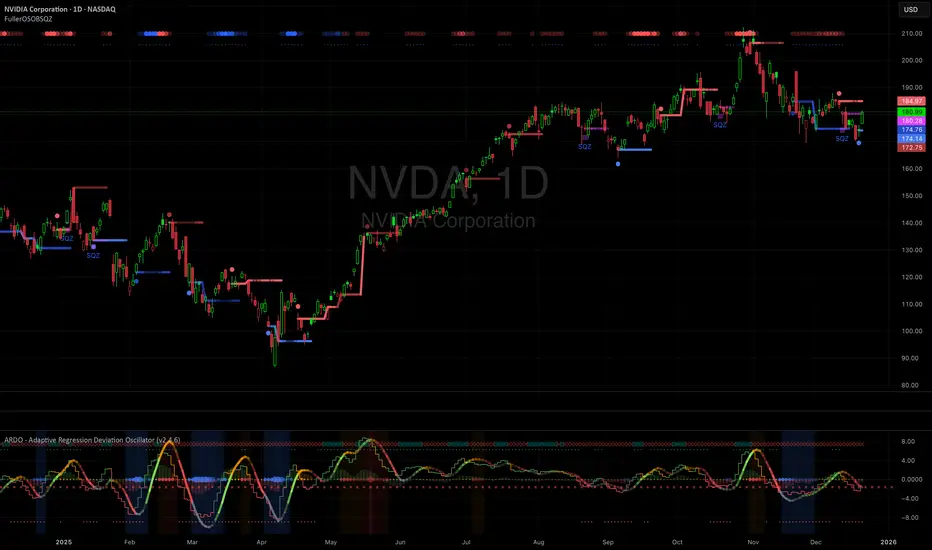
FullerOSOBSQZ v1.1.x — OS/OB Levels + Squeeze Anchor + Slope Accel + Alerts
Core Concepts
How to read the plots
Settings — What they do and how changing them affects signals
1) Base Triggers
2) Base Lines
3) Refined Triggers
4) Refined Colors + Widths
5) Trend Context
6) Squeeze
7) Markers
Alerts (built-in alertconditions)
Suggested workflows
Notes
- What this script does
- Plots Oversold (OS) and Overbought (OB) price levels as horizontal segments (line breaks) that persist for a configurable number of bars.
- Tracks two layers of OS/OB logic:
- Base triggers (broader detection)
- Refined triggers (stricter pattern match layered on top of Base)
- Plots a Squeeze anchor level during squeeze “ON” runs and provides squeeze lifecycle alerts (start/release + bull/bear release).
- Optionally plots OS/OB start markers (seed points) and slope-acceleration markers for momentum context.
- Provides alertconditions for starts, active lines, price interactions, within-N-bar follow-through, squeeze lifecycle, and hold/confirm.
Core Concepts
- Mutually inclusive Base + Refined
- Refined logic is not a competing system. It is a stricter confirmation layer on top of the Base logic.
- You can use Base levels as the “watch” context, and Refined levels as a higher-confidence confirmation (or display both).
- Line segments (line breaks)
- OS/OB levels are drawn as horizontal segments using line-break style plotting. Each segment represents a “reference level” that remains valid for a limited number of bars after it triggers.
- If a new, more extreme OS/OB triggers while a prior one is active, the plot will step to the new level (by design).
How to read the plots
- OS Levels (below price)
- These are support reference levels. Common reads:
- Touch: price trades into the OS line.
- Reclaim: close crosses back above the OS line.
- Bounce: price dips below OS intrabar but closes above it (same bar).
- Hold/Confirm: close stays above OS for N consecutive bars.
- These are support reference levels. Common reads:
- OB Levels (above price)
- These are resistance reference levels. Common reads:
- Touch: price trades into the OB line.
- Reject: price trades above/into OB but closes back below it.
- Breakout: close crosses above OB.
- Hold/Confirm: close stays below OB for N consecutive bars (bear confirmation) or use breakout/hold logic for bull continuation.
- These are resistance reference levels. Common reads:
- Squeeze Anchor
- When squeeze is ON, the script anchors a reference line from the first ON bar and holds it for the duration of the continuous squeeze run.
- On squeeze release (OFF), you can interpret direction by where price closes relative to the anchor.
- Slope Acceleration Markers
- These markers highlight momentum inflection behavior derived from the internal regression/slope logic.
- If you see fewer markers than another script, it usually means the underlying trend-gate and/or slope parameters differ (not that the feature is “missing”).
Settings — What they do and how changing them affects signals
1) Base Triggers
- Controls the Base OS/OB detection layer.
- Changing Base thresholds generally affects:
- Frequency: looser = more lines; stricter = fewer lines
- Quality: stricter = fewer but cleaner levels
- Responsiveness: shorter lookbacks = faster reacting, more noise; longer = slower, smoother
2) Base Lines
- Controls the Base OS/OB plotted appearance and segmentation length.
- Segment length (forward bars): longer = level remains visible/valid longer; shorter = faster turnover and fewer active segments.
- Line width: purely visual emphasis (does not change the underlying detection).
3) Refined Triggers
- Controls the stricter confirmation layer (Refined OS/OB).
- Refined triggers typically reduce false positives but may occur later than Base.
- Use Refined when you want: “Only alert me on the higher-confidence pattern.”
4) Refined Colors + Widths
- Color and width controls for Refined levels.
- Recommended usage:
- Keep Base slightly lighter/less prominent.
- Make Refined more prominent so confirmations stand out.
5) Trend Context
- Trend SMA length (default 62)
- Shorter SMA = more sensitive trend context (more “below trend” flips).
- Longer SMA = slower trend context (fewer flips, more stability).
- Trend mode affects how some context cues render (for example, whether certain momentum markers appear in “below-trend” context).
6) Squeeze
- Squeeze ON indicates compression conditions. The script plots a held anchor line during the ON run.
- Per-bar render vs static
- Per-bar render updates opacity per bar while squeeze is ON (based on your selected strength model).
- Static render keeps the anchor appearance constant through the run.
- Squeeze opacity model selection
- Compression ratio: based on 1 − (BB width / KC width). Higher = tighter squeeze.
- Z-score style: normalizes the BB/KC ratio over a lookback and maps extremes to opacity.
- Duration boost: increases opacity with consecutive ON bars up to a cap.
- Changing squeeze settings affects:
- How early/late squeeze turns ON/OFF
- How aggressively “tightness” is visually emphasized
- How frequently bull/bear release alerts fire
7) Markers
- OS/OB Start markers
- Shows the first bar where an OS/OB segment begins (Base and/or Refined).
- Useful for “N bars after start” logic and for validating what bar started a segment.
Alerts (built-in alertconditions)
- Start alerts
- OS Start (Any) — Base OR Refined start.
- OB Start (Any) — Base OR Refined start.
- Active line alerts (true while a line is plotted)
- OS Active (Any line)
- OB Active (Any line)
- Price interaction alerts
- OS Touch (Any)
- OS Reclaim (Any) — close crosses above OS line
- OS Bounce (Any) — low below OS line and close above
- OS Breakdown (Any) — close crosses below OS line
- OB Touch (Any)
- OB Reject (Any) — price probes above/into OB and closes below
- OB Breakout (Any) — close crosses above OB line
- OB Breakdown (Any)
- Within N bars after start alerts
- Uses the setting: Within N bars after start (default 5).
- OS Reclaim within N bars
- OS Bounce within N bars
- OS Breakdown within N bars
- OB Reject within N bars
- OB Breakout within N bars
- OB Breakdown within N bars
- Hold/Confirm alerts
- OS Hold/Confirm (N closes above) — first bar where close stayed above OS for N consecutive bars.
- OB Hold/Confirm (N closes below) — first bar where close stayed below OB for N consecutive bars.
- SQZ lifecycle alerts
- SQZ Start
- SQZ Release
- SQZ Bull Release — release bar close > SQZ anchor
- SQZ Bear Release — release bar close < SQZ anchor
Suggested workflows
- Bottom / bounce workflow
- Watch: OS Start (Any) or OS Touch (Any)
- Confirm: OS Reclaim within N bars + OS Hold/Confirm
- Context: SQZ ON and/or SQZ Bull Release to time expansion
- Top / rejection workflow
- Watch: OB Start (Any) or OB Touch (Any)
- Confirm: OB Reject within N bars (or OB Breakdown)
- Context: SQZ Bear Release to time expansion lower
Notes
- “Active line” alerts will be true on every bar while the line is present. For one-shot alerts, prefer the Start or Within-N-bar alerts.
- If you change trend, slope, or squeeze parameters compared to a framework strategy script, you should expect differences in marker density and background behavior. The signal is highly parameter-dependent.
- “Oversold/Overbought” levels are currently hardcoded, future version will open up configuration settings.

Отказ от ответственности
Информация и публикации не предназначены для предоставления и не являются финансовыми, инвестиционными, торговыми или другими видами советов или рекомендаций, предоставленных или одобренных TradingView. Подробнее читайте в Условиях использования.
Отказ от ответственности
Информация и публикации не предназначены для предоставления и не являются финансовыми, инвестиционными, торговыми или другими видами советов или рекомендаций, предоставленных или одобренных TradingView. Подробнее читайте в Условиях использования.