Auto Wolfe Waves [AFD]
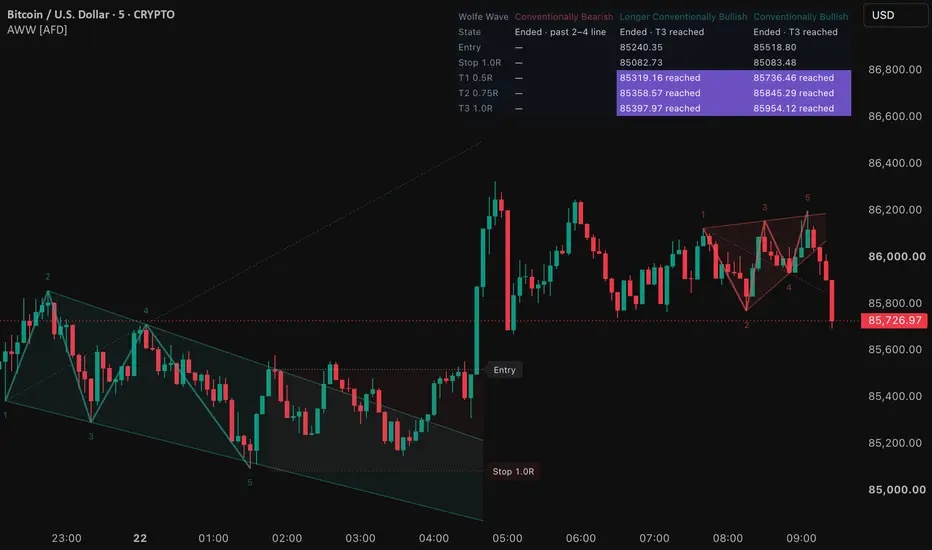
Auto Wolfe Waves identifies qualifying five-point Wolfe Wave counts from confirmed swing pivots. For chart readers who use Wolfe geometry, it automates the count and draws its guides, Entry, Stop and T1–T3 levels. An optional Longer layer uses a larger pivot strength on the same timeframe.
HOW COUNTS FORM
Qualifying counts require point 3 beyond point 1, point 4 beyond point 1 on the reversal side, 1–3 and 2–4 lines converging toward an apex after point 5, and point 5 on or beyond the extended 1–3 line by no more than one ATR. Additional pivot filters and the ATR bound are product calibrations. ATR is a 14-bar simple mean of true range, not Wilder smoothing. Time symmetry and the sweet-zone channel are not checked.
Point 5 appears only after the layer's effective swing strength confirms it. Scalp, Day and Swing presets use strengths 3, 5 and 8, with Entry windows of 5, 10 and 15 bars; Custom sets both. Longer is off by default and multiplies strength by 2–4, default 3. Day with Longer at 3 therefore needs 15 further bars to confirm point 5. Direction selects Both, Bullish only or Bearish only. Longer waves have one-step-wider strokes, capped at 4, and a Longer prefix in hover and event text.
WHAT THE CHART SHOWS
At defaults: a labelled 1–5 zigzag, wedge shading, the 1–3 and 2–4 guides, a dotted 1–4 reference line, and a table of the three newest waves. Point labels and wedge shading can be switched off. The Beyond point 5 colour also applies to Stop and order-unknown endings; the table distinguishes the reason.
Dashed developing waves use confirmed points 1–4. Their band extends one ATR beyond the 1–3 line, frozen when selected; admission uses then-current volatility. Developing geometry can change on the latest bar and disappear when invalidated.
LEVELS AND REACHED TIERS
Entry is the first eligible confirmed close inside the 1–3 line, starting on the admission bar. A close already past the 2–4 line ends the wave without Entry. Stop uses 0.10 ATR beyond point 5 with a 0.50 ATR minimum distance from Entry. R is the Entry-to-Stop distance. T1–T3 default to 0.5R, 0.75R and 1R, rounded outward with one-tick separation; coarse ticks can increase the actual distances.
Once reached defaults to Clear: definitely reached T lines and zones become transparent, and their names leave the shared tag. The tag follows the first remaining tier. Keep retains all tiers and reached marks. If a later bar trades both Stop and a previously unreached tier, its order is unknown; that tier stays visible in both modes. Entry, Stop and table records remain.
A wave can end before Entry when price trades beyond point 5, closes past the 2–4 line or its Entry window expires. After Entry it ends at Stop, T3, an order-unknown bar, or after as many bars from Entry as points 1–5 took to form.
LIMITS AND ALERTS
Each layer has four live slots. Ended-wave retention and the newest-three table are shared, so Longer can replace older kept Main drawings. Counts can be skipped at capacity. Detection uses a 500-bar pivot horizon and admits a 2–3–4 core once per layer. Opaque tags can overlap other tags, cover later candles or clip at viewport edges. Standard time-based bars are required.
Four named alert conditions cover formed, Entry, level reached and ended. Any alert() function call provides batched Brief, Full or JSON messages.
Entry, Stop and T1–T3 describe chart geometry, not a measured outcome. They are not signals, orders or advice.
CREDITS
Based on Bill Wolfe's geometry, with adaptations from Auction Foundry's Auto Harmonic Patterns, Auto Pitchfork + Trade Levels, Classical Auto Chart Patterns and Auto Trend Channels. Direction-filter and Beyond point 5 colour ideas follow BigBeluga's public Wolfe Wave description. No third-party script code was used.

Auction Foundry — see the auction more clearly. Educational tools; not investment advice.
Discord support: discord.gg/df6XEnyGC6
Website: auction-foundry.io
Instagram: instagram.com/AuctionFoundry
X: @AuctionFoundry
Discord support: discord.gg/df6XEnyGC6
Website: auction-foundry.io
Instagram: instagram.com/AuctionFoundry
X: @AuctionFoundry
Отказ от ответственности
Информация и публикации не предназначены для предоставления и не являются финансовыми, инвестиционными, торговыми или другими видами советов или рекомендаций, предоставленных или одобренных TradingView. Подробнее читайте в Условиях использования.