OPEN-SOURCE SCRIPT
Обновлено Trend Maturity Ladder [AGPro Series]
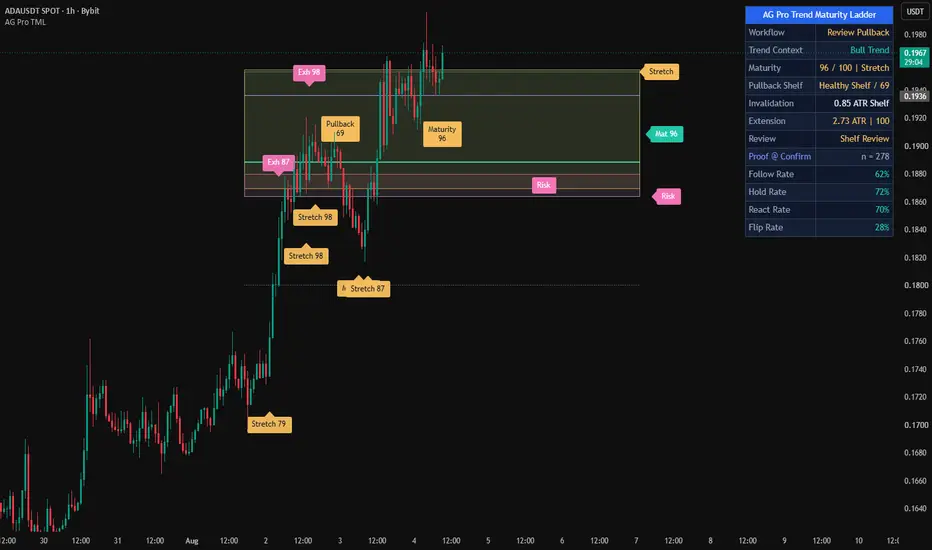
Trend Maturity Ladder [AGPro Series]
🧠 Core Idea
Is the trend still early, healthy, mature, stretched, or vulnerable to exhaustion?

📌 Overview / What it does
Trend Maturity Ladder is a trend lifecycle visualization tool built to classify the stage of an active trend.
The script builds a staged trend ladder, maps a healthy pullback shelf, marks an invalidation shelf, tracks maturity score, evaluates extension, identifies exhaustion risk, and summarizes the current lifecycle state in an AG Pro panel.
It does not predict price direction, automate trades, or claim that a mature trend must reverse. It is a structured decision-support tool for reading trend stage, pullback quality, and late-trend risk.
🎯 Purpose & Design Philosophy
Many trend tools answer only one question:
Is price trending?
This script was built to answer a more useful question:
Where is the trend in its lifecycle?
The design goal is to help traders separate early trend development, healthy continuation, mature structure, stretched extension, and invalidation pressure.
⚡ Why This Script Is Different
Most trend tools focus on moving average direction, ribbon color, or generic trend strength.
This script does NOT act as another trend-strength meter or moving-average ribbon.
Instead, it models the trend as a ladder with stages: early trend, active trend, mature trend, stretched trend, exhaustion watch, and invalidation pressure. It combines trend alignment, slope, ADX, distance from the slow trend reference, trend age, pullback depth, and momentum risk into one visual lifecycle map.
⚙️ Methodology
1. Context Detection
The script checks fast, slow, and anchor trend alignment to determine whether the market has a bullish trend, bearish trend, or mixed structure.
2. Maturity Scoring
It scores trend age, ATR-adjusted extension, slope, ADX, and moving-average alignment to estimate how mature the trend is.
3. Pullback Evaluation
It builds a healthy pullback shelf around the trend references and checks whether price is pulling back without breaking the broader ladder.
4. Exhaustion and Invalidation Review
It identifies late-trend extension risk and invalidation pressure when price closes through the trend shelf.
5. Visual Output
The chart displays maturity ladder zones, pullback shelves, invalidation shelves, trend rails, event labels, right-side tags, alerts, and a compact AG Pro panel.
🗺️ How to Read the Chart
Trend Maturity Ladder = the active lifecycle zone around the current trend.
Healthy Pullback Shelf = the area where pullbacks can remain structurally constructive.
Invalidation Shelf = the area where the trend ladder becomes vulnerable.
Trend Rails = fast, slow, and anchor trend references.
EARLY TREND = trend alignment is fresh.
ACTIVE TREND = trend structure is aligned and still developing.
MATURE TREND = trend has aged and expanded meaningfully.
STRETCHED TREND = the trend is extended relative to its slow reference.
EXHAUSTION WATCH = maturity, extension, and momentum conditions suggest late-trend risk.
INVALIDATION PRESSURE = price has closed through the invalidation shelf.
Panel = summarizes trend stage, maturity score, direction, pullback health, exhaustion risk, age, extension, and next context.
🚦 Signals & States
• EARLY TREND → trend alignment is fresh and still developing.
• ACTIVE TREND → trend is aligned and not yet deeply mature.
• MATURE TREND → trend has aged and expanded.
• STRETCHED TREND → price is extended from the slow trend reference.
• HEALTHY PULLBACK → price has pulled into the trend shelf without invalidating it.
• EXHAUSTION RISK → maturity, extension, and momentum risk are aligned.
• INVALIDATION PRESSURE → price has closed through the invalidation shelf.
• NO CLEAR TREND → fast, slow, and anchor references are not aligned.
🔔 Alerts Logic
Alerts trigger when a major trend lifecycle state appears.
• Trend Maturity Transition → the active trend stage changes.
• Healthy Trend Pullback → price pulls into the healthy trend shelf without invalidating the ladder.
• Trend Exhaustion Risk → maturity, extension, and momentum conditions align.
• Trend Invalidation Pressure → price closes through the invalidation shelf.
Alerts are attention markers, not trade instructions.
🧩 Confluence Logic
The context becomes stronger when:
• Fast, slow, and anchor trend references align
• The slow reference has directional slope
• ADX supports directional structure
• Pullbacks respect the healthy shelf
• Extension is not excessively stretched
• The panel state agrees with the chart label
Late-trend caution increases when maturity, extension, and RSI pressure align.
📊 When to Use
• Trend-following review
• Pullback continuation planning
• Late-trend risk monitoring
• Crypto, stocks, futures, forex, and liquid markets
• 30m, 1H, 4H, 1D, and 1W charts
• Markets where trend structure is visible
⚠️ When NOT to Use
• Very choppy, non-directional markets
• Low-liquidity assets
• Extremely noisy micro timeframes
• Markets with frequent gaps that distort trend references
• Situations where a single trend score should not be over-interpreted
• When the user wants guaranteed entries or exits
🎛️ Key Inputs
• Fast Trend Length → controls short-term trend pressure.
• Slow Trend Length → controls the main maturity reference.
• Anchor Trend Length → filters weak or mixed trend regimes.
• ATR Length → controls ladder spacing, extension scoring, and label offsets.
• Early Trend Max Age → defines how long a fresh trend can remain early.
• Mature Trend Age → defines when age contributes strongly to maturity.
• Stretched Distance ATR → defines when trend extension becomes stretched.
• Healthy Pullback Width ATR → controls the pullback shelf thickness.
• Invalidation Shelf ATR → controls the distance of the invalidation shelf.
• Exhaustion RSI Level → adds momentum pressure to exhaustion-risk logic.
🖥️ Interface & Visual Design
The visual hierarchy is built around the trend lifecycle:
The ladder shows the active maturity zone.
The pullback shelf shows where continuation can be evaluated.
The invalidation shelf shows where the trend becomes vulnerable.
Event labels mark lifecycle transitions and risk states.
Right-side tags keep the current trend stage visible.
The AG Pro panel compresses the current trend lifecycle into a fast, readable summary.
🧪 Practical Usage Workflow
1. Read the panel trend stage.
2. Check whether trend direction is aligned.
3. Locate the healthy pullback shelf.
4. Watch whether price respects or breaks the shelf.
5. Check maturity score and exhaustion risk.
6. Confirm with market structure, liquidity, volume, and risk planning.
🔍 Interpretation Guidelines
An early trend does not guarantee continuation.
A mature trend does not guarantee reversal.
Exhaustion risk does not mean price must immediately turn.
Invalidation pressure means the current ladder structure has weakened.
The script is best used to understand trend lifecycle context, not to replace independent analysis.
🚫 What This Script Is NOT
This script is not a prediction engine.
It is not financial advice.
It is not an auto-trading system.
It does not provide guaranteed entry or exit signals.
It is not a moving-average ribbon or a simple trend-strength meter.
⚠️ Limitations & Transparency
Trend stages depend on timeframe.
Choppy markets can create frequent stage changes.
Strong news moves can stretch trend references quickly.
Low-liquidity markets may create unreliable trend readings.
Different assets may require different trend lengths.
🧠 Market Context Notes
Trends often move through recognizable phases:
alignment → expansion → maturity → extension → pullback or invalidation.
This script visualizes that sequence so the user can avoid treating every trend as equally fresh.
🧾 Use Case Examples
If trend references align shortly after a transition, the script may classify EARLY TREND.
If price pulls into the shelf while the ladder remains intact, the script may mark HEALTHY PULLBACK.
If the trend becomes aged and extended while RSI is stretched, the script may mark EXHAUSTION RISK.
If price closes through the invalidation shelf, the script may mark INVALIDATION PRESSURE.
🧱 System Philosophy
The goal is not to chase trend strength.
The goal is to understand trend timing.
This script treats trend as a lifecycle:
early → active → mature → stretched → vulnerable.
🔐 Non-Promise Statement
No trend stage guarantees future price direction.
No pullback shelf guarantees continuation.
No exhaustion label guarantees reversal.
All outputs should be interpreted as analytical context.
📉 Risk Disclosure
Trading involves risk.
This script is for educational and analytical purposes only.
It does not provide financial advice, investment advice, or guaranteed trading outcomes.
Users are fully responsible for their own decisions, risk management, and trade execution.
📚 Educational Note
Use the script to study where trends tend to age, stretch, reset, or fail.
The most important question is not only whether a market is trending.
The better question is whether the trend is still fresh enough to deserve attention.
🧠 Core Idea
Is the trend still early, healthy, mature, stretched, or vulnerable to exhaustion?
📌 Overview / What it does
Trend Maturity Ladder is a trend lifecycle visualization tool built to classify the stage of an active trend.
The script builds a staged trend ladder, maps a healthy pullback shelf, marks an invalidation shelf, tracks maturity score, evaluates extension, identifies exhaustion risk, and summarizes the current lifecycle state in an AG Pro panel.
It does not predict price direction, automate trades, or claim that a mature trend must reverse. It is a structured decision-support tool for reading trend stage, pullback quality, and late-trend risk.
🎯 Purpose & Design Philosophy
Many trend tools answer only one question:
Is price trending?
This script was built to answer a more useful question:
Where is the trend in its lifecycle?
The design goal is to help traders separate early trend development, healthy continuation, mature structure, stretched extension, and invalidation pressure.
⚡ Why This Script Is Different
Most trend tools focus on moving average direction, ribbon color, or generic trend strength.
This script does NOT act as another trend-strength meter or moving-average ribbon.
Instead, it models the trend as a ladder with stages: early trend, active trend, mature trend, stretched trend, exhaustion watch, and invalidation pressure. It combines trend alignment, slope, ADX, distance from the slow trend reference, trend age, pullback depth, and momentum risk into one visual lifecycle map.
⚙️ Methodology
1. Context Detection
The script checks fast, slow, and anchor trend alignment to determine whether the market has a bullish trend, bearish trend, or mixed structure.
2. Maturity Scoring
It scores trend age, ATR-adjusted extension, slope, ADX, and moving-average alignment to estimate how mature the trend is.
3. Pullback Evaluation
It builds a healthy pullback shelf around the trend references and checks whether price is pulling back without breaking the broader ladder.
4. Exhaustion and Invalidation Review
It identifies late-trend extension risk and invalidation pressure when price closes through the trend shelf.
5. Visual Output
The chart displays maturity ladder zones, pullback shelves, invalidation shelves, trend rails, event labels, right-side tags, alerts, and a compact AG Pro panel.
🗺️ How to Read the Chart
Trend Maturity Ladder = the active lifecycle zone around the current trend.
Healthy Pullback Shelf = the area where pullbacks can remain structurally constructive.
Invalidation Shelf = the area where the trend ladder becomes vulnerable.
Trend Rails = fast, slow, and anchor trend references.
EARLY TREND = trend alignment is fresh.
ACTIVE TREND = trend structure is aligned and still developing.
MATURE TREND = trend has aged and expanded meaningfully.
STRETCHED TREND = the trend is extended relative to its slow reference.
EXHAUSTION WATCH = maturity, extension, and momentum conditions suggest late-trend risk.
INVALIDATION PRESSURE = price has closed through the invalidation shelf.
Panel = summarizes trend stage, maturity score, direction, pullback health, exhaustion risk, age, extension, and next context.
🚦 Signals & States
• EARLY TREND → trend alignment is fresh and still developing.
• ACTIVE TREND → trend is aligned and not yet deeply mature.
• MATURE TREND → trend has aged and expanded.
• STRETCHED TREND → price is extended from the slow trend reference.
• HEALTHY PULLBACK → price has pulled into the trend shelf without invalidating it.
• EXHAUSTION RISK → maturity, extension, and momentum risk are aligned.
• INVALIDATION PRESSURE → price has closed through the invalidation shelf.
• NO CLEAR TREND → fast, slow, and anchor references are not aligned.
🔔 Alerts Logic
Alerts trigger when a major trend lifecycle state appears.
• Trend Maturity Transition → the active trend stage changes.
• Healthy Trend Pullback → price pulls into the healthy trend shelf without invalidating the ladder.
• Trend Exhaustion Risk → maturity, extension, and momentum conditions align.
• Trend Invalidation Pressure → price closes through the invalidation shelf.
Alerts are attention markers, not trade instructions.
🧩 Confluence Logic
The context becomes stronger when:
• Fast, slow, and anchor trend references align
• The slow reference has directional slope
• ADX supports directional structure
• Pullbacks respect the healthy shelf
• Extension is not excessively stretched
• The panel state agrees with the chart label
Late-trend caution increases when maturity, extension, and RSI pressure align.
📊 When to Use
• Trend-following review
• Pullback continuation planning
• Late-trend risk monitoring
• Crypto, stocks, futures, forex, and liquid markets
• 30m, 1H, 4H, 1D, and 1W charts
• Markets where trend structure is visible
⚠️ When NOT to Use
• Very choppy, non-directional markets
• Low-liquidity assets
• Extremely noisy micro timeframes
• Markets with frequent gaps that distort trend references
• Situations where a single trend score should not be over-interpreted
• When the user wants guaranteed entries or exits
🎛️ Key Inputs
• Fast Trend Length → controls short-term trend pressure.
• Slow Trend Length → controls the main maturity reference.
• Anchor Trend Length → filters weak or mixed trend regimes.
• ATR Length → controls ladder spacing, extension scoring, and label offsets.
• Early Trend Max Age → defines how long a fresh trend can remain early.
• Mature Trend Age → defines when age contributes strongly to maturity.
• Stretched Distance ATR → defines when trend extension becomes stretched.
• Healthy Pullback Width ATR → controls the pullback shelf thickness.
• Invalidation Shelf ATR → controls the distance of the invalidation shelf.
• Exhaustion RSI Level → adds momentum pressure to exhaustion-risk logic.
🖥️ Interface & Visual Design
The visual hierarchy is built around the trend lifecycle:
The ladder shows the active maturity zone.
The pullback shelf shows where continuation can be evaluated.
The invalidation shelf shows where the trend becomes vulnerable.
Event labels mark lifecycle transitions and risk states.
Right-side tags keep the current trend stage visible.
The AG Pro panel compresses the current trend lifecycle into a fast, readable summary.
🧪 Practical Usage Workflow
1. Read the panel trend stage.
2. Check whether trend direction is aligned.
3. Locate the healthy pullback shelf.
4. Watch whether price respects or breaks the shelf.
5. Check maturity score and exhaustion risk.
6. Confirm with market structure, liquidity, volume, and risk planning.
🔍 Interpretation Guidelines
An early trend does not guarantee continuation.
A mature trend does not guarantee reversal.
Exhaustion risk does not mean price must immediately turn.
Invalidation pressure means the current ladder structure has weakened.
The script is best used to understand trend lifecycle context, not to replace independent analysis.
🚫 What This Script Is NOT
This script is not a prediction engine.
It is not financial advice.
It is not an auto-trading system.
It does not provide guaranteed entry or exit signals.
It is not a moving-average ribbon or a simple trend-strength meter.
⚠️ Limitations & Transparency
Trend stages depend on timeframe.
Choppy markets can create frequent stage changes.
Strong news moves can stretch trend references quickly.
Low-liquidity markets may create unreliable trend readings.
Different assets may require different trend lengths.
🧠 Market Context Notes
Trends often move through recognizable phases:
alignment → expansion → maturity → extension → pullback or invalidation.
This script visualizes that sequence so the user can avoid treating every trend as equally fresh.
🧾 Use Case Examples
If trend references align shortly after a transition, the script may classify EARLY TREND.
If price pulls into the shelf while the ladder remains intact, the script may mark HEALTHY PULLBACK.
If the trend becomes aged and extended while RSI is stretched, the script may mark EXHAUSTION RISK.
If price closes through the invalidation shelf, the script may mark INVALIDATION PRESSURE.
🧱 System Philosophy
The goal is not to chase trend strength.
The goal is to understand trend timing.
This script treats trend as a lifecycle:
early → active → mature → stretched → vulnerable.
🔐 Non-Promise Statement
No trend stage guarantees future price direction.
No pullback shelf guarantees continuation.
No exhaustion label guarantees reversal.
All outputs should be interpreted as analytical context.
📉 Risk Disclosure
Trading involves risk.
This script is for educational and analytical purposes only.
It does not provide financial advice, investment advice, or guaranteed trading outcomes.
Users are fully responsible for their own decisions, risk management, and trade execution.
📚 Educational Note
Use the script to study where trends tend to age, stretch, reset, or fail.
The most important question is not only whether a market is trending.
The better question is whether the trend is still fresh enough to deserve attention.
Информация о релизе
🔧 UPDATE NOTES - VERSION 1.1This update focuses on chart readability, visual hierarchy, panel flow, and lifecycle interpretation.
The core purpose of the script remains unchanged.
This release improves how the existing trend maturity logic is presented, organized, and interpreted on the chart.
This script continues to function as an analytical and visualization tool.
It does not attempt to predict price direction or provide guaranteed outcomes.
------------------------
What Changed
------------------------
• Refined maturity ladder visuals
The main ladder, pullback shelf, and invalidation shelf now use cleaner projected zones with stronger visual separation.
• Added premium centered zone badges
Zone text is now handled through centered high-contrast labels instead of relying on native box text, improving readability across dark and light charts.
• Reworked the panel into a clearer dashboard
The panel now prioritizes workflow, trend context, maturity state, pullback shelf, invalidation, extension, and review context.
• Improved right-side tags
Right-side tags were shortened to compact stage, maturity, and invalidation markers for cleaner screenshots.
• Reduced label load
Event labels are shorter and controlled by a visible label limit, helping the chart stay informative without becoming crowded.
• Shortened zone badge language
Maturity, pullback, and invalidation badges now use compact labels to reduce overlap inside the projected zones.
------------------------
Visual Improvements
------------------------
• Improved chart readability by shortening labels and spacing them farther from candles
• Reduced default label density to keep repeated pullback events from dominating the chart
• Reduced visual clutter while keeping enough context for publication screenshots
• Refined visual hierarchy so the active maturity stage and shelf context stand out more clearly
• Improved zone label contrast for dark and light chart themes
------------------------
Interface & Usability
------------------------
• Added a full panel location set, including center positions
• Kept the panel header as one merged blue row with the script name only
• Preserved panel show, theme, location, and font-size controls
• Improved panel information flow for quicker trend lifecycle review
------------------------
Behavior Notes
------------------------
This update does not change the core analytical logic of the script.
The goal is to improve clarity and usability, not to introduce new predictive behavior.
Users should interpret outputs the same way as before, but with improved visual structure and a cleaner workflow.
------------------------
Limitations Reminder
------------------------
The script remains a rule-based analytical tool.
Market conditions such as volatility, liquidity, trend transitions, and timeframe differences may affect how maturity states appear.
Outputs should always be interpreted within broader market context.
------------------------
Risk Reminder
------------------------
This script is for educational and analytical purposes only.
It does not provide financial advice, trade instructions, or guaranteed trading outcomes.
Users remain responsible for their own decisions.
Информация о релизе
UPDATE NOTES - V1.2This update focuses on AGPro zone-label compliance, cleaner ladder readability, and publication polish.
The core purpose of the script remains unchanged.
Trend Maturity Ladder continues to map trend lifecycle maturity through early, active, mature, stretched, exhaustion, and invalidation-pressure states.
This script continues to function as an analytical and visualization tool.
It does not attempt to predict price direction or provide guaranteed outcomes.
------------------------
What Changed
------------------------
• Preserved the full trend maturity engine
Trend alignment, age, slope, ADX, extension, pullback health, exhaustion risk, invalidation pressure, alerts, panel, and rails remain intact.
• Removed box text usage
Maturity, pullback, and invalidation zones now rely fully on separate centered label badges instead of box text payloads.
• Refined zone badge wording
The main zone labels now read as Maturity, Pullback, and Risk for clearer first-glance interpretation.
• Preserved the merged blue panel header
The panel continues to clear and re-merge the first row before rendering the AG Pro panel title.
------------------------
Visual Improvements
------------------------
• Improved chart readability by making zone badge wording more explicit.
• Preserved the energetic ladder look while removing unnecessary box-text plumbing.
• Kept right-side tags, trend rails, maturity bands, pullback shelves, and invalidation shelves.
• Reduced ambiguity around the invalidation shelf by changing the visual text from INV to Risk.
------------------------
Interface & Usability
------------------------
• Kept panel show/hide, panel location, panel theme, panel font size, label font size, projection controls, and event-label controls.
• No core settings were removed.
• Default behavior remains focused on premium publication readability.
------------------------
Behavior Notes
------------------------
This update does not change the core analytical logic of the script.
The goal is to improve clarity, consistency, and usability without changing how trend maturity is evaluated.
Users should interpret outputs the same way as before.
------------------------
Limitations Reminder
------------------------
The script remains a rule-based analytical tool.
Market conditions such as volatility, liquidity, timeframe differences, and trend regime changes may affect how ladder states appear.
Outputs should always be interpreted within broader market context.
------------------------
Risk Reminder
------------------------
This script is for educational and analytical purposes only.
It does not provide financial advice or guaranteed trading outcomes.
Users remain responsible for their own decisions.
Информация о релизе
UPDATE NOTES - V1.3This update focuses on on-chart readability and a cleaner, more consistent premium presentation.
The core purpose of the script remains unchanged.
This release improves how the existing trend-maturity readout is displayed on the chart, the ladder badges, the right-side tags, the event labels, and the panel. It does not change the trend engine, the maturity scoring, the stage logic, or the alerts.
This script continues to function as a chart-first trend lifecycle and visualization tool. It does not attempt to predict price direction or provide guaranteed outcomes.
------------------------
What Changed
------------------------
- Consistent Title Case
All on-chart stage and workflow text now uses Title Case (Early, Active, Mature, Stretch, Maturity, Pullback, Risk) instead of all-caps, and panel values such as Trend Context, Pullback Shelf, Invalidation, Workflow, and Review follow the same calmer style. This gives the chart a more professional first-glance look.
- Tidier badges and tags
The ladder, pullback, and invalidation badges, plus the right-side tags, were unified to the same clean casing so the maturity map reads more like a premium dashboard.
- Cleaner panel wording
Panel rows were aligned to consistent casing for a more balanced, premium appearance.
- No logic changes
The trend alignment engine, maturity and extension scoring, pullback and exhaustion evaluation, stage transitions, and all alerts behave exactly as before.
------------------------
Visual Improvements
------------------------
- Improved chart readability by unifying label casing across ladder badges, event labels, right-side tags, and the panel.
- Reduced visual noise so the active trend stage stands out more clearly.
- Refined the visual hierarchy between the maturity ladder, the pullback shelf, the invalidation shelf, and the trend rails.
- Kept event labels offset away from candles and ladder zones to reduce overlap.
------------------------
Interface & Usability
------------------------
- Cleaner panel value formatting for a more balanced, premium appearance.
- More consistent wording between the panel, the badges, the event labels, and the right-side tags.
- Default visual settings remain tuned for clean public-release screenshots.
- Overall user experience improved without changing core logic.
------------------------
Behavior Notes
------------------------
This update does not change the core analytical logic of the script.
The goal is to improve clarity and presentation, not to introduce new predictive behavior.
Users should interpret outputs the same way as before, now with a cleaner and more consistent on-chart readout.
------------------------
Limitations Reminder
------------------------
The script remains a rule-based analytical tool.
Market conditions such as volatility, liquidity, and timeframe differences may affect how trend stages appear.
Outputs should always be interpreted within broader market context.
------------------------
Risk Reminder
------------------------
This script is for educational and analytical purposes only.
It does not provide financial advice or guaranteed trading outcomes.
Users remain responsible for their own decisions.
Информация о релизе
🔧 UPDATE NOTES - v1.4This update focuses on decision confidence and proof.
The core purpose of the script remains unchanged.
This release adds a confirmation-anchored proof layer that measures how past
trends on the current symbol followed through, held, or failed after they formed.
This script continues to function as an analytical and visualization tool.
It does not attempt to predict price direction or provide guaranteed outcomes.
------------------------
What Changed
------------------------
• Added a Proof Layer (Follow / Hold / React / Flip)
The panel now reports how past established trends on the current symbol and timeframe
resolved. Each newly established trend is tracked forward over a configurable horizon:
- Follow Rate : share of trends that advanced one follow-through distance in the trend
direction before the invalidation shelf was breached
- Hold Rate : share that resolved without closing through the invalidation shelf
- React Rate : share that produced an early favorable push inside the reaction window
- Flip Rate : share that closed through the invalidation shelf (failed)
A sample size (n) is shown so the rates are read in context, and they display as
"building" until at least one trend has resolved.
• Added hidden data exports
Maturity score, trend quality, and the Follow / Hold / React / Flip rates are exposed as
hidden plots so these values can be referenced by alerts, screeners, or other tools
without changing the chart visuals.
------------------------
Visual Improvements
------------------------
• Kept the maturity, pullback, and risk badges centered inside their zones.
• Reduced visual clutter so the panel reads as a single, structured decision card.
• Refined visual hierarchy so the maturity stage and its proof context stand out clearly.
• Maintained candle-clearance offsets so event labels stay readable above or below price.
------------------------
Interface & Usability
------------------------
• Optimized panel layout for clearer information flow, with the proof block grouped
under a dedicated "Proof @ Confirm" heading.
• Improved at-a-glance interpretation by reporting trend follow-through reliability.
• Adjusted default visual settings for a more balanced appearance.
• Added a Proof input group (show/hide, proof horizon bars, follow-through ATR, reaction
window bars, reaction progress threshold) so the proof layer is fully configurable
without affecting the core maturity logic.
------------------------
Behavior Notes
------------------------
This update does not change the core analytical logic of the script.
The proof rates are descriptive statistics of past established trends on the current
symbol and timeframe. They are not forecasts, and they do not change how trends are
detected, staged, scored, or how the invalidation shelf is defined.
Users should interpret outputs the same way as before, now with added historical context.
------------------------
Limitations Reminder
------------------------
The script remains a rule-based analytical tool.
Proof rates depend on the amount of available history and on the current symbol and
timeframe; because trends are relatively infrequent events, the sample (n) is typically
smaller than on faster setup tools and should be treated with care when low. Each trend is
counted once, anchored to its establishment. Market conditions such as volatility,
liquidity, and timeframe differences may affect how trends and rates appear.
Outputs should always be interpreted within broader market context.
------------------------
Risk Reminder
------------------------
This script is for educational and analytical purposes only.
It does not provide financial advice or guaranteed trading outcomes.
Users remain responsible for their own decisions.
Информация о релизе
Version 1.5 — Trend-Call Accuracy, Proof Integrity and Visual HardeningThis update strengthens trend-call confirmation, maturity-age consistency, Proof-layer integrity, critical-event visibility, right-side tag hierarchy, initialization safety, and runtime efficiency while preserving the indicator’s core maturity model, ladder visuals, panel structure, input names, alert titles, and AGPro publication styling.
• Added historical-capacity protection for the maximum Anchor Trend Length and related long-lookback calculations.
• Added an engine warm-up requirement based on the active EMA, ATR, RSI, ADX, and slope windows.
• Prevented premature trend-stage and Proof calls before the required historical context is available.
• Added internal ordering protection between Early Trend Max Age and Mature Trend Age.
• The effective Early stage now always ends before the effective Mature-age threshold begins.
• Added initialization protection to the slow-EMA slope, RSI, and ADX measurements.
• Confirmed trend establishments now require a completed bar before a new directional trend call is registered.
• Rebuilt the confirmation-anchored Proof layer around one evaluation per confirmed trend establishment.
• Each Proof evaluation stores the confirmed trend direction, establishment close, invalidation shelf, ATR-based follow-through target, and start bar.
• Favorable movement is now measured from the bar’s actual high or low rather than close-only movement.
• Follow requires the favorable ATR target to be reached before invalidation or loss of the stored trend direction.
• Hold records established trends that resolve without invalidation or direction loss.
• Flip records an invalidation-shelf touch or loss of the established trend direction.
• React records favorable early progress inside the effective reaction window.
• Constrained the effective Reaction Window so it cannot extend beyond the active Proof Horizon.
• Bars where both the follow-through target and invalidation shelf are touched are treated as sequence-ambiguous and excluded from Follow, Hold, React, and Flip rates.
• Bars where the target is reached while the established trend direction is lost are also treated as sequence-ambiguous.
• Added explicit tracking for excluded ambiguous Proof outcomes.
• The Proof sample now displays excluded outcomes as “x =” alongside the completed sample size when applicable.
• Improved critical event-label handling so trend transitions, exhaustion-risk calls, and invalidation-pressure events are not suppressed by ordinary cooldown or minimum-quality filters.
• Refined event-label placement so exhaustion and invalidation events appear on the appropriate directional side of price.
• Reworked the right-side Early/Maturity/Risk tags into persistent chart objects.
• Horizontally staggered the stage, maturity, and risk tags to reduce overlap and improve publication screenshot readability.
• Removed unnecessary repeated deletion and recreation of right-side tags on every latest-bar refresh.
• Added hidden exports for Ambiguous Proof Count, Stage ID, Trend Direction, Trend Age, Extension Score, and Pullback Health.
• Reduced drawing-object limits to better match the script’s actual box, line, and label requirements.
• Preserved all existing trend-quality components, maturity stages, pullback shelves, invalidation shelves, trend rails, event labels, panel rows, alerts, and AGPro visual identity.
Existing TradingView alerts should be deleted and recreated after installing Version 1.5 so they use the updated script logic and settings.
Скрипт с открытым кодом
В истинном духе TradingView, создатель этого скрипта сделал его открытым исходным кодом, чтобы трейдеры могли проверить и убедиться в его функциональности. Браво автору! Вы можете использовать его бесплатно, но помните, что перепубликация кода подчиняется нашим Правилам поведения.

🧠 Trading Suite - Flagship Workflow
tradingview.com/script/XJmX3p98-Trading-Suite-AGPro-Series/
🔷 Crypto Setup Planner - Multi-Symbol Planner
tradingview.com/script/LgVRo7Ql-Crypto-Setup-Planner-AGPro-Series/
tradingview.com/script/XJmX3p98-Trading-Suite-AGPro-Series/
🔷 Crypto Setup Planner - Multi-Symbol Planner
tradingview.com/script/LgVRo7Ql-Crypto-Setup-Planner-AGPro-Series/
Отказ от ответственности
Информация и публикации не предназначены для предоставления и не являются финансовыми, инвестиционными, торговыми или другими видами советов или рекомендаций, предоставленных или одобренных TradingView. Подробнее читайте в Условиях использования.
Скрипт с открытым кодом
В истинном духе TradingView, создатель этого скрипта сделал его открытым исходным кодом, чтобы трейдеры могли проверить и убедиться в его функциональности. Браво автору! Вы можете использовать его бесплатно, но помните, что перепубликация кода подчиняется нашим Правилам поведения.
🧠 Trading Suite - Flagship Workflow
tradingview.com/script/XJmX3p98-Trading-Suite-AGPro-Series/
🔷 Crypto Setup Planner - Multi-Symbol Planner
tradingview.com/script/LgVRo7Ql-Crypto-Setup-Planner-AGPro-Series/
tradingview.com/script/XJmX3p98-Trading-Suite-AGPro-Series/
🔷 Crypto Setup Planner - Multi-Symbol Planner
tradingview.com/script/LgVRo7Ql-Crypto-Setup-Planner-AGPro-Series/
Отказ от ответственности
Информация и публикации не предназначены для предоставления и не являются финансовыми, инвестиционными, торговыми или другими видами советов или рекомендаций, предоставленных или одобренных TradingView. Подробнее читайте в Условиях использования.