
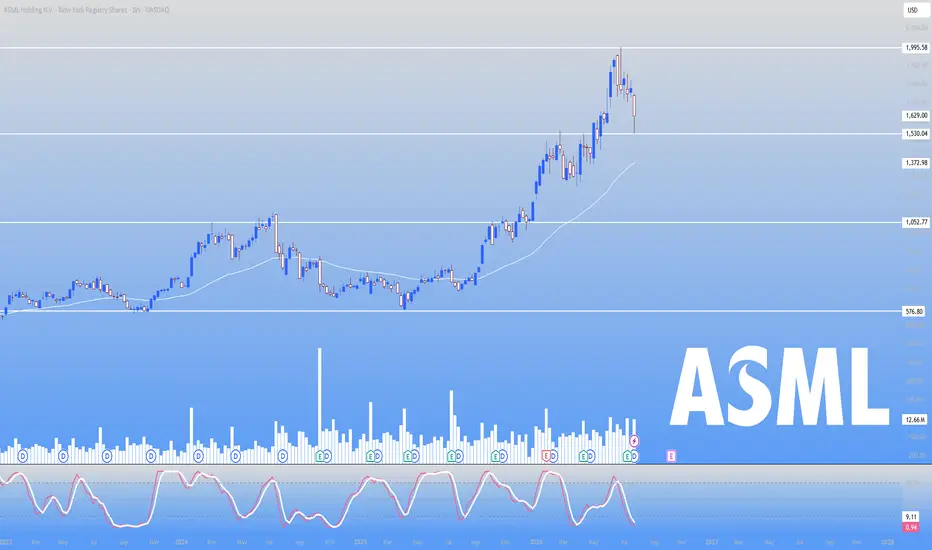
The AI driven semiconductor rally suffered one of its sharpest pullbacks of the year as investors questioned whether the industry's massive capital spending can generate returns quickly enough to justify record valuations.
The selloff accelerated after concerns emerged that cheaper Chinese AI models and growing competition could reduce the long-term demand for premium AI infrastructure, while rising Treasury yields further pressured high growth technology stocks. Hedge funds also reduced exposure to semiconductor companies for multiple consecutive weeks, signaling that institutional investors were becoming more defensive ahead of earnings season. Although the Philadelphia Semiconductor Index entered correction territory, many analysts described the move as a valuation reset rather than a collapse in AI demand. The market is transitioning from rewarding AI narratives to demanding measurable financial returns from AI investments
💥 The Collapse of a $45 Billion AI Fund Sparked Forced Selling Across the Market
One of the biggest catalysts behind the volatility was the rapid collapse of Situational Awareness, an AI focused hedge fund founded by former OpenAI researcher Leopold Aschenbrenner.. At its peak, the fund managed roughly $45 billion in gross exposure, much of it financed with leverage and concentrated in AI infrastructure and semiconductor related investments. As AI stocks declined, lenders demanded additional collateral, forcing the fund to unwind much of its public equity portfolio
The fund lost 67% during July, removed all leverage, and sold billions of dollars in holdings including a large block reportedly acquired by Citadel to stabilize its balance sheet. While the fund remains positive for the year, the episode demonstrated how excessive leverage can transform a sector correction into a market wide liquidity event, temporarily pushing fundamentally strong companies well below intrinsic value
🤖 AI Spending Is No Longer Being Judged by Growth Alone
For the past two years, investors largely rewarded companies announcing larger AI infrastructure budgets, assuming demand for computing power would continue expanding at an exponential pace. That narrative is beginning to evolve. Markets are now asking when hundreds of billions of dollars invested in GPUs, networking equipment, cloud infrastructure, and data centers will begin producing sustainable earnings growth and stronger free cash flow.
Concerns intensified after advances from lower cost Chinese AI models challenged assumptions that only the largest and most expensive AI systems would dominate the market. Investors increasingly want evidence that AI investment is creating profitable commercial products rather than simply increasing capital expenditures. This shift represents a significant change in market psychology, moving from growth at any price toward returns on invested capital
⚙️ Frontier AI Labs Are Prioritizing Safety, Efficiency, and Commercialization
The conversation surrounding frontier AI has shifted beyond building ever larger models. Leading AI developers are placing greater emphasis on model safety, regulatory frameworks, computational efficiency, and responsible deployment while balancing fierce commercial competition. This reflects growing recognition that scaling frontier AI requires enormous investments in chips, electricity, networking, cooling systems, and data centers. As training costs continue climbing, improving model efficiency and delivering practical enterprise applications may become more valuable than simply increasing model size
For investors, this suggests the next phase of the AI cycle could reward software adoption, recurring enterprise revenue, and efficient infrastructure utilization rather than hardware expansion alone
📊 Higher Interest Rates Continue to Challenge AI Valuations
Macroeconomic conditions remain an important driver of technology valuations. Elevated Treasury yields increase the cost of capital while reducing the present value of future earnings, placing pressure on companies whose valuations depend heavily on long term growth expectations. This environment has encouraged institutional investors to rotate toward businesses with stronger balance sheets, consistent profitability, and reliable cash generation while becoming more selective toward highly valued AI related companies
The recent semiconductor correction illustrates how quickly investor sentiment can shift when macroeconomic pressures combine with elevated valuations and leveraged positioning. Companies capable of consistently translating AI demand into revenue growth and expanding margins are likely to attract premium valuations, while those relying solely on future expectations may experience greater volatility
🛒 Mamdani's Grocery Store Proposal Raises New Questions About Government Intervention
Another major topic was New York City mayoral candidate Zohran Mamdani's proposal to establish publicly owned grocery stores as a way to combat rising food prices and improve access to affordable essentials. Supporters argue that publicly operated stores could increase competition and reduce costs in underserved communities, while critics warn that government run retail operations could distort competition, require ongoing taxpayer subsidies, and discourage private investment.. Although the proposal primarily affects local politics, investors are watching it closely because it reflects a broader policy trend toward greater government involvement in consumer markets during periods of persistent inflation and affordability concerns. Similar policy initiatives could eventually influence retail pricing, supply chains, labor costs, and competitive dynamics across the consumer sector
🚀 The Long Term AI Investment Thesis Remains Intact but Discipline Matters More Than Ever
Despite recent volatility, the structural drivers supporting artificial intelligence remain firmly in place. Global demand for cloud computing, enterprise automation, AI software, advanced semiconductors, and high performance data centers continues to expand as businesses integrate AI into core operations. However, the market is entering a more mature phase where execution matters more than expectations.. Investors are increasingly rewarding companies that convert AI spending into recurring revenue, expanding operating margins, and durable free cash flow while penalizing businesses relying primarily on ambitious future projections
The recent correction is therefore better viewed as a repricing of risk rather than the end of the AI investment cycle. Going forward, leadership is likely to belong to companies that combine technological innovation with disciplined capital allocation, sustainable profitability, and consistent earnings execution.

การนำเสนอที่เกี่ยวข้อง
คำจำกัดสิทธิ์ความรับผิดชอบ
ข้อมูลและบทความไม่ได้มีวัตถุประสงค์เพื่อก่อให้เกิดกิจกรรมทางการเงิน, การลงทุน, การซื้อขาย, ข้อเสนอแนะ หรือคำแนะนำประเภทอื่น ๆ ที่ให้หรือรับรองโดย TradingView อ่านเพิ่มเติมใน ข้อกำหนดการใช้งาน
การนำเสนอที่เกี่ยวข้อง
คำจำกัดสิทธิ์ความรับผิดชอบ
ข้อมูลและบทความไม่ได้มีวัตถุประสงค์เพื่อก่อให้เกิดกิจกรรมทางการเงิน, การลงทุน, การซื้อขาย, ข้อเสนอแนะ หรือคำแนะนำประเภทอื่น ๆ ที่ให้หรือรับรองโดย TradingView อ่านเพิ่มเติมใน ข้อกำหนดการใช้งาน