
Brent corrects its price zone following preliminary agreement between the US and Iran over Hormuz
By Ion Jauregui – Analyst at ActivTrades
Oil prices recorded sharp declines on Monday after the United States and Iran announced an agreement aimed at reopening the Strait of Hormuz, one of the world's most important energy routes, thereby reducing fears of prolonged disruptions to global crude oil supplies.
Brent crude, the international benchmark, fell below the key $83 area, while West Texas Intermediate (WTI) traded slightly above $80 per barrel. Both contracts accumulated losses of more than 10% over the last two sessions, reflecting the rapid removal of part of the geopolitical risk premium that had been built into prices during the months of conflict.
US President Donald Trump announced an agreement with Iran to allow the reopening of the Strait of Hormuz and lift the maritime blockade affecting Iranian ports. The pact, which according to Pakistani authorities will be formally signed this week in Switzerland, seeks to bring an end to several months of hostilities that had significantly disrupted international energy trade.
The Strait of Hormuz is a strategic chokepoint for global energy markets. Approximately 20% of the world's oil consumption passes through this maritime route connecting the Persian Gulf with international markets. Its closure forced numerous exporters to seek alternative routes, increasing logistical costs and raising uncertainty over supply.
The market reaction reflects expectations that oil flows could gradually normalize if the terms of the agreement are implemented as planned. However, traders and analysts remain cautious regarding the possibility of delays or difficulties in the execution of the pact.
Price developments also coincide with a market environment in which investors continue to closely monitor global demand prospects, particularly in China, as well as future production decisions from OPEC+.
Brent technical analysis
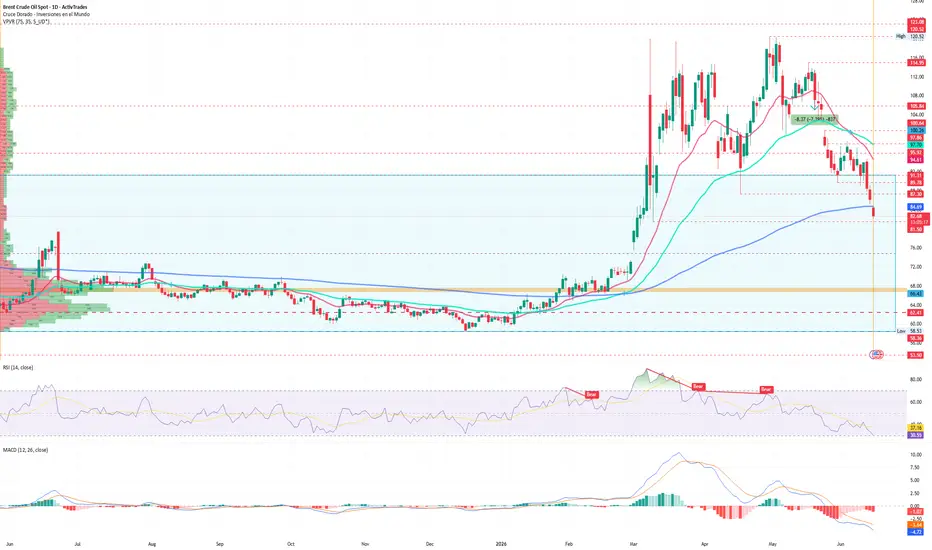
From a technical perspective, Brent has corrected sharply following the gains recorded during the period of maximum geopolitical tension.
After breaking below the $90 level ahead of schedule on Thursday, Brent continued its bearish correction during Friday's session. This downward move extended into the opening of the European session on Monday, pushing prices below $83 per barrel, trading around $82.40 during the first half hour after breaking below the 200-day moving average.
The midpoint of the previous trading range is located around $74.80 per barrel. Should the current bearish momentum continue testing lower prices, we could see a correction toward the point of control near the $67 area.
A close below current levels could increase selling pressure and support the moves described above, with the psychologically important $80 per barrel level remaining under close market scrutiny.
On the upside, current resistance levels are found at the former support zone around $86–87 per barrel and subsequently at $91, a level that defined much of the risk escalation phase associated with the Middle East conflict.
Momentum indicators show a rapid reduction in the overbought conditions observed during previous weeks, with the Relative Strength Index (RSI) standing at 37.14%, while the MACD remains bearish with an extension below the negative histogram, reflecting the market's sensitivity to any developments regarding the implementation of the agreement.
In the short term, crude oil prices will remain closely linked to the effective reopening of transit through the Strait of Hormuz, signals coming from OPEC+, and the ability of major economies to sustain energy demand growth during the second half of the year.
*******************************************************************************************
The information provided does not constitute investment research. The material has not been prepared in accordance with the legal requirements designed to promote the independence of investment research and such should be considered a marketing communication.
All information has been prepared by ActivTrades ("AT"). The information does not contain a record of AT's prices, or an offer of or solicitation for a transaction in any financial instrument. No representation or warranty is given as to the accuracy or completeness of this information.
Any material provided does not have regard to the specific investment objective and financial situation of any person who may receive it. Past performance and forecasting are not a synonym of a reliable indicator of future performance. AT provides an execution-only service. Consequently, any person acting on the information provided does so at their own risk. Political risk is unpredictable. Central bank actions can vary. Platform tools do not guarantee success.
By Ion Jauregui – Analyst at ActivTrades
Oil prices recorded sharp declines on Monday after the United States and Iran announced an agreement aimed at reopening the Strait of Hormuz, one of the world's most important energy routes, thereby reducing fears of prolonged disruptions to global crude oil supplies.
Brent crude, the international benchmark, fell below the key $83 area, while West Texas Intermediate (WTI) traded slightly above $80 per barrel. Both contracts accumulated losses of more than 10% over the last two sessions, reflecting the rapid removal of part of the geopolitical risk premium that had been built into prices during the months of conflict.
US President Donald Trump announced an agreement with Iran to allow the reopening of the Strait of Hormuz and lift the maritime blockade affecting Iranian ports. The pact, which according to Pakistani authorities will be formally signed this week in Switzerland, seeks to bring an end to several months of hostilities that had significantly disrupted international energy trade.
The Strait of Hormuz is a strategic chokepoint for global energy markets. Approximately 20% of the world's oil consumption passes through this maritime route connecting the Persian Gulf with international markets. Its closure forced numerous exporters to seek alternative routes, increasing logistical costs and raising uncertainty over supply.
The market reaction reflects expectations that oil flows could gradually normalize if the terms of the agreement are implemented as planned. However, traders and analysts remain cautious regarding the possibility of delays or difficulties in the execution of the pact.
Price developments also coincide with a market environment in which investors continue to closely monitor global demand prospects, particularly in China, as well as future production decisions from OPEC+.
Brent technical analysis
From a technical perspective, Brent has corrected sharply following the gains recorded during the period of maximum geopolitical tension.
After breaking below the $90 level ahead of schedule on Thursday, Brent continued its bearish correction during Friday's session. This downward move extended into the opening of the European session on Monday, pushing prices below $83 per barrel, trading around $82.40 during the first half hour after breaking below the 200-day moving average.
The midpoint of the previous trading range is located around $74.80 per barrel. Should the current bearish momentum continue testing lower prices, we could see a correction toward the point of control near the $67 area.
A close below current levels could increase selling pressure and support the moves described above, with the psychologically important $80 per barrel level remaining under close market scrutiny.
On the upside, current resistance levels are found at the former support zone around $86–87 per barrel and subsequently at $91, a level that defined much of the risk escalation phase associated with the Middle East conflict.
Momentum indicators show a rapid reduction in the overbought conditions observed during previous weeks, with the Relative Strength Index (RSI) standing at 37.14%, while the MACD remains bearish with an extension below the negative histogram, reflecting the market's sensitivity to any developments regarding the implementation of the agreement.
In the short term, crude oil prices will remain closely linked to the effective reopening of transit through the Strait of Hormuz, signals coming from OPEC+, and the ability of major economies to sustain energy demand growth during the second half of the year.
*******************************************************************************************
The information provided does not constitute investment research. The material has not been prepared in accordance with the legal requirements designed to promote the independence of investment research and such should be considered a marketing communication.
All information has been prepared by ActivTrades ("AT"). The information does not contain a record of AT's prices, or an offer of or solicitation for a transaction in any financial instrument. No representation or warranty is given as to the accuracy or completeness of this information.
Any material provided does not have regard to the specific investment objective and financial situation of any person who may receive it. Past performance and forecasting are not a synonym of a reliable indicator of future performance. AT provides an execution-only service. Consequently, any person acting on the information provided does so at their own risk. Political risk is unpredictable. Central bank actions can vary. Platform tools do not guarantee success.

คำจำกัดสิทธิ์ความรับผิดชอบ
ข้อมูลและบทความไม่ได้มีวัตถุประสงค์เพื่อก่อให้เกิดกิจกรรมทางการเงิน, การลงทุน, การซื้อขาย, ข้อเสนอแนะ หรือคำแนะนำประเภทอื่น ๆ ที่ให้หรือรับรองโดย TradingView อ่านเพิ่มเติมใน ข้อกำหนดการใช้งาน
คำจำกัดสิทธิ์ความรับผิดชอบ
ข้อมูลและบทความไม่ได้มีวัตถุประสงค์เพื่อก่อให้เกิดกิจกรรมทางการเงิน, การลงทุน, การซื้อขาย, ข้อเสนอแนะ หรือคำแนะนำประเภทอื่น ๆ ที่ให้หรือรับรองโดย TradingView อ่านเพิ่มเติมใน ข้อกำหนดการใช้งาน