
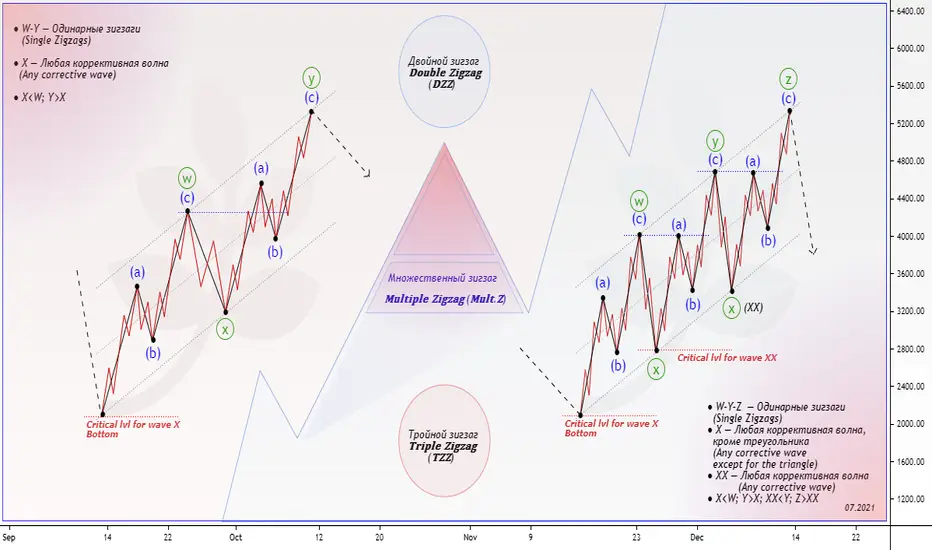
●●● 𝙈𝙪𝙡𝙩𝙞𝙥𝙡𝙚 𝙕𝙞𝙜𝙯𝙖𝙜 (Mult.Z)

Keep in mind that an triple zigzag is rare
❗❗ 𝙍𝙪𝙡𝙚𝙨
● A Multiple Zigzag comprise two (or three) single zigzags separated by one (or two) corrective pattern(s) in the opposite direction, labeled X. In the first case, it is called «double zigzag», in the second - «triple zigzag» (The first single zigzag is labeled W, the second Y, and the third, if there is one, Z.)
● Waves W, Y and Z are always single zigzags.
● Wave X never goes beyond the beginning of waves W and Y.
● Wave Y always ends past the end of the W, and wave Z, if any, always ends past the end of the Y.
● The first X wave always ends on the territory of the W wave, the second X, if any, on the territory of the Y wave.
● In a triple zigzag, the first X wave is always a zigzag, flat or combination. The second X wave is always a zigzag, flat, triangle or combination.
● In a double zigzag, wave X is always a zigzag, flat, triangle, or combination.
● Double and triple zigzags replace single zigzags, but cannot appear as W, Y, or Z waves.
❗ 𝙂𝙪𝙞𝙙𝙚𝙡𝙞𝙣𝙚𝙨
●In a double zigzag, wave Y can equal wave W, .618 wave W, 1.618 wave W, or .terminate at a distance equal to .618 wave W past wave W. In a triple zigzag, there can be equality among waves W, Y and Z, or wave Z can equal .618 wave Y, 1.618 wave Y, or .terminate at a distance equal to .618 wave Y, past wave Y. In a triple zigzag, the Fibonacci relationships between waves W and Y, would be the same as a double zigzag.
● The Fibonacci relationships between waves W and X in a double zigzag, and waves Y and XX in a triple zigzag are analogous to the relationships between waves A and B in a single zigzag.
● In a double zigzag, as a guideline, wave b of wave Y should not break the trendline that connects the beginning of wave W with the end of wave X.
● As a guideline, wave X (second wave X of the triple zigzag) of a double zigzag should break the trend channel formed by the first zigzag in wave W (Y) and be greater than 80% of subwave b of wave W (Y and Z).
● When a zigzag appears too small to be the entire wave with respect to the preceding wave (or, if it is to be wave 4, the preceding wave 2), the complication of the structure to a multiple zigzag will probably follow.
Elliott Wave Principal 2005 and Q&A EWI .
Keep in mind that an triple zigzag is rare
❗❗ 𝙍𝙪𝙡𝙚𝙨
● A Multiple Zigzag comprise two (or three) single zigzags separated by one (or two) corrective pattern(s) in the opposite direction, labeled X. In the first case, it is called «double zigzag», in the second - «triple zigzag» (The first single zigzag is labeled W, the second Y, and the third, if there is one, Z.)
● Waves W, Y and Z are always single zigzags.
● Wave X never goes beyond the beginning of waves W and Y.
● Wave Y always ends past the end of the W, and wave Z, if any, always ends past the end of the Y.
● The first X wave always ends on the territory of the W wave, the second X, if any, on the territory of the Y wave.
● In a triple zigzag, the first X wave is always a zigzag, flat or combination. The second X wave is always a zigzag, flat, triangle or combination.
● In a double zigzag, wave X is always a zigzag, flat, triangle, or combination.
● Double and triple zigzags replace single zigzags, but cannot appear as W, Y, or Z waves.
❗ 𝙂𝙪𝙞𝙙𝙚𝙡𝙞𝙣𝙚𝙨
●In a double zigzag, wave Y can equal wave W, .618 wave W, 1.618 wave W, or .terminate at a distance equal to .618 wave W past wave W. In a triple zigzag, there can be equality among waves W, Y and Z, or wave Z can equal .618 wave Y, 1.618 wave Y, or .terminate at a distance equal to .618 wave Y, past wave Y. In a triple zigzag, the Fibonacci relationships between waves W and Y, would be the same as a double zigzag.
● The Fibonacci relationships between waves W and X in a double zigzag, and waves Y and XX in a triple zigzag are analogous to the relationships between waves A and B in a single zigzag.
● In a double zigzag, as a guideline, wave b of wave Y should not break the trendline that connects the beginning of wave W with the end of wave X.
● As a guideline, wave X (second wave X of the triple zigzag) of a double zigzag should break the trend channel formed by the first zigzag in wave W (Y) and be greater than 80% of subwave b of wave W (Y and Z).
● When a zigzag appears too small to be the entire wave with respect to the preceding wave (or, if it is to be wave 4, the preceding wave 2), the complication of the structure to a multiple zigzag will probably follow.
Elliott Wave Principal 2005 and Q&A EWI .

🌐 Наш сайт: tradewaves.ru/
🔴 Больше аналитики в Telegram: t.me/+bUHqXwZtxgI2OTcy
📚 Теория (Ellliott Wave Theory): tradewaves.ru/teoriya/
📚 Библиотека (Ellott Wave Archive): t.me/biblioewa
🔴 Больше аналитики в Telegram: t.me/+bUHqXwZtxgI2OTcy
📚 Теория (Ellliott Wave Theory): tradewaves.ru/teoriya/
📚 Библиотека (Ellott Wave Archive): t.me/biblioewa
การนำเสนอที่เกี่ยวข้อง
คำจำกัดสิทธิ์ความรับผิดชอบ
ข้อมูลและบทความไม่ได้มีวัตถุประสงค์เพื่อก่อให้เกิดกิจกรรมทางการเงิน, การลงทุน, การซื้อขาย, ข้อเสนอแนะ หรือคำแนะนำประเภทอื่น ๆ ที่ให้หรือรับรองโดย TradingView อ่านเพิ่มเติมใน ข้อกำหนดการใช้งาน
🌐 Наш сайт: tradewaves.ru/
🔴 Больше аналитики в Telegram: t.me/+bUHqXwZtxgI2OTcy
📚 Теория (Ellliott Wave Theory): tradewaves.ru/teoriya/
📚 Библиотека (Ellott Wave Archive): t.me/biblioewa
🔴 Больше аналитики в Telegram: t.me/+bUHqXwZtxgI2OTcy
📚 Теория (Ellliott Wave Theory): tradewaves.ru/teoriya/
📚 Библиотека (Ellott Wave Archive): t.me/biblioewa
การนำเสนอที่เกี่ยวข้อง
คำจำกัดสิทธิ์ความรับผิดชอบ
ข้อมูลและบทความไม่ได้มีวัตถุประสงค์เพื่อก่อให้เกิดกิจกรรมทางการเงิน, การลงทุน, การซื้อขาย, ข้อเสนอแนะ หรือคำแนะนำประเภทอื่น ๆ ที่ให้หรือรับรองโดย TradingView อ่านเพิ่มเติมใน ข้อกำหนดการใช้งาน