
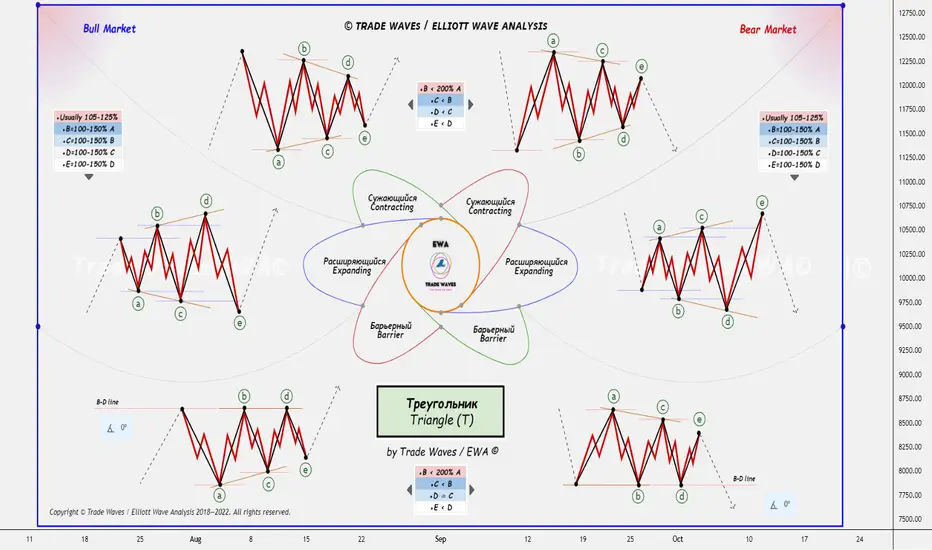
●●● 𝙏𝙧𝙞𝙖𝙣𝙜𝙡𝙚 (T)

__________________________
❗️❗️ 𝙂𝙚𝙣𝙚𝙧𝙖𝙡 𝙧𝙪𝙡𝙚𝙨
● A triangle always subdivides into five waves.
● At least four waves among waves A, B, C, D and E are subdivided into a single zigzag .
● A triangle never has more than one complex subwave, in which case it is always a multiple zigzag or a triangle.
❗️ 𝙂𝙚𝙣𝙚𝙧𝙖𝙡 𝙜𝙪𝙞𝙙𝙚𝙡𝙞𝙣𝙚𝙨
● Usually, wave C subdivides into a "multiple zigzag" that is longer lasting and contains deeper percentage retracements than each of the other subwaves.
● Usually, wave D subdivides into a "multiple zigzag" that is longer lasting and contains deeper percentage retracements than each of the other subwaves.
● Alternating waves of a triangle may be in Fibonacci proportion to each other by a ratio of 0.618 for contracting triangles and 1.618 for expanding triangles. For example, in a contracting triangle, look for wave C to equal 0.618 of wave A.
● A triangle can be wave 4 impuls, wave B of a zigzag , wave X of a double or second wave of an X of a triple zigzag , sub-wave C, D or E of a triangle and the last structure of a combination.
__________________________
●● 𝘾𝙤𝙣𝙩𝙧𝙖𝙘𝙩𝙞𝙣𝙜 𝙏𝙧𝙞𝙖𝙣𝙜𝙡𝙚 (Contr.T — CT)
❗️❗️ 𝙍𝙪𝙡𝙚𝙨
● Wave C never moves beyond the end of wave A, wave D never moves beyond the end of wave B, and wave E never moves beyond the end of wave C. The result is that going forward in time, a line connecting the ends of waves B and D converges with a line connecting the ends of waves A and C.
● Waves A and B never subdivide into a triangle.
● In a running triangle, wave B should be no more than twice as long as wave A. (Q&A EWI)
❗️ 𝙂𝙪𝙞𝙙𝙚𝙡𝙞𝙣𝙚𝙨
● Sometimes one of the waves, usually wave C, D or E, subdivides into a contracting or barrier triangle. Often the effect is as if the entire triangle consisted of nine zigzags.
● About 60% of the time, wave B goes beyond the beyond the start of wave A. When this happens, the triangle is called a running triangle.
__________________________
●● 𝘽𝙖𝙧𝙧𝙞𝙚𝙧 𝙏𝙧𝙞𝙖𝙣𝙜𝙡𝙚 (Barr.T — BT)
❗️❗️ 𝙍𝙪𝙡𝙚𝙨
● Wave C never moves beyond the end of wave A, wave D never moves beyond the end of wave B, and wave E never moves beyond the end of wave C. The result is that going forward in time, a line connecting the ends of waves B and D converges with a line connecting the ends of waves A and C.
● Waves B and D end at essentially the same level.
● In a running triangle, wave B should be no more than twice as long as wave A. (Q&A EWI)
❗️ 𝙂𝙪𝙞𝙙𝙚𝙡𝙞𝙣𝙚𝙨
● About 60% of the time, wave B goes beyond the beyond the start of wave A. When this happens, the triangle is called a running barrier triangle.
● When wave 5 follows a triangle, it is typically either a brief, rapid movement or an exceptionally long extension.
☝️ 𝙉𝙤𝙩𝙚𝙨
● We have yet to observe a 9-wave barrier triangle, implying that this form may not extend.
__________________________
●● 𝙀𝙭𝙥𝙖𝙣𝙙𝙞𝙣𝙜 𝙏𝙧𝙞𝙖𝙣𝙜𝙡𝙚 (Exp .T — ET)
❗️❗️ 𝙍𝙪𝙡𝙚𝙨
● Wave C, D and E each moves beyond the end of the preceding same-directional subwave. (The result is that going forward in time, a line connecting the ends of waves B and D diverges from a line connecting the ends of waves A and C.)
● Subwaves B, C and D each retrace at least 100 percent but no more than 150 percent of the preceding subwave.
❗️ 𝙂𝙪𝙞𝙙𝙚𝙡𝙞𝙣𝙚𝙨
● Subwaves B, C and D usually retrace 105 to 125 percent of the preceding subwave.
☝️ 𝙉𝙤𝙩𝙚𝙨
● No subwave has yet been observed to subdivide into a triangle.
__________________________
🔗References:
Elliott Wave Principal 2005
RSWA: Q&A EWI
__________________________
❗️❗️ 𝙂𝙚𝙣𝙚𝙧𝙖𝙡 𝙧𝙪𝙡𝙚𝙨
● A triangle always subdivides into five waves.
● At least four waves among waves A, B, C, D and E are subdivided into a single zigzag .
● A triangle never has more than one complex subwave, in which case it is always a multiple zigzag or a triangle.
❗️ 𝙂𝙚𝙣𝙚𝙧𝙖𝙡 𝙜𝙪𝙞𝙙𝙚𝙡𝙞𝙣𝙚𝙨
● Usually, wave C subdivides into a "multiple zigzag" that is longer lasting and contains deeper percentage retracements than each of the other subwaves.
● Usually, wave D subdivides into a "multiple zigzag" that is longer lasting and contains deeper percentage retracements than each of the other subwaves.
● Alternating waves of a triangle may be in Fibonacci proportion to each other by a ratio of 0.618 for contracting triangles and 1.618 for expanding triangles. For example, in a contracting triangle, look for wave C to equal 0.618 of wave A.
● A triangle can be wave 4 impuls, wave B of a zigzag , wave X of a double or second wave of an X of a triple zigzag , sub-wave C, D or E of a triangle and the last structure of a combination.
__________________________
●● 𝘾𝙤𝙣𝙩𝙧𝙖𝙘𝙩𝙞𝙣𝙜 𝙏𝙧𝙞𝙖𝙣𝙜𝙡𝙚 (Contr.T — CT)
❗️❗️ 𝙍𝙪𝙡𝙚𝙨
● Wave C never moves beyond the end of wave A, wave D never moves beyond the end of wave B, and wave E never moves beyond the end of wave C. The result is that going forward in time, a line connecting the ends of waves B and D converges with a line connecting the ends of waves A and C.
● Waves A and B never subdivide into a triangle.
● In a running triangle, wave B should be no more than twice as long as wave A. (Q&A EWI)
❗️ 𝙂𝙪𝙞𝙙𝙚𝙡𝙞𝙣𝙚𝙨
● Sometimes one of the waves, usually wave C, D or E, subdivides into a contracting or barrier triangle. Often the effect is as if the entire triangle consisted of nine zigzags.
● About 60% of the time, wave B goes beyond the beyond the start of wave A. When this happens, the triangle is called a running triangle.
__________________________
●● 𝘽𝙖𝙧𝙧𝙞𝙚𝙧 𝙏𝙧𝙞𝙖𝙣𝙜𝙡𝙚 (Barr.T — BT)
❗️❗️ 𝙍𝙪𝙡𝙚𝙨
● Wave C never moves beyond the end of wave A, wave D never moves beyond the end of wave B, and wave E never moves beyond the end of wave C. The result is that going forward in time, a line connecting the ends of waves B and D converges with a line connecting the ends of waves A and C.
● Waves B and D end at essentially the same level.
● In a running triangle, wave B should be no more than twice as long as wave A. (Q&A EWI)
❗️ 𝙂𝙪𝙞𝙙𝙚𝙡𝙞𝙣𝙚𝙨
● About 60% of the time, wave B goes beyond the beyond the start of wave A. When this happens, the triangle is called a running barrier triangle.
● When wave 5 follows a triangle, it is typically either a brief, rapid movement or an exceptionally long extension.
☝️ 𝙉𝙤𝙩𝙚𝙨
● We have yet to observe a 9-wave barrier triangle, implying that this form may not extend.
__________________________
●● 𝙀𝙭𝙥𝙖𝙣𝙙𝙞𝙣𝙜 𝙏𝙧𝙞𝙖𝙣𝙜𝙡𝙚 (Exp .T — ET)
❗️❗️ 𝙍𝙪𝙡𝙚𝙨
● Wave C, D and E each moves beyond the end of the preceding same-directional subwave. (The result is that going forward in time, a line connecting the ends of waves B and D diverges from a line connecting the ends of waves A and C.)
● Subwaves B, C and D each retrace at least 100 percent but no more than 150 percent of the preceding subwave.
❗️ 𝙂𝙪𝙞𝙙𝙚𝙡𝙞𝙣𝙚𝙨
● Subwaves B, C and D usually retrace 105 to 125 percent of the preceding subwave.
☝️ 𝙉𝙤𝙩𝙚𝙨
● No subwave has yet been observed to subdivide into a triangle.
__________________________
🔗References:
Elliott Wave Principal 2005
RSWA: Q&A EWI

🌐 Наш сайт: tradewaves.ru/
✔️ Сообщество во ВКонтакте: vk.ru/freetradelife
🔴 Больше аналитики в Telegram: t.me/+bUHqXwZtxgI2OTcy
📚 Теория (Ellliott Wave Theory): tradewaves.ru/teoriya/
✔️ Сообщество во ВКонтакте: vk.ru/freetradelife
🔴 Больше аналитики в Telegram: t.me/+bUHqXwZtxgI2OTcy
📚 Теория (Ellliott Wave Theory): tradewaves.ru/teoriya/
คำจำกัดสิทธิ์ความรับผิดชอบ
ข้อมูลและบทความไม่ได้มีวัตถุประสงค์เพื่อก่อให้เกิดกิจกรรมทางการเงิน, การลงทุน, การซื้อขาย, ข้อเสนอแนะ หรือคำแนะนำประเภทอื่น ๆ ที่ให้หรือรับรองโดย TradingView อ่านเพิ่มเติมใน ข้อกำหนดการใช้งาน
🌐 Наш сайт: tradewaves.ru/
✔️ Сообщество во ВКонтакте: vk.ru/freetradelife
🔴 Больше аналитики в Telegram: t.me/+bUHqXwZtxgI2OTcy
📚 Теория (Ellliott Wave Theory): tradewaves.ru/teoriya/
✔️ Сообщество во ВКонтакте: vk.ru/freetradelife
🔴 Больше аналитики в Telegram: t.me/+bUHqXwZtxgI2OTcy
📚 Теория (Ellliott Wave Theory): tradewaves.ru/teoriya/
คำจำกัดสิทธิ์ความรับผิดชอบ
ข้อมูลและบทความไม่ได้มีวัตถุประสงค์เพื่อก่อให้เกิดกิจกรรมทางการเงิน, การลงทุน, การซื้อขาย, ข้อเสนอแนะ หรือคำแนะนำประเภทอื่น ๆ ที่ให้หรือรับรองโดย TradingView อ่านเพิ่มเติมใน ข้อกำหนดการใช้งาน