
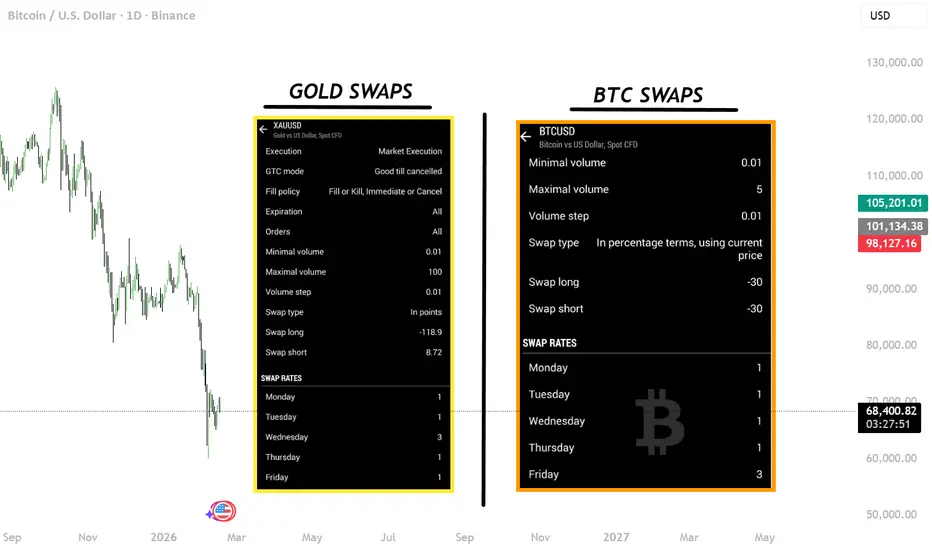
As seen in the two pictures, we can observe the swaps of Gold CFD (XAU/USD) and BTC CFD (BTC/USD). One very important piece of knowledge that everyone should understand when trading is that you can either earn money or lose money from holding a position overnight. To put it simply and logically, swaps are influenced by the interest rate differential between the two assets being traded against each other. For example, with XAU/USD, we have gold trading against the U.S. dollar. However, holding gold pays no interest, compared to the dollar, which currently has an interest rate set around 3.5–3.75%. Therefore, if you go long on XAU/USD and hold the position overnight, you will typically pay a swap rate because you are effectively holding gold instead of dollars. Since gold has a rate of 0% and the dollar has a rate of approximately 3.5–3.75%, the simplified calculation would be 0% – 3.5% = -3.5%. As such, every night you would pay a swap on your open long position. Vice versa, if you go short, you are effectively holding dollars instead of gold. In a simplified model, you would receive 3.5% – 0% = +3.5%, meaning you would earn the swap rate.
Now, this is the simplified explanation, because in reality the broker you trade with (including prop firms) determines the actual swap rates. For example, FTMO’s swap rates (as shown in the two photos) differ from other brokers such as IC Markets, even though it concerns the exact same CFD asset. Brokers incorporate their own financing costs, liquidity arrangements, and markups, which is why swap values differ between platforms. In addition, depending on the number of lots you hold long or short, you will earn or lose more money, as swaps are calculated based on the position size of your trade.
Furthermore, depending on the asset you are trading, you must check which day of the week applies the triple swap (3x the normal swap rate). For most forex pairs, this is typically Wednesday. For BTC CFDs, it is often applied on Friday (as shown in the photos). This adjustment accounts for weekend settlement. Lastly, some may ask why BTC shows a negative swap rate for both long and short positions. As mentioned earlier, the broker ultimately sets the swap rates. Even if, in theory, going short might suggest earning a swap based on interest differentials, crypto CFDs do not follow traditional interest structures, and brokers may apply financing costs on both sides. Therefore, you should always verify the swap specifications directly with your broker. Many traders overlook this topic, but it is crucial for swing trading success, as swaps also apply to stock CFDs and other CFD assets such as commodities, natural gas, oil, and more.
Disclaimer:
This analysis is for informational and educational purposes only and does not constitute financial advice, investment recommendation, or an offer to buy or sell any securities. Asset prices, valuations, and performance metrics are subject to change and may be outdated. Always conduct your own due diligence and consult with a licensed financial advisor before making investment decisions. The information presented may contain inaccuracies and should not be solely relied upon for financial decisions. I am not a licensed financial advisor or professional trader. I am not personally liable for your own losses; this is not financial advice.
Now, this is the simplified explanation, because in reality the broker you trade with (including prop firms) determines the actual swap rates. For example, FTMO’s swap rates (as shown in the two photos) differ from other brokers such as IC Markets, even though it concerns the exact same CFD asset. Brokers incorporate their own financing costs, liquidity arrangements, and markups, which is why swap values differ between platforms. In addition, depending on the number of lots you hold long or short, you will earn or lose more money, as swaps are calculated based on the position size of your trade.
Furthermore, depending on the asset you are trading, you must check which day of the week applies the triple swap (3x the normal swap rate). For most forex pairs, this is typically Wednesday. For BTC CFDs, it is often applied on Friday (as shown in the photos). This adjustment accounts for weekend settlement. Lastly, some may ask why BTC shows a negative swap rate for both long and short positions. As mentioned earlier, the broker ultimately sets the swap rates. Even if, in theory, going short might suggest earning a swap based on interest differentials, crypto CFDs do not follow traditional interest structures, and brokers may apply financing costs on both sides. Therefore, you should always verify the swap specifications directly with your broker. Many traders overlook this topic, but it is crucial for swing trading success, as swaps also apply to stock CFDs and other CFD assets such as commodities, natural gas, oil, and more.
Disclaimer:
This analysis is for informational and educational purposes only and does not constitute financial advice, investment recommendation, or an offer to buy or sell any securities. Asset prices, valuations, and performance metrics are subject to change and may be outdated. Always conduct your own due diligence and consult with a licensed financial advisor before making investment decisions. The information presented may contain inaccuracies and should not be solely relied upon for financial decisions. I am not a licensed financial advisor or professional trader. I am not personally liable for your own losses; this is not financial advice.

คำจำกัดสิทธิ์ความรับผิดชอบ
ข้อมูลและบทความไม่ได้มีวัตถุประสงค์เพื่อก่อให้เกิดกิจกรรมทางการเงิน, การลงทุน, การซื้อขาย, ข้อเสนอแนะ หรือคำแนะนำประเภทอื่น ๆ ที่ให้หรือรับรองโดย TradingView อ่านเพิ่มเติมใน ข้อกำหนดการใช้งาน
คำจำกัดสิทธิ์ความรับผิดชอบ
ข้อมูลและบทความไม่ได้มีวัตถุประสงค์เพื่อก่อให้เกิดกิจกรรมทางการเงิน, การลงทุน, การซื้อขาย, ข้อเสนอแนะ หรือคำแนะนำประเภทอื่น ๆ ที่ให้หรือรับรองโดย TradingView อ่านเพิ่มเติมใน ข้อกำหนดการใช้งาน