
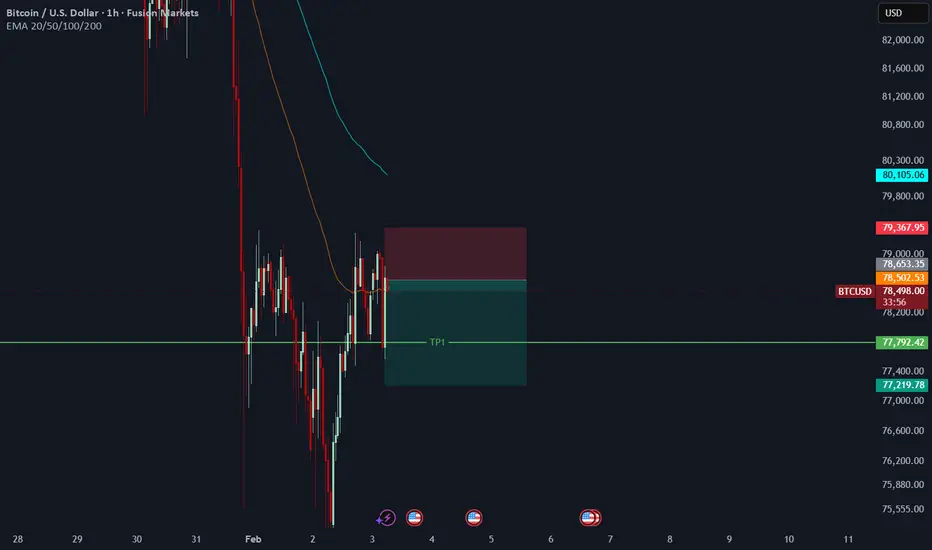
This entry is not discretionary. It triggered because the RegimeWorks Engine 1 conditions aligned: permission (context) → trigger (price action) → risk (defined invalidation).
1) Permission (context had to be “on”)
From the chart structure:
BTC had an aggressive downside impulse earlier, then shifted into a choppy consolidation / pullback under overhead resistance.
Price was trading below the higher EMA cluster (downside pressure / bearish structure still dominant).
The move back up was treated as a pullback into supply, not a fresh long regime.
RegimeWorks interpretation: if the broader context is bearish and price is retracing into resistance, E1 looks for continuation shorts — but only when the trigger confirms.
2) Trigger (what actually caused the entry)
Engine 1 fired when price:
Pushed into the resistance zone (your red risk box area / rejection region),
Failed to reclaim and hold higher, and
Printed continuation confirmation (rejection + loss of short-term support), indicating the pullback was likely done.
In simple terms:
pullback into supply → rejection → continuation trigger
That sequence is the E1 entry template.
3) Risk framework (why this is a valid E1 trade)
The trade is valid because it has objective invalidation:
Stop is positioned above the rejection/supply area (if price accepts above that zone, the short idea is wrong).
Target is set toward the next logical downside area (your green box projects into the lower liquidity / support region).
This is critical RegimeWorks style: the engine doesn’t “predict” — it executes only when it can define where it’s wrong.
4) Why it opened here (and not earlier)
Because E1 waits for:
a pullback into a known resistance region and
confirmation that buyers failed (rejection + continuation structure).
Without that, it stays idle and avoids noise trades.
This short opened because BTCUSD was in a bearish continuation context, price retraced into resistance, then rejected and confirmed continuation, giving E1 a clean entry with defined invalidation and a downside objective.
Not a guarantee — just a rules-based execution when permission was present.
1) Permission (context had to be “on”)
From the chart structure:
BTC had an aggressive downside impulse earlier, then shifted into a choppy consolidation / pullback under overhead resistance.
Price was trading below the higher EMA cluster (downside pressure / bearish structure still dominant).
The move back up was treated as a pullback into supply, not a fresh long regime.
RegimeWorks interpretation: if the broader context is bearish and price is retracing into resistance, E1 looks for continuation shorts — but only when the trigger confirms.
2) Trigger (what actually caused the entry)
Engine 1 fired when price:
Pushed into the resistance zone (your red risk box area / rejection region),
Failed to reclaim and hold higher, and
Printed continuation confirmation (rejection + loss of short-term support), indicating the pullback was likely done.
In simple terms:
pullback into supply → rejection → continuation trigger
That sequence is the E1 entry template.
3) Risk framework (why this is a valid E1 trade)
The trade is valid because it has objective invalidation:
Stop is positioned above the rejection/supply area (if price accepts above that zone, the short idea is wrong).
Target is set toward the next logical downside area (your green box projects into the lower liquidity / support region).
This is critical RegimeWorks style: the engine doesn’t “predict” — it executes only when it can define where it’s wrong.
4) Why it opened here (and not earlier)
Because E1 waits for:
a pullback into a known resistance region and
confirmation that buyers failed (rejection + continuation structure).
Without that, it stays idle and avoids noise trades.
This short opened because BTCUSD was in a bearish continuation context, price retraced into resistance, then rejected and confirmed continuation, giving E1 a clean entry with defined invalidation and a downside objective.
Not a guarantee — just a rules-based execution when permission was present.
การซื้อขายยังคงดำเนินอยู่
Update: TP1 has been reached on the RegimeWorks E1 short (see chart). Per engine rules, the position has been de-risked.Risk Management (Rule-Based)
Stop moved to breakeven (or structure-safe) after TP1 → trade is now risk-free.
Remaining position is held for TP2, provided price continues to respect the bearish structure.
What I’m watching next
If we get a clean continuation / lower-high rejection, I’ll simply let the system manage toward TP2.
If price reclaims and invalidates the continuation structure, the breakeven stop protects capital and the trade is done.
RegimeWorks note: This is an execution update, not a signal. The purpose is to show transparent, rules-based trade management: permission → trigger → risk → scale-out.
ปิดการเทรด: ถึงเป้าหมายการทำกำไร
Update: TP2 has been reached and the RegimeWorks E1 short is now fully closed (see chart).Execution recap (rule-based)
Entry: Triggered under a valid bearish regime with downside continuation conditions.
Management: TP1 was secured first and risk was reduced per engine rules.
Exit: Remaining position held to TP2, where the trade is completed.
Outcome
Trade followed the full RegimeWorks sequence: Permission → Trigger → Risk Control → Scale/Targets → Exit.
No prediction, no chasing — the engine simply executed and managed according to predefined rules.
RegimeWorks note: This is a transparency update, not a signal. The goal is to document how the engine handles trades consistently from entry to exit.

คำจำกัดสิทธิ์ความรับผิดชอบ
ข้อมูลและบทความไม่ได้มีวัตถุประสงค์เพื่อก่อให้เกิดกิจกรรมทางการเงิน, การลงทุน, การซื้อขาย, ข้อเสนอแนะ หรือคำแนะนำประเภทอื่น ๆ ที่ให้หรือรับรองโดย TradingView อ่านเพิ่มเติมใน ข้อกำหนดการใช้งาน
คำจำกัดสิทธิ์ความรับผิดชอบ
ข้อมูลและบทความไม่ได้มีวัตถุประสงค์เพื่อก่อให้เกิดกิจกรรมทางการเงิน, การลงทุน, การซื้อขาย, ข้อเสนอแนะ หรือคำแนะนำประเภทอื่น ๆ ที่ให้หรือรับรองโดย TradingView อ่านเพิ่มเติมใน ข้อกำหนดการใช้งาน