
❗❗ 𝙍𝙪𝙡𝙚𝙨
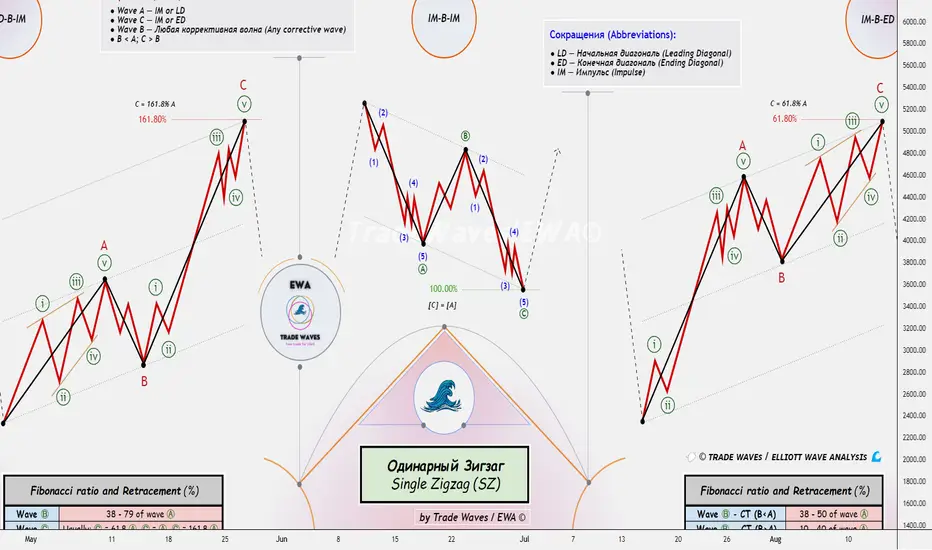
● A zigzag always subdivides into three waves.
● Wave Ⓐ always subdivides into an impulse or leading diagonal.
● Wave Ⓒ always subdivides into an impulse or ending diagonal.
● Wave Ⓑ always subdivides into a zigzag, flat, triangle or combination thereof.
● Wave Ⓑ never moves beyond the start of wave Ⓐ.
● Wave Ⓑ always ends within the price territory of wave Ⓐ.
● Wave Ⓒ almost always ends beyond the end of wave Ⓐ. (failure to comply with this requirement is called «truncation»)*
*guideline, but should be followed as a rule
❗ 𝙂𝙪𝙞𝙙𝙚𝙡𝙞𝙣𝙚𝙨
● Wave Ⓒ should not fail to reach the end of wave Ⓐ by more than 10% of the length of wave Ⓐ. (Q&A EWI)
● In a zigzag, the length of wave Ⓒ is usually equal to that of wave Ⓐ, although it is not uncommonly 1.618 or .618 times the length of wave Ⓐ (rarely 2.618).
● Wave Ⓑ typically retraces 38 to 79 percent of wave Ⓐ.
● If wave Ⓑ is a contracting triangle, it will typically retrace 38 to 50 percent of wave Ⓐ.
● If wave Ⓑ is a running contracting triangle, it will typically retrace between 10 and 40 percent of wave Ⓐ.
● If wave Ⓑ is a zigzag, it will typically retrace 50 to 79 percent of wave Ⓐ.
● In a zigzag, if wave Ⓐ is a leading diagonal, then we would not expect to see an ending diagonal for wave Ⓒ.
● A line connecting the ends of waves Ⓐ and Ⓒ is often parallel to a line connecting the end of wave Ⓑ and the start of wave Ⓐ. (Forecasting guideline: Wave Ⓒ often ends upon reaching a line drawn from the end of wave Ⓐ that is parallel to a line connecting the start of wave Ⓐ and the end of wave Ⓑ.)
● Waves Ⓐ and Ⓒ within the zigzag often appear in the form of impulses, but more often alternate according to the type of motive waves: if wave Ⓐ is an impulse, expect wave Ⓒ in the form of a diagonal, and vice versa. It is much less common to find waves Ⓐ and Ⓒ in the form of diagonals, but in this case they will alternate in form: contracting / expanding, and vice versa. (TWEWA)
● If a similar amplitude and duration of waves Ⓐ and Ⓒ within a single zigzag is expected, the line passing through the top of Ⓐ, which is parallel to the line connecting the beginning of wave Ⓐ and the end of wave Ⓑ, often turns out to be the level of completion of wave Ⓒ. In case of a extended wave Ⓐ within a single zigzag, expect the wave Ⓒ to reach the middle line of the channel, and in case of signals in favor of a extended wave Ⓒ, it is worth resorting to the technique of doubling the channel to determine potential support or resistance. (TWEWA)
__________________________
🔗References:
Elliott Wave Principal 2005
Trade Waves / Elliott Waves Analysis (TWEWA)
📚 Elliott Wave Guide & Ellott Wave Archive ⬇️⬇️

🌐 Наш сайт: tradewaves.ru/
✔️ Сообщество во ВКонтакте: vk.ru/freetradelife
🔴 Больше аналитики в Telegram: t.me/+bUHqXwZtxgI2OTcy
📚 Теория (Ellliott Wave Theory): tradewaves.ru/teoriya/
✔️ Сообщество во ВКонтакте: vk.ru/freetradelife
🔴 Больше аналитики в Telegram: t.me/+bUHqXwZtxgI2OTcy
📚 Теория (Ellliott Wave Theory): tradewaves.ru/teoriya/
การนำเสนอที่เกี่ยวข้อง
คำจำกัดสิทธิ์ความรับผิดชอบ
ข้อมูลและบทความไม่ได้มีวัตถุประสงค์เพื่อก่อให้เกิดกิจกรรมทางการเงิน, การลงทุน, การซื้อขาย, ข้อเสนอแนะ หรือคำแนะนำประเภทอื่น ๆ ที่ให้หรือรับรองโดย TradingView อ่านเพิ่มเติมใน ข้อกำหนดการใช้งาน
🌐 Наш сайт: tradewaves.ru/
✔️ Сообщество во ВКонтакте: vk.ru/freetradelife
🔴 Больше аналитики в Telegram: t.me/+bUHqXwZtxgI2OTcy
📚 Теория (Ellliott Wave Theory): tradewaves.ru/teoriya/
✔️ Сообщество во ВКонтакте: vk.ru/freetradelife
🔴 Больше аналитики в Telegram: t.me/+bUHqXwZtxgI2OTcy
📚 Теория (Ellliott Wave Theory): tradewaves.ru/teoriya/
การนำเสนอที่เกี่ยวข้อง
คำจำกัดสิทธิ์ความรับผิดชอบ
ข้อมูลและบทความไม่ได้มีวัตถุประสงค์เพื่อก่อให้เกิดกิจกรรมทางการเงิน, การลงทุน, การซื้อขาย, ข้อเสนอแนะ หรือคำแนะนำประเภทอื่น ๆ ที่ให้หรือรับรองโดย TradingView อ่านเพิ่มเติมใน ข้อกำหนดการใช้งาน