
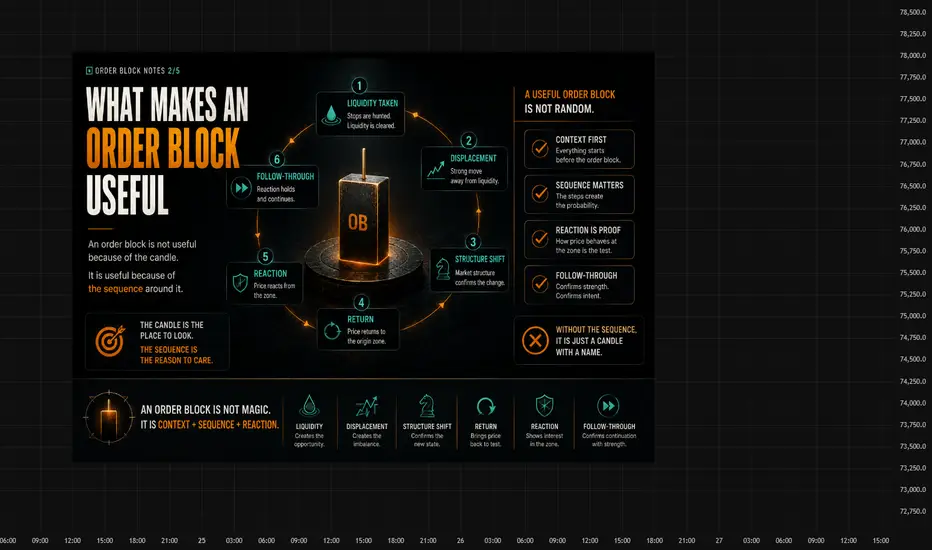
Order Block Notes 2/5
An order block is not useful because it looks clean.
It is useful because of what happened around it.
That difference matters.
A clean candle can still mean nothing. A perfect rectangle can still fail. A zone can look obvious and still produce no reaction.
The label is not enough.
For me, an order block becomes worth reviewing only when it sits inside a sequence.
First, liquidity should be taken.
That does not mean every order block needs a perfect sweep. But there should be some form of liquidity context: stops taken, trapped participation, or a prior level cleared before the move begins.
Second, price needs displacement.
If price only drifts away from the zone, the move is weak. A useful order block usually has a clear impulse away from the area. Not just movement, but commitment.
Third, structure should shift.
Displacement without structure is incomplete. I want to see whether the move actually changed the state of the market, not just created one strong candle.
Fourth, price has to return.
An untouched zone is only potential. The test happens when price comes back to the area.
Fifth, the reaction matters.
Does price respect the zone?
Does it reject?
Does it stall?
Does it accept through it?
Does it fail immediately?
That response is the evidence.
Finally, there must be follow-through.
A reaction that dies after one candle is weak. A useful order block should show that the market can actually hold the response and continue away from the area.
This is why I do not treat every last up/down candle as important.
The useful part is not the candle.
The useful part is the chain of events around the candle.
Liquidity → displacement → structure shift → return → reaction → follow-through.
If that sequence is missing, the order block is mostly just a drawing.
If the sequence is present, the zone becomes worth reviewing.
A useful order block is not random.
It is context plus sequence plus reaction.
An order block is not useful because it looks clean.
It is useful because of what happened around it.
That difference matters.
A clean candle can still mean nothing. A perfect rectangle can still fail. A zone can look obvious and still produce no reaction.
The label is not enough.
For me, an order block becomes worth reviewing only when it sits inside a sequence.
First, liquidity should be taken.
That does not mean every order block needs a perfect sweep. But there should be some form of liquidity context: stops taken, trapped participation, or a prior level cleared before the move begins.
Second, price needs displacement.
If price only drifts away from the zone, the move is weak. A useful order block usually has a clear impulse away from the area. Not just movement, but commitment.
Third, structure should shift.
Displacement without structure is incomplete. I want to see whether the move actually changed the state of the market, not just created one strong candle.
Fourth, price has to return.
An untouched zone is only potential. The test happens when price comes back to the area.
Fifth, the reaction matters.
Does price respect the zone?
Does it reject?
Does it stall?
Does it accept through it?
Does it fail immediately?
That response is the evidence.
Finally, there must be follow-through.
A reaction that dies after one candle is weak. A useful order block should show that the market can actually hold the response and continue away from the area.
This is why I do not treat every last up/down candle as important.
The useful part is not the candle.
The useful part is the chain of events around the candle.
Liquidity → displacement → structure shift → return → reaction → follow-through.
If that sequence is missing, the order block is mostly just a drawing.
If the sequence is present, the zone becomes worth reviewing.
A useful order block is not random.
It is context plus sequence plus reaction.

SMC structure tools — no signals, just the map. Free alerts → t.me/smc_scanner_free | Scanner PRO → whop.com/smc-scanner | @EmpArchitect
คำจำกัดสิทธิ์ความรับผิดชอบ
ข้อมูลและบทความไม่ได้มีวัตถุประสงค์เพื่อก่อให้เกิดกิจกรรมทางการเงิน, การลงทุน, การซื้อขาย, ข้อเสนอแนะ หรือคำแนะนำประเภทอื่น ๆ ที่ให้หรือรับรองโดย TradingView อ่านเพิ่มเติมใน ข้อกำหนดการใช้งาน
SMC structure tools — no signals, just the map. Free alerts → t.me/smc_scanner_free | Scanner PRO → whop.com/smc-scanner | @EmpArchitect
คำจำกัดสิทธิ์ความรับผิดชอบ
ข้อมูลและบทความไม่ได้มีวัตถุประสงค์เพื่อก่อให้เกิดกิจกรรมทางการเงิน, การลงทุน, การซื้อขาย, ข้อเสนอแนะ หรือคำแนะนำประเภทอื่น ๆ ที่ให้หรือรับรองโดย TradingView อ่านเพิ่มเติมใน ข้อกำหนดการใช้งาน